Best ASVAB Scores for Air Force Medical AFSC Jobs
Air Force medical careers cover a wider range of work than most people expect, from patient care and surgery support to pharmacy, radiology, cardiopulmonary testing, and biomedical equipment repair. Each AFSC has its own ASVAB line score threshold, and a few of them sit higher than you might think. Knowing which composites matter before test day gives you a clear target to train toward.
How the Air Force Scores Medical Aptitude
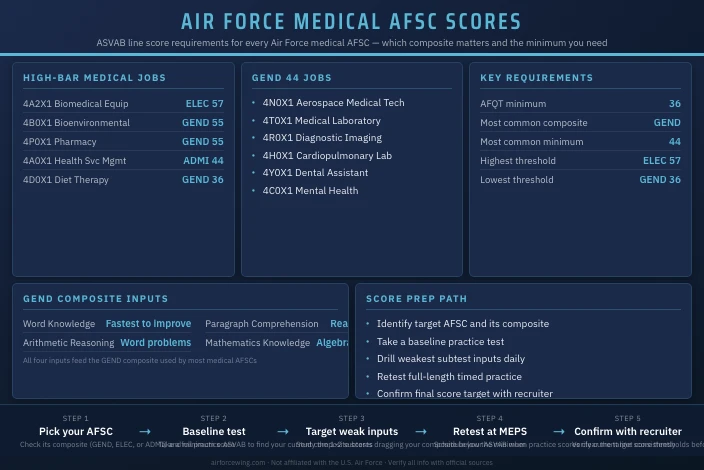
The Air Force doesn’t score the ASVAB as ten separate line scores the way the Army does. It groups subtest results into five composite areas. Medical AFSCs draw primarily from two of them:
- GEND (General): Word Knowledge + Paragraph Comprehension + Arithmetic Reasoning + Mathematics Knowledge
- ELEC (Electronics): General Science + Arithmetic Reasoning + Mathematics Knowledge + Electronics
Most medical jobs use GEND. The exception is 4A2X1 Biomedical Equipment, which requires ELEC 57 because the work involves electrical troubleshooting and technical repair of hospital equipment.
Your AFQT score: the overall enlistment qualifying score, must be at least 36 to enlist in the active-duty Air Force. That gets you through the door. Your GEND or ELEC composite score is what unlocks each specific medical AFSC.
ASVAB Requirements for Every Air Force Medical AFSC
The table below lists every major medical AFSC, the composite that applies, and the minimum score required. Scores are sourced from AFI 36-2101 and verified against the ASVAB Scores for Every Air Force AFSC pillar reference.
| AFSC | Title | Composite | Minimum Score |
|---|---|---|---|
| 4A0X1 | Health Services Management | ADMI | 44 |
| 4A2X1 | Biomedical Equipment | ELEC | 57 |
| 4B0X1 | Bioenvironmental Engineering | GEND | 55 |
| 4C0X1 | Mental Health | GEND | 44 |
| 4D0X1 | Diet Therapy | GEND | 36 |
| 4E0X1 | Public Health | GEND | 44 |
| 4H0X1 | Cardiopulmonary Laboratory | GEND | 44 |
| 4J0X2 | Physical Medicine | GEND | 44 |
| 4N0X1 | Aerospace Medical Technician | GEND | 44 |
| 4P0X1 | Pharmacy | GEND | 55 |
| 4R0X1 | Diagnostic Imaging | GEND | 44 |
| 4T0X1 | Medical Laboratory | GEND | 44 |
| 4V0X1 | Optometry | GEND | 44 |
| 4Y0X1 | Dental Assistant | GEND | 44 |
GEND 44 is the most common threshold in this group. If you score at least 44 on the General composite, the majority of Air Force medical jobs are within reach. Three AFSCs set a higher bar: 4B0X1 and 4P0X1 both require GEND 55, and 4A2X1 requires ELEC 57.
The High-Bar Medical AFSCs
Three jobs stand out from the rest and deserve specific attention.
4A2X1 Biomedical Equipment is the most technically demanding medical AFSC in the enlisted inventory. Technicians inspect, calibrate, and repair medical devices, everything from patient monitors to ventilators to imaging systems. The ELEC 57 requirement reflects that the work is closer to electronics maintenance than clinical care. This job has strong civilian career translation into healthcare technology and biomedical engineering roles.
4B0X1 Bioenvironmental Engineering monitors occupational and environmental health hazards on Air Force installations. The GEND 55 minimum reflects the reading and analytical demands: airmen in this specialty write technical reports, interpret exposure data, and advise commanders on health risk. A Secret clearance is typical for this role.
4P0X1 Pharmacy requires GEND 55 and places airmen in pharmacy operations supporting base medical facilities. The score requirement reflects the precision reading and math the job demands, dosage calculations, formulary management, and patient record interpretation.
Most Accessible Medical Jobs
If you’re working toward the GEND 44 floor, these roles become available once you clear that threshold:
- 4N0X1 Aerospace Medical Technician: the Air Force medic role, working in flight medicine and clinical settings
- 4T0X1 Medical Laboratory: blood work, specimen processing, and lab diagnostics
- 4R0X1 Diagnostic Imaging: X-ray and imaging support in clinic and deployed environments
- 4H0X1 Cardiopulmonary Laboratory: EKG, pulmonary function testing, and cardiac monitoring
- 4Y0X1 Dental Assistant: chairside dental support and radiology
All five use the same GEND 44 threshold. The difference between them is job function, training length, and where you’ll be stationed, not the ASVAB bar.
Which Subtests to Focus On
Whether you’re targeting GEND or ELEC, the right study approach depends on which inputs are dragging your score down.
For GEND improvement:
- Word Knowledge: vocabulary breadth. Daily reading and word list drilling moves this score quickly.
- Paragraph Comprehension: reading for main ideas and inference. Short, timed reading practice works well.
- Arithmetic Reasoning: word problems and basic math reasoning. This subtest responds well to practice with timed problem sets.
- Mathematics Knowledge: algebra, geometry, and number properties. The most study-intensive input in the GEND composite.
For ELEC improvement (4A2X1):
- Electronics Information: voltage, circuits, and basic electrical theory. A structured review of electrical fundamentals is the most direct prep.
- General Science: physics, chemistry, and biology fundamentals. ELEC pulls heavily from this subtest.
- Arithmetic Reasoning and Mathematics Knowledge: same inputs as GEND, so GEND and ELEC prep overlaps significantly on the math side.
If your GEND is already at 44 and you’re eyeing 4B0X1 or 4P0X1 at 55, you need approximately 25% more score. That gap typically requires focused study on the math inputs. Arithmetic Reasoning and Mathematics Knowledge, where gains are largest with structured practice.
For a detailed plan to move your scores in 30 to 60 days, see How to Raise Your ASVAB Line Scores.
What Else Qualifies You
ASVAB line scores are the entry gate, but they aren’t the only requirement for medical AFSCs. Most roles also require:
- Physical standards: Normal color vision for several roles (4T0X1, 4R0X1, 4H0X1). Check the specific profile for the AFSC you want.
- Medical history review: MEPS will screen for conditions that might limit the role.
- Background investigation: Most medical AFSCs require at least a National Agency Check. 4B0X1 typically requires a Secret clearance.
- ASVAB AFQT minimum: 36 for high school diploma holders; 65 for GED holders.
None of these requirements are unusual, but color vision requirements catch some candidates off guard. If you’re targeting a lab or imaging role, confirm that requirement at MEPS before committing.
ASVAB Prep Resources
An ASVAB flashcard set is effective for vocabulary drilling (Word Knowledge) and science and mechanical terminology review (Electronics, General Science). Flashcards work well as a daily supplement alongside a full practice test routine.
Full career profiles for every medical AFSC are at the Air Force Medical career group. And if you want to compare medical requirements against the rest of the Air Force, the complete line score chart is at ASVAB Scores for Every Air Force AFSC.
You may also find ASVAB Line Scores Explained and How to Raise Your ASVAB Line Scores helpful as you build your prep plan. The Air Force ASVAB test prep guide covers the full study pipeline from choosing a start date through final practice tests.