Best ASVAB Scores for Maintenance AFSC Jobs
The Air Force’s aircraft maintenance career group is one of the most direct paths to an FAA-relevant civilian career. But before you can turn wrenches on a fighter jet, you have to hit the right ASVAB composite. Most maintenance jobs require a MECH score of 47. Avionics roles push that bar higher and swap the composite entirely.
How Maintenance ASVAB Scores Are Structured
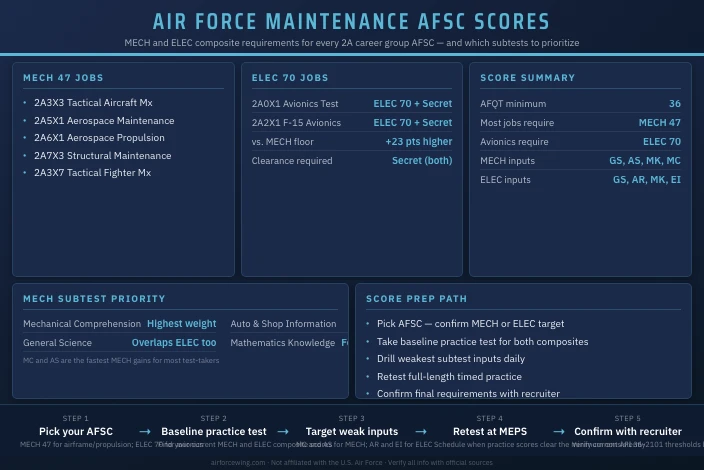
The Air Force assigns each AFSC a minimum score in one of five composites, not a single ASVAB total. For the 2A career group, almost every job draws from two composites: MECH and ELEC.
MECH (Mechanical composite) combines four ASVAB subtests: General Science, Auto & Shop Information, Mathematics Knowledge, and Mechanical Comprehension. It measures your ability to understand how physical systems work, engines, leverage, pressure, materials. This is the baseline composite for airframe, propulsion, and structural maintenance.
ELEC (Electronics composite) combines General Science, Arithmetic Reasoning, Mathematics Knowledge, and Electronics Information. It’s the score that matters for avionics, where you’re diagnosing faults in radar systems, weapons computers, and flight control electronics. ELEC minimums run higher than MECH minimums because the work is more technical.
Here’s how to read the composites on your score report: each is expressed as a single two- or three-digit number derived from those four raw subtest scores. You need to meet or beat the minimum listed for your target AFSC.
Maintenance AFSC ASVAB Requirements at a Glance
The table below covers every AFSC in the 2A career group. The airframe and propulsion jobs cluster around a MECH 47 floor. Avionics roles require ELEC 70, nearly 50% higher, and add a Secret clearance requirement on top.
| AFSC | Title | Composite | Minimum Score | Clearance |
|---|---|---|---|---|
| 2A3X3 | Tactical Aircraft Maintenance | MECH | 47 | None |
| 2A5X1 | Aerospace Maintenance | MECH | 47 | None |
| 2A6X1 | Aerospace Propulsion | MECH | 47 | None |
| 2A7X3 | Aircraft Structural Maintenance | MECH | 47 | None |
| 2A3X7 | Tactical Fighter Maintenance | MECH | 47 | None |
| 2A0X1 | Avionics Test Station and Component | ELEC | 70 | Secret |
| 2A2X1 | F-15 Avionics | ELEC | 70 | Secret |
MECH 47 is achievable for most candidates who prepare specifically for the General Science, Auto & Shop, and Mechanical Comprehension subtests. ELEC 70 is a real threshold that separates applicants, and the clearance requirement adds a background investigation layer that MECH jobs don’t have.
MECH Jobs: What Each Role Actually Does
A MECH 47 score opens five distinct maintenance AFSCs. They sound similar, but the day-to-day work is different.
2A3X3 Tactical Aircraft Maintenance is the broadest entry point into fighter jet maintenance. You own the aircraft from preflight to post-flight, running inspections, fixing discrepancies, and signing off the jet as safe to fly. This role works across multiple tactical airframes, so you’ll see different platform types over a career.
2A3X7 Tactical Fighter Maintenance narrows that scope to a specific fighter platform. The operational tempo tends to run high, and the work is tightly focused on keeping that one airframe combat-ready. If you want to specialize deeply on a single aircraft, 2A3X7 is the cleaner path than 2A3X3.
2A5X1 Aerospace Maintenance covers a wider range of airframes, including mobility aircraft and tankers. The inspection and troubleshooting work is similar to the fighter codes, but the aircraft are larger and the mission set is different. Airmen who prefer strategic airlift over fighter operations tend to gravitate here.
2A6X1 Aerospace Propulsion is entirely engine-focused. You remove, install, troubleshoot, and test aircraft engines, including test cell operations where engines are run at full power in a controlled environment. Civilian powerplant mechanics with military propulsion backgrounds are consistently in demand, and this AFSC maps directly to the FAA Powerplant certificate process.
2A7X3 Aircraft Structural Maintenance handles the physical structure of the aircraft: sheet metal repair, welding, corrosion control, and component fabrication. It’s hands-on work that doesn’t require electronics aptitude, but precision matters because structural repairs have direct airworthiness implications.
ELEC Jobs: Avionics and Why the Bar Is Higher
Both avionics AFSCs in this group require ELEC 70, which is 23 points above the MECH floor. That gap reflects the complexity of the work.
2A0X1 Avionics Test Station and Component uses automated test equipment (ATE) to diagnose and repair avionics components removed from aircraft. You’re not working on the jet itself, you’re repairing the boxes that get pulled off the jet and sent to the shop. The ATE systems are sophisticated, and reading circuit diagrams and interpreting test data is a daily task.
2A2X1 F-15 Avionics is platform-specific. You’ll become an expert on one airframe’s complete avionics suite: radar, fire control, navigation, and integrated weapons systems. The F-15 has been continuously upgraded since the 1970s and still flies combat missions, which means the systems mix legacy hardware with modern upgrades. That complexity is why the score requirement is high.
Both avionics codes also require a Secret security clearance, which involves an NBIB background investigation covering your finances, foreign contacts, and personal history. The investigation typically takes several months, and the clearance is a job-killer if you have significant unresolved debt or recent foreign travel that raises flags.
Which Composite Should You Strengthen First?
If you’re scoring below the minimum on your first practice test, the answer depends on which job you want.
For any of the five MECH roles, prioritize these three subtests in this order:
- Mechanical Comprehension: the heaviest hitter in the MECH formula
- Auto & Shop Information: broad category with predictable question types; study guides cover this well
- General Science: covers basic physics, chemistry, and earth science; overlaps with Electronics Information study material
For the ELEC roles, the overlap between composites works in your favor. General Science, Mathematics Knowledge, and Arithmetic Reasoning feed into both ELEC and the overall AFQT. Raising your math baseline lifts multiple scores at once.
The MECH and ELEC composites share General Science and Mathematics Knowledge. If you’re deciding which path to pursue and haven’t tested yet, studying those two first gives you the most flexibility.
Maintenance Careers After Service
The civilian demand side of this career group is strong. Aircraft mechanics and avionics technicians are on the FAA’s and BLS’s consistently short-supply lists.
The 2A career group maps to FAA certification pathways. Airframe and engine work counts toward the practical experience requirement for the FAA Airframe and Powerplant (A&P) certificate. Most 2A Airmen finish their first enlistment with enough documented hands-on hours to apply for A&P testing immediately after separation. Avionics technicians can pursue the FAA Avionics Technician (AET) certificate through a similar process.
Starting pay for civilian A&P mechanics ranges widely by employer and location, but commercial airline and MRO (maintenance, repair, and overhaul) shops at major air carrier hubs pay significantly more than general aviation. Avionics technicians with military experience and an active Secret clearance often move into defense contractor roles that command a premium.
If the Air Force maintenance career group interests you, the full ASVAB line score chart for every AFSC and the ASVAB test prep guide are the two most useful next steps.