Best ASVAB Scores for Intelligence AFSC Jobs
Intelligence careers in the Air Force are some of the hardest to get into, not because the jobs are rare, but because the ASVAB scores required are among the highest in the enlisted force. Every 1N AFSC pulls from the General (GEND) composite, which measures verbal reasoning and math. If your GEND is low, you’re closed out of the entire intelligence career field before the conversation starts.
This post breaks down the line score requirement for each major intelligence AFSC, explains the security clearance process, and tells you what to study to hit the numbers.
Want to raise your GEND score before you apply? An ASVAB prep course walks you through Arithmetic Reasoning, Word Knowledge, Paragraph Comprehension, and Mathematics Knowledge, the four subtests that feed your GEND composite.
When you purchase through links on our site, we may receive compensation at no extra cost to you.
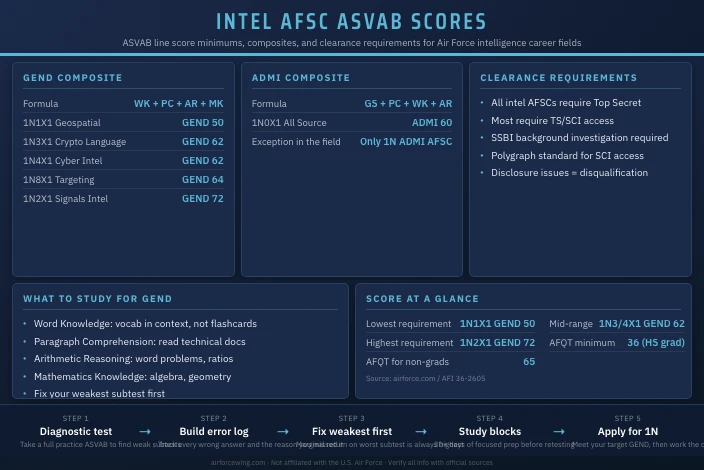
What the GEND Composite Measures
The Air Force uses several ASVAB composites to route recruits into career fields. Intelligence jobs draw almost exclusively from the GEND composite. Per AFI 36-2605, the GEND formula is:
GEND = Word Knowledge + Paragraph Comprehension + Arithmetic Reasoning + Mathematics Knowledge
Those four subtests measure reading comprehension, verbal reasoning, and quantitative ability. They’re the same subtests that feed your AFQT score, which means a strong AFQT usually signals a competitive GEND.
The one exception is 1N0X1 (All Source Intelligence Analyst), which uses the ADMI (Administrative) composite instead. ADMI pulls from General Science, Paragraph Comprehension, Word Knowledge, and Arithmetic Reasoning. The verbal overlap is similar, but General Science replaces the math-heavy Mathematics Knowledge subtest.
Understanding which composite your target AFSC uses shapes your study plan. Spending three weeks on algebra when your AFSC cares more about reading comprehension is wasted prep time.
Intelligence AFSC Line Score Requirements
The table below lists the six primary enlisted intelligence AFSCs and their minimum ASVAB composite scores. All data is sourced from official Air Force recruiting pages.
| AFSC | Title | Composite | Minimum Score |
|---|---|---|---|
| 1N0X1 | All Source Intelligence Analyst | ADMI | 60 |
| 1N1X1 | Geospatial Intelligence Specialist | GEND | 50 |
| 1N2X1 | Signals Intelligence Analyst | GEND | 72 |
| 1N3X1 | Cryptologic Language Analyst | GEND | 62 |
| 1N4X1 | Cyber Intelligence Analyst | GEND | 62 |
| 1N8X1 | Targeting Analyst | GEND | 64 |
A few things stand out. The 1N1X1 (Geospatial Intelligence) threshold of 50 is the lowest bar in the intel field, but the job still requires a security clearance background investigation, and competition for available slots is real. The 1N2X1 (Signals Intelligence) minimum of 72 is one of the highest GEND requirements across all Air Force career fields, not just intelligence.
AFSC-by-AFSC Breakdown
1N0X1: All Source Intelligence Analyst
The 1N0X1 is the Air Force’s generalist intelligence role. Analysts at this level synthesize information from multiple collection sources, human intelligence, signals, imagery, and produce finished intelligence products for commanders. It’s the broadest AFSC in the 1N career field.
The ADMI minimum of 60 is accessible for most recruits who score well on verbal subtests. Tech school is at Goodfellow AFB, TX. A Top Secret clearance with a Single Scope Background Investigation (SSBI) is required, along with a polygraph test.
1N1X1: Geospatial Intelligence Specialist
Geospatial analysts work with satellite and aerial imagery to identify targets, assess battle damage, and map terrain. The GEND minimum of 50 is the lowest in the field. Still, the SSBI requirement and the competitive nature of slot availability mean a score close to 50 may not be enough in practice.
Training is at Goodfellow AFB, TX. This AFSC opens paths to careers with the National Geospatial-Intelligence Agency (NGA) after service.
1N2X1: Signals Intelligence Analyst
Signals intelligence (SIGINT) analysts collect and analyze electronic communications and radar signals. The GEND minimum of 72 reflects the technical depth of this work, you’re reading raw signals data and making analytical judgments under time pressure.
This is one of the most demanding enlisted ASVAB thresholds in the Air Force. A TS clearance with SSBI is required, and a polygraph is standard for SCI access. Tech school is at Goodfellow AFB, TX.
1N3X1: Cryptologic Language Analyst
Cryptologic language analysts listen to, translate, and analyze foreign-language communications. The Air Force typically selects this AFSC before enlistment and sends qualified airmen to the Defense Language Institute Foreign Language Center (DLIFLC) at Presidio of Monterey, CA.
The GEND minimum of 62 is the floor. A passing score on the Defense Language Aptitude Battery (DLAB) is also required, this is a separate test from the ASVAB that measures your ability to learn a new language quickly. A TS clearance with SSBI and polygraph is required. The language assignment is based on mission need, not personal preference.
1N4X1: Cyber Intelligence Analyst
Cyber intelligence analysts focus on adversary cyberspace activities, analyzing threats and producing intelligence to support defensive and offensive operations. The GEND minimum of 62 matches the 1N3X1 threshold.
This AFSC has significant overlap with cyber career fields in terms of mission, but it sits squarely in the intelligence family. A TS clearance with SSBI and polygraph is required.
1N8X1: Targeting Analyst
Targeting analysts develop and maintain target packages used in kinetic and non-kinetic operations. The work requires integrating geospatial, signals, and human intelligence data to produce actionable target nominations. The GEND minimum of 64 reflects this analytical depth.
Advanced training for 1N8X1 requires TS/SCI clearance, meaning Sensitive Compartmented Information access on top of the base TS. This is the broadest clearance level in the enlisted intelligence force.
Security Clearance: What to Expect
Every intelligence AFSC requires at minimum a Top Secret (TS) clearance, and most require TS/SCI access. The investigation process starts with a background check called the Single Scope Background Investigation (SSBI). From there, the timeline depends on your personal history.
What can delay or disqualify you:
- Financial problems (unpaid debt, bankruptcy, tax liens)
- Foreign contacts or dual citizenship
- Drug use (marijuana use is now evaluated case-by-case; harder drugs are more likely disqualifying)
- Criminal history (arrests, not just convictions, are reviewed)
- Dishonesty on your SF-86 application (this is typically fatal to a clearance)
The polygraph is standard for SCI-level access. It’s not a test you pass or fail outright, it’s an interview tool. Answer questions truthfully, and the polygraph is not the barrier most recruits fear.
Start building your clearance profile early. Pay off debts, disclose foreign contacts fully on the SF-86, and keep your social media history clean. Recruiters can walk you through the timeline, but the investigation itself takes months. You will not ship to tech school until the investigation clears to a sufficient level.
How to Hit Your GEND Target
The GEND composite draws from four subtests: Word Knowledge, Paragraph Comprehension, Arithmetic Reasoning, and Mathematics Knowledge. Here’s what to prioritize by target AFSC:
If your target is 1N2X1 (GEND: 72):
- All four subtests matter. A weak performance on any one pulls the composite down fast.
- Arithmetic Reasoning and Mathematics Knowledge are the hardest to improve quickly, start there first.
- Read widely and specifically: technical documents, intelligence-adjacent articles, policy papers. Vocabulary in context beats flashcard drilling.
If your target is 1N3X1, 1N4X1, or 1N8X1 (GEND: 62-64):
- Verbal subtests (Word Knowledge, Paragraph Comprehension) are your fastest win. Most recruits leave 5-10 points on the table here through poor reading habits.
- Math subtests still matter, don’t ignore them.
General approach for all intel AFSCs:
- Take a full diagnostic ASVAB practice test first. Don’t guess where you’re weak.
- Build an error log, write down every wrong answer and why you missed it.
- Fix your weakest subtest first. The marginal return on your worst area is higher than polishing your best.
- Retest at intervals of at least 30 days after study blocks. Cramming the night before doesn’t move ASVAB scores.
You may also find ASVAB Scores for Every Air Force AFSC and Air Force ASVAB test prep helpful. Explore the full Air Force intelligence career group for individual AFSC profiles, clearance details, and training pipeline information.