Best ASVAB Scores for Cyber AFSC Jobs
Cyber jobs are the Air Force’s hardest enlisted career field to qualify for on the ASVAB. The 1B4X1 Cyber Operations Specialist requires a GEND 64, and most other cyber and network roles cluster between ELEC 60 and GEND 64, well above the scores that open most other career fields. If you want one of these jobs, you need a specific prep plan, not a general one.
How the Air Force Scores Cyber Jobs
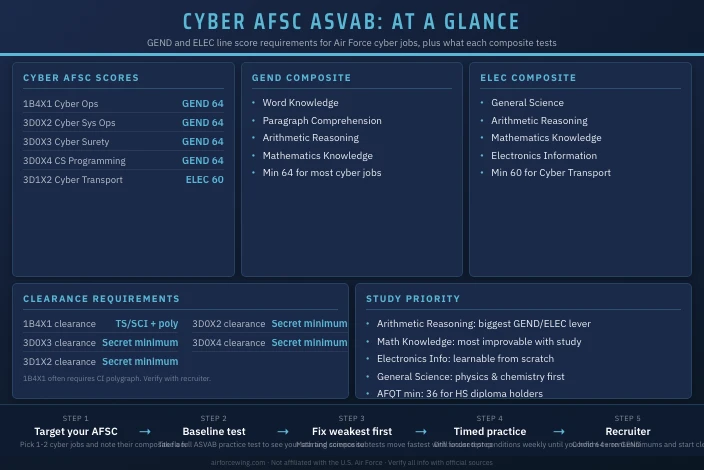
The Air Force uses five composite scores, not the raw subtest scores themselves, to qualify candidates for specific AFSCs. Cyber and communications jobs draw mainly from two of them.
| Composite | Subtest Inputs |
|---|---|
| GEND | Word Knowledge + Paragraph Comprehension + Arithmetic Reasoning + Mathematics Knowledge |
| ELEC | General Science + Arithmetic Reasoning + Mathematics Knowledge + Electronics Information |
GEND measures general verbal and mathematical reasoning. ELEC adds General Science and Electronics Information to the mix, making it the more technical of the two. Cyber jobs that involve hands-on network hardware or radio frequency systems tend to use ELEC. Jobs focused on software, operations, or intelligence functions lean on GEND.
Your overall AFQT score only determines whether you can enlist. A score of 36 for high school diploma holders gets you in the door. After that, your composite scores decide which jobs are available to you.
Cyber AFSC Score Requirements
These are the five core enlisted cyber AFSCs and their minimum line score requirements.
| AFSC | Title | Composite | Minimum |
|---|---|---|---|
| 1B4X1 | Cyber Operations Specialist | GEND | 64 |
| 3D0X2 | Cyber Systems Operations | GEND | 64 |
| 3D0X4 | Computer Systems Programming | GEND | 64 |
| 3D1X2 | Cyber Transport Systems | ELEC | 60 |
| 3D0X3 | Cyber Surety | GEND | 64 |
A GEND 64 puts you in approximately the 60th percentile nationally on the verbal and math subtests. That is a meaningful threshold, many enlistees who qualify on the AFQT still fall short of this composite. The ELEC 60 required for 3D1X2 is slightly more forgiving on the math side but adds General Science and Electronics, which require their own preparation.
All five of these AFSCs require at minimum a Secret security clearance. The 1B4X1 often requires a Top Secret/SCI clearance with a polygraph, that clearance process can take a year or more after enlistment.
What Each AFSC Actually Does
Knowing the score minimums matters, but knowing which job fits your interests matters more.
1B4X1 Cyber Operations Specialist is the Air Force’s dedicated cyber warfare role. These airmen plan and execute offensive and defensive cyber operations. It is the most selective cyber AFSC and typically requires TS/SCI access.
3D0X2 Cyber Systems Operations focuses on managing and maintaining network infrastructure, servers, and operating systems. Think systems administration at the enterprise level on classified networks.
3D0X3 Cyber Surety is the Air Force’s information assurance and security role. Airmen in this AFSC implement security policies, manage access controls, and assess vulnerabilities on Air Force systems.
3D0X4 Computer Systems Programming is exactly what the title says: writing and maintaining software for Air Force systems. It requires the same GEND 64 and is one of the few enlisted paths that involves coding as the primary duty.
3D1X2 Cyber Transport Systems covers the physical network layer, switches, routers, cables, and the transport infrastructure that carries data across bases and into the field. The ELEC composite requirement reflects that hardware focus.
How to Build the GEND 64
The GEND composite pulls from four ASVAB subtests. You can raise it systematically by targeting the subtests that are dragging it down.
- Word Knowledge: vocabulary questions. Build this by reading daily and using flashcards for common SAT-level vocabulary.
- Paragraph Comprehension: reading comprehension under time pressure. Practice reading dense technical paragraphs quickly and pulling out main ideas.
- Arithmetic Reasoning: word problems requiring basic algebra and logic. This responds well to timed practice, not just content review.
- Mathematics Knowledge: algebra, geometry, and number theory. This is the subtest with the most room for improvement through focused study.
For most candidates, Arithmetic Reasoning and Mathematics Knowledge offer the biggest score gains per hour of study. Word Knowledge is harder to move quickly.
How to Build the ELEC 60
The ELEC composite uses the same Arithmetic Reasoning and Mathematics Knowledge inputs as GEND, but swaps the verbal subtests for General Science and Electronics Information.
- General Science: biology, chemistry, physics, and earth science fundamentals. If you haven’t studied science recently, a full review of the physics and chemistry sections pays off here.
- Electronics Information: basic circuits, voltage, current, resistance, and component functions. This subtest rewards candidates who have done any hands-on electronics work, but it can be learned from scratch with the right resources.
Candidates aiming for 3D1X2 who already score well on the math subtests should prioritize General Science and Electronics Information. Those two subtests are the differentiators between a GEND-range score and an ELEC-range score.
Security Clearance Adds Another Layer
Passing the ASVAB opens the door. Clearing the background investigation keeps it open.
Every cyber AFSC requires at minimum a Secret clearance. The 1B4X1 pathway routinely requires Top Secret/SCI with a Counterintelligence Scope Polygraph. Factors that commonly delay or disqualify clearance processing include significant foreign contacts, extensive debt, substance history, and criminal record.
Your recruiter will walk you through the SF-86 (Standard Form 86) security questionnaire. Answer every question honestly, adjudicators consider the whole person, and voluntary disclosure is treated far more favorably than information found during investigation.
Related Career Fields
Cyber AFSCs share score thresholds with several communications and intelligence jobs that are worth knowing about, especially if your scores come in just under the cyber minimums.
The Air Force Communications career group includes roles like 2E1X1 Ground Radar Systems (ELEC 64) and 2E2X1 Network Infrastructure Systems (ELEC 60) that sit at or near the same thresholds as cyber jobs.
If your GEND composite is strong but you’re weighing intelligence roles, the Air Force Cyber career group and the intelligence field both open at similar score levels. The 1N-series intelligence AFSCs start at GEND 59.
The full score chart across every career field is in ASVAB Scores for Every Air Force AFSC.
You may also find ASVAB Line Scores Explained and Best ASVAB Scores for Intelligence AFSC Jobs helpful if you’re deciding between cyber and intel paths.
The Air Force ASVAB test prep guide covers the full study plan from picking a start date to taking timed practice tests under real conditions.