Best ASVAB Scores for Communications AFSC Jobs
The Air Force’s 3D Communications career group runs everything from base desktop support to global satellite links. These jobs are technical, clearance-required, and in high demand, but each AFSC has its own ASVAB composite threshold, and the gap between the easiest and hardest to qualify for is wider than most candidates expect. Knowing which score you need before you sit down to test changes your entire prep strategy.
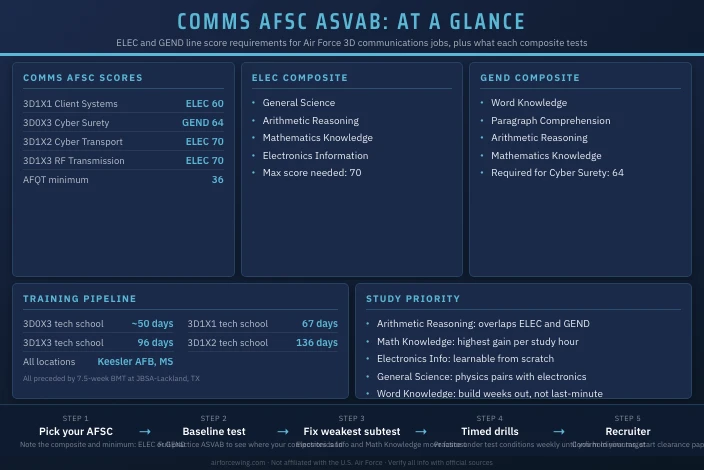
How the Air Force Scores Communications Jobs
The Air Force converts your ASVAB subtest results into five composite scores. Communications AFSCs draw primarily from two of them: ELEC and GEND.
| Composite | Subtest Inputs |
|---|---|
| ELEC | General Science + Arithmetic Reasoning + Mathematics Knowledge + Electronics Information |
| GEND | Word Knowledge + Paragraph Comprehension + Arithmetic Reasoning + Mathematics Knowledge |
ELEC is the more hardware-focused composite. Jobs that involve physical network infrastructure, antennas, transmission equipment, or radio frequency systems use it. GEND measures verbal reasoning and general math, it applies to roles where analytical thinking, policy work, and written communication are the primary demands.
Your AFQT score only determines whether you can enlist. A minimum of 36 for high school diploma holders clears the enlistment threshold. After that, your ELEC or GEND composite decides which communications jobs are on the table.
ASVAB Score Requirements by AFSC
The four enlisted 3D-series AFSCs in the Communications career group each have a distinct threshold.
| AFSC | Title | Composite | Minimum |
|---|---|---|---|
| 3D1X1 | Client Systems | ELEC | 60 |
| 3D0X3 | Cyber Surety | GEND | 64 |
| 3D1X2 | Cyber Transport Systems | ELEC | 70 |
| 3D1X3 | RF Transmission Systems | ELEC | 70 |
3D1X1 Client Systems has the lowest threshold in the group at ELEC 60. 3D1X2 Cyber Transport Systems and 3D1X3 RF Transmission Systems both require ELEC 70, the highest bar in this career field, reflecting the complexity of enterprise networking and RF systems work. 3D0X3 Cyber Surety stands apart from the others: it uses the GEND composite rather than ELEC, because the work centers on policy enforcement and security auditing rather than hardware maintenance.
All four AFSCs require at least a Secret security clearance. The 3D1X2 Cyber Transport pathway often requires a Top Secret/SCI clearance, plan for a longer background investigation timeline if that’s your target.
What Each Job Actually Does
Score minimums tell you whether you qualify. The job descriptions tell you whether you’d want to.
3D1X1 Client Systems is the Air Force’s IT support and user services role. These airmen configure and maintain computers, printers, software, and base network accounts. If you’ve ever worked a help desk or built your own PC, the work will feel familiar on day one. Tech school runs 67 days at Keesler AFB, MS, the shortest pipeline in the group.
3D1X2 Cyber Transport Systems handles the enterprise network backbone: switches, routers, voice and video circuits, and the data links connecting bases and deployed units worldwide. This is infrastructure work at scale. The 136-day tech school at Keesler is the longest in the group, reflecting how much ground there is to cover. Civilian equivalents lean toward network engineering and systems administration, where experienced professionals earn well above the IT median.
3D1X3 RF Transmission Systems installs and operates ground radio and satellite systems that keep aircraft, forward units, and remote installations connected when fiber isn’t an option. It is the most hardware-intensive role in the group, expect to work with antenna arrays, satellite terminals, and transmission equipment in both garrison and deployed environments. Tech school is 96 days at Keesler.
3D0X3 Cyber Surety is different in character from the other three. Rather than building or maintaining infrastructure, Surety airmen audit it. They assess whether Air Force systems meet DoD security standards, manage access controls, and enforce information assurance policies. The GEND composite requirement reflects the analytical and written communication demands. The tech school pipeline is approximately 50 days, but Surety airmen are expected to earn DoD-approved certifications like CompTIA Security+ during their career.
The Overlap with Cyber Career Field Jobs
One AFSC that candidates frequently ask about alongside 3D communications jobs is 3D0X2 Cyber Systems Operations. That job requires GEND 64: the same threshold as Cyber Surety, but it sits in the Air Force’s Cyber career group rather than Communications.
The distinction matters because recruiters will present these career fields separately, and the day-to-day work differs. Cyber Systems Operations focuses on managing servers, operating systems, and classified network environments. Communications jobs focus on transport infrastructure, radio systems, and endpoint IT support. Both groups pull from ELEC and GEND composites at similar thresholds, so if your scores are strong in one area, you likely qualify across both fields.
The full cross-field comparison is in ASVAB Scores for Every Air Force AFSC.
How to Hit ELEC 70
The ELEC 70 required for 3D1X2 and 3D1X3 is the highest composite threshold in the communications group. Getting there from a baseline score takes targeted work on the right subtests.
ELEC pulls from four inputs. Arithmetic Reasoning and Mathematics Knowledge overlap with the GEND composite, so any math prep you do helps both. General Science and Electronics Information are the differentiators.
- Electronics Information: basic circuits, voltage, current, resistance, and component identification. This subtest is learnable from scratch with the right study materials, even if you have no electronics background. It rewards candidates who spend time on fundamentals rather than guessing at formulas.
- General Science: physics, chemistry, biology, and earth science. The physics portion overlaps with electronics concepts and pays double dividends when studying both together.
- Arithmetic Reasoning: word problems requiring multi-step logic. Practice with timed problem sets, not just content review, moves this score.
- Mathematics Knowledge: algebra, geometry, and number theory. For most candidates this is the highest-impact input because it responds well to structured study.
A reasonable target before test day: get comfortable with Ohm’s Law, basic circuit analysis, and the relationship between voltage, current, and resistance. That covers a large portion of the Electronics Information subtest content.
How to Hit GEND 64
GEND 64 is required for 3D0X3 Cyber Surety. It is a meaningful threshold, many candidates who clear the 36 AFQT minimum still fall short of 64 on the General composite.
GEND draws from Word Knowledge, Paragraph Comprehension, Arithmetic Reasoning, and Mathematics Knowledge. For most candidates, the fastest path to 64 runs through the math inputs.
- Arithmetic Reasoning and Mathematics Knowledge offer the largest score gains per hour of study. If you’re under 64, this is where to start.
- Paragraph Comprehension responds to timed reading practice, reading dense technical material and pulling out the main idea quickly. This is a skill that improves with repetition.
- Word Knowledge is the hardest to move quickly. Build it with daily vocabulary review over several weeks, not a last-minute cram session.
A GEND composite of 64 roughly corresponds to the 60th percentile on the verbal and math inputs nationally. For most candidates who cleared a 36 AFQT, getting to 64 on GEND means focused work on math and a steady vocabulary routine.
Training Pipeline Overview
All four communications AFSCs follow the same two-phase pipeline before you arrive at your first duty station.
What Else You Need Beyond the ASVAB
Clearing the composite threshold is necessary but not sufficient. Every communications AFSC also requires:
- U.S. citizenship (required for all security clearances)
- High school diploma (or GED with AFQT of 65+)
- Normal color vision: check the specific AFSC profile; some roles require it, others do not
- No disqualifying financial or legal history for clearance eligibility
- AFQT minimum of 36 for active-duty enlistment
The clearance requirement is worth thinking about early. Your recruiter can walk you through the SF-86 questionnaire, but anything involving foreign contacts, significant debt, or prior legal issues should be disclosed honestly. Adjudicators evaluate the whole person, voluntary disclosure is treated far better than information discovered during investigation.
You may also find Best ASVAB Scores for Cyber AFSC Jobs helpful if you’re deciding between the communications and cyber career fields, both groups share similar score thresholds. The Air Force ASVAB test prep guide covers the full study plan from choosing a start date through taking timed practice tests under real conditions. Full profiles for each role are in the Communications career group.