Best Air Force Reserve AFSC Jobs for Civilian Careers
Picking a Reserve AFSC is not just a weekend commitment. The skills, certifications, and security clearances you earn in that role follow you into every civilian job interview for decades. Pick the right one and your part-time service directly funds your full-time career.
The Air Force Reserve lets you train in a specialty, keep drilling to stay sharp, and walk into civilian employers with credentials that most applicants can’t touch. Some AFSCs build toward federal licenses. Others fast-track security clearances worth six figures in the defense contractor market. A few do both.
This post covers the Reserve AFSCs with the strongest civilian payoff, what line scores you need to qualify, and how each specialty maps to civilian job titles.
Why Your AFSC Choice Matters More in the Reserve
Active duty airmen can change careers over time. Reserve airmen typically stay in one AFSC for their entire service. That makes the initial choice more consequential.
Your Reserve AFSC determines three things that shape your civilian career:
- Certifications and licenses earned during tech school and maintained through drills
- Security clearance tier (Secret, Top Secret, or TS/SCI) that transfers to defense contractor work
- Civilian job titles your DD-214 and resume can map directly to
A poorly chosen AFSC might satisfy your Reserve obligation but add nothing to your civilian resume. The AFSCs below do the opposite.
Healthcare AFSCs: Credentials That Pay Off Anywhere
Healthcare is the clearest example of Reserve training that converts directly into civilian income. The Air Force trains you to a clinical standard, then civilian employers hire you at that level.
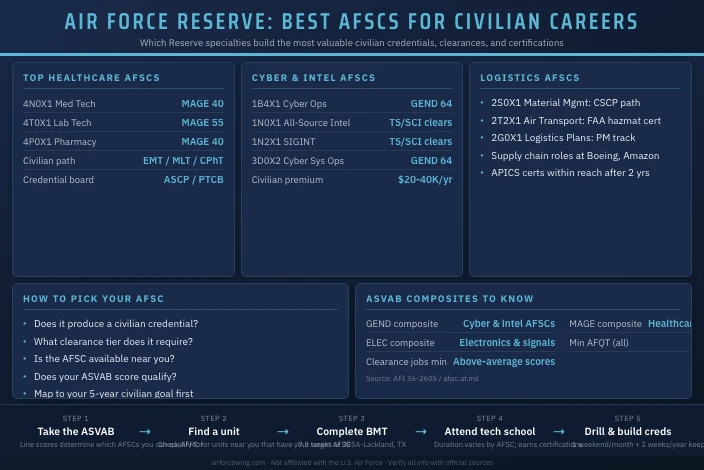
4N0X1 Aerospace Medical Technician is the Reserve’s primary enlisted healthcare role. Tech school runs roughly 65 days and covers patient assessment, emergency procedures, phlebotomy, and medication administration. Civilian mapping: medical assistant, EMT-Basic, patient care technician. Reserve airmen in this role work alongside active duty providers during drills, which means continuous clinical exposure, not just occasional weekend training.
4T0X1 Medical Laboratory Technician trains you in blood banking, hematology, urinalysis, and chemistry panels. The ASVAB requirement is a MAGE score of 55. Civilians with this background qualify for MLT certification through ASCP. That credential opens jobs in hospital labs, reference labs, and urgent care systems paying $45,000-$65,000 annually.
4P0X1 Aerospace Pharmacist (the pharmacy technician specialty) builds prescription processing, drug interaction screening, and inventory management skills. The civilian Pharmacy Technician Certification Board (PTCB) exam is the natural next step after tech school. Employers from CVS to hospital pharmacy departments actively recruit veterans with this background.
| AFSC | ASVAB Composite Required | Civilian Credential Path |
|---|---|---|
| 4N0X1 Aerospace Medical Tech | MAGE 40 | EMT-Basic, Medical Assistant |
| 4T0X1 Medical Lab Tech | MAGE 55 | ASCP MLT certification |
| 4P0X1 Pharmacy Tech | MAGE 40 | PTCB CPhT certification |
The Air Force medical career group covers every healthcare AFSC in detail, including active duty and Reserve availability.
Cyber and Intelligence AFSCs: Clearance Is the Product
In the defense and federal contractor world, a TS/SCI clearance can be worth $20,000-$40,000 more annually than the same role without one. Several Reserve AFSCs build that clearance as a direct byproduct of the job.
1B4X1 Cyberspace Operations is one of the most valuable Reserve specialties for a civilian IT career. The role covers network defense, vulnerability analysis, and offensive cyber operations. Contractors like Leidos, Booz Allen, and SAIC pay significant premiums for people who hold active TS/SCI and have hands-on cyberspace operations experience. The ASVAB requirement is a GEND composite of 64, which filters for exactly the analytical skills the job demands. That’s not an easy bar to clear.
1N0X1 All Source Intelligence trains in fusing signals, imagery, human, and open-source intelligence into finished assessments. The TS/SCI clearance comes with the job. Civilian mapping is direct: intelligence analyst, government contractor analyst, federal agency positions. Many 1N0X1 Reserve airmen work government contractor jobs that overlap with their drill responsibilities.
1N2X1 Signals Intelligence Analyst is the electronic warfare and signals collection specialty. This clearance tier and skill set maps directly to NSA contractor work, telecommunications security, and spectrum management roles.
To qualify for any cyber or intelligence AFSC, you’ll need to pass ASVAB with the right line scores. Check the Air Force ASVAB test prep guide for section-by-section strategies and the specific composites these AFSCs require.
Logistics and Supply AFSCs: Civilian Certifications Are Within Reach
Logistics is chronically understaffed in both the military and civilian sectors. Reserve airmen in logistics roles build skills that map to six-figure supply chain positions.
2S0X1 Material Management covers inventory control, warehouse management, asset tracking, and supply chain data systems like AFMC’s Standard Base Supply System. Civilian mapping: supply chain analyst, logistics coordinator, inventory manager. The APICS Certified Supply Chain Professional (CSCP) exam is within reach after a few years in this AFSC. Supply chain roles at Amazon, Boeing, and defense primes actively seek this combination.
2T2X1 Air Transportation trains in cargo loading, aircraft weight and balance, hazardous materials handling, and passenger movement. The FAA hazmat certification and IATA dangerous goods training embedded in this AFSC have direct civilian value for freight forwarding, airline ground operations, and logistics management. Civilian air cargo companies like FedEx, UPS Airlines, and cargo handlers specifically recruit veterans with aircraft loading experience.
2G0X1 Logistics Plans builds planning skills at a system level: deployment planning, tanker airlift requests, and theater logistics coordination. Civilian mapping: project manager, operations analyst, logistics consultant. This AFSC tends to attract airmen who want the MBA-track career in supply chain, not the warehouse floor.
The Air Force logistics career group covers ASVAB requirements and training details for all logistics AFSCs.
Cyber-Adjacent Technical AFSCs Worth Considering
Not everyone will qualify for 1B4X1 or score high enough for intel work. Several technical AFSCs sit one step below in clearance tier but still build marketable civilian credentials.
3D0X2 Cyber Systems Operations focuses on network infrastructure: Active Directory, firewalls, server administration, and IT helpdesk escalation. The ASVAB requirement is a GEND composite of 64. This AFSC maps to CompTIA Security+, Network+, and Microsoft certifications that civilian employers treat as entry-level IT credentials. Reserve airmen in this role often work civilian IT jobs during the week and drill in the same technical stack on weekends.
3D1X2 Cyber Transport Systems covers fiber, wireless infrastructure, and voice over IP systems. Civilian equivalent: network engineer, telecom technician. BICSI certifications and the civilian telecom market value the hands-on wiring and switching experience from this AFSC.
Both cyber-adjacent AFSCs qualify for Department of Defense SkillBridge internships, which place separating airmen with contractors before they even leave the Reserve.
How to Match an AFSC to Your Civilian Goals
Before picking a Reserve AFSC based on availability at your closest Reserve unit, map it against what you actually want to do in five years.
Ask three questions:
- Does this AFSC produce a civilian-recognized credential? Healthcare, cyber, and logistics AFSCs often do. Operational AFSCs (aerial gunner, loadmaster) build skills that are valuable but harder to transfer directly.
- Does the clearance tier match your target employer? TS/SCI opens defense contractor work. Secret clearance helps but is more common. No clearance requirement means limited civilian premium.
- Is the AFSC available at a Reserve unit near you? Reserve AFSCs are tied to specific units. A cyber AFSC may only exist at a handful of installations. Check Air Force Reserve Command for unit locations before you commit.
Your ASVAB line scores determine which AFSCs you can actually qualify for. Most of the high-civilian-value specialties listed here require above-average scores in the GEND, ELEC, or MAGE composites. Taking the ASVAB seriously before you talk to a recruiter is the single most important thing you can do to keep your options open.
Reading AFSC Profiles Before You Decide
Reserve service is a means to an end for many airmen. The end goal is a civilian career with better pay, better credentials, and better job security. The AFSCs above give you the clearest path from drill weekend to a competitive resume, but the decision should rest on specifics, not a blog post summary.
Browse the Air Force enlisted careers section to read full profiles for any AFSC that catches your eye, including ASVAB requirements, tech school length, and civilian career paths. For a broader look at how Reserve service compares to active duty and the Guard, the Active Duty vs Air Force Reserve vs Air National Guard guide covers every major trade-off. You may also find Air Force Reserve Benefits: What You Actually Get helpful for understanding the full compensation picture before you choose a component.
This site is not affiliated with the U.S. Air Force or any government agency. Verify all information with official Air Force sources before making enlistment or career decisions.