Best Air Force Medical Jobs for Civilian Healthcare Careers
Healthcare employers hire veterans faster than almost any other sector, because a military-trained medic, rad tech, or pharmacy tech walks in with documented clinical hours, a national certification, and a track record of working under pressure. The question is which Air Force medical AFSC actually sets you up for a strong civilian career, and which ones require another two years of school before anyone will hire you.
The short answer: five enlisted AFSCs map cleanly to civilian credentials that employers require. The five are 4N0X1, 4T0X1, 4R0X1, 4H0X1, and 4P0X1. Each one earns or positions you for a national certification during service, and each one connects to a civilian job market with real hiring demand. This post breaks down the credential path, the salary range, and the transition steps for each.
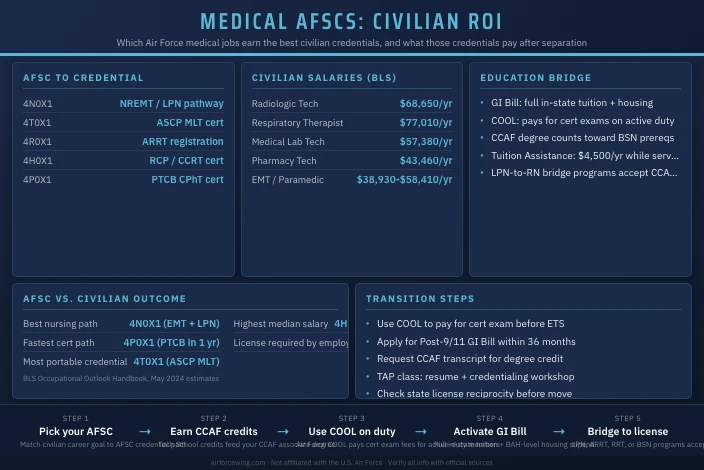
How Air Force Medical Training Converts to Civilian Credentials
Before you can understand which AFSCs are worth your time, you need to know how the conversion actually works.
The Air Force trains all enlisted medical Airmen at the Medical Education and Training Campus (METC) at Fort Sam Houston, TX. METC is a joint-service campus, which means the curriculum is designed to meet the same clinical and academic standards used by civilian accreditation bodies. That’s not marketing, it’s why the certifications you earn there are the same ones civilian hospitals require.
Two programs accelerate the conversion. The first is the Air Force COOL program (Credentialing Opportunities On-Line), which pays for certification exam fees for active-duty Airmen. You can sit for your national exam before you separate. The second is the Community College of the Air Force (CCAF) associate degree, which is built on your Tech School credits. That degree satisfies the academic prerequisite for multiple bachelor’s and graduate-level healthcare programs.
The Post-9/11 GI Bill covers the next step for Airmen who want to bridge up to a full nursing license, radiologic technology bachelor’s degree, or respiratory therapy certification. The benefit pays full in-state tuition at public universities, plus a monthly housing allowance. For most enlisted medics, the combination of military training and GI Bill funding replaces what would otherwise cost four to six years and significant debt.
AFSC-by-AFSC Civilian Credential Map
The table below shows the five strongest civilian career paths from enlisted medical AFSCs. Salary figures are BLS national median estimates.
| AFSC | Title | Civilian Credential | Civilian Title | Median Annual Salary |
|---|---|---|---|---|
| 4N0X1 | Aerospace Medical Technician | NREMT-Basic at Tech School; LPN/RN via GI Bill | EMT, CNA, LPN, RN | $38,930, $86,070 |
| 4T0X1 | Medical Laboratory Specialist | ASCP MLT (required at 5-level) | Medical Lab Technician / Technologist | $57,380, $61,890 |
| 4R0X1 | Diagnostic Imaging Technician | ARRT exam eligible after separation | Radiologic Technologist | $68,650 |
| 4H0X1 | Cardiopulmonary Lab Technician | CCRT or RCP exam eligible | Cardiovascular Tech / Respiratory Therapist | $62,080, $77,010 |
| 4P0X1 | Pharmacy Technician | PTCB CPhT exam during or after service | Pharmacy Technician | $43,460 |
Salary data from BLS Occupational Outlook Handbook, May 2024 estimates.
4N0X1 Aerospace Medical Technician: Broadest Clinical Foundation
The 4N0X1 is the Air Force’s generalist clinical role. Tech School at METC runs roughly 14 weeks, and graduates earn the Nationally Registered EMT-Basic (NREMT) credential at completion. That’s a civilian license you can use the week after you separate.
EMT-Basic is the floor, not the ceiling. Airmen who earn the 4N0X1H shredout, the National Registry Paramedic track, exit with a paramedic license. Median paramedic salary is $58,410 (BLS, May 2024), significantly higher than EMT-Basic work. The independent duty track (4N0X1C) builds even more advanced clinical skills, though that shredout is designed for military use and doesn’t map to a single civilian license.
For Airmen with longer-term goals, 4N0X1 is the strongest starting point toward nursing. The clinical hours you accumulate. IV starts, medication administration, patient assessment, wound care, satisfy the hands-on prerequisites for most Licensed Practical Nurse (LPN) and Registered Nurse (RN) bridge programs. Many community college LPN programs accept CCAF credits toward the academic requirements. A single enlistment of 4N0X1 service, followed by GI Bill-funded LPN or ADN coursework, gets someone to a civilian nursing job without the pre-service debt load.
LPN median salary sits at roughly $59,730 per year. Registered Nurses earn a national median of $86,070. The bridge from 4N0X1 to RN takes two years of additional school, which the GI Bill can cover at a public program.
4T0X1 Medical Laboratory Specialist: Most Portable Credential
Lab work isn’t glamorous, but the credential is one of the most portable in healthcare. 4T0X1 Airmen spend roughly 12 months at METC covering hematology, urinalysis, blood bank operations, clinical chemistry, and microbiology. The curriculum is directly aligned with the ASCP Board of Certification’s Medical Laboratory Technician (MLT) exam.
The MLT certification is a hard requirement for independent bench work at most U.S. hospitals. You need it to be hired, period. The Air Force mandates it at the 5-skill level, so most 4T0X1 Airmen earn it before they separate, and it arrives with zero additional testing or school cost.
National median salary for clinical laboratory technicians is $57,380. Technologists with a bachelor’s degree and the higher-level MT certification earn closer to $61,890. Airmen who use the CCAF associate degree in Medical Laboratory Technology as a bridge toward a clinical laboratory science bachelor’s program can reach the technologist level with roughly two additional years of college.
The shortage of qualified lab workers has pushed wages higher in most metro areas. Hospital networks and national reference labs actively recruit military-trained technicians because their documentation habits and quality assurance experience exceed what civilian programs typically produce.
4R0X1 Diagnostic Imaging Technician: Employer-Required License
Radiologic technologists need the ARRT credential to be employed at virtually any U.S. hospital. There is no workaround, imaging departments won’t hire without it. 4R0X1 Airmen complete roughly 11 months of training at METC that covers radiographic positioning, exposure technique, digital imaging systems, patient safety, and radiation protection. The curriculum mirrors the content of an accredited associate’s degree in radiologic technology.
After separation, 4R0X1 Airmen are eligible to sit for the ARRT examination. They are not automatically credentialed, they still need to pass the exam, but the METC training satisfies the education and clinical hour requirements to apply. That’s the same standing that graduates of civilian two-year ARRT programs hold. A civilian radiologic technology associate’s degree typically costs $15,000 to $30,000 at community colleges. The Air Force eliminates that cost while paying you to train.
BLS median salary for radiologic technologists is $68,650. The field is growing at 4% through 2034, which is average, but hourly rates in hospital environments are consistently strong, particularly for technologists willing to work evenings or nights.
Airmen who want to advance beyond general radiography can pursue specialty certifications in CT, MRI, mammography, or vascular interventional radiology after earning the ARRT. Each specialty credential adds earning potential.
4H0X1 Cardiopulmonary Lab Technician: Path to Respiratory Therapy
The 4H0X1 AFSC covers electrocardiography, stress testing, Holter monitoring, and pulmonary function testing. It’s a narrower clinical niche than 4N0X1 but maps to two distinct and growing civilian credential paths.
The first is cardiovascular technology. 4H0X1 Airmen are eligible for the CCI (Cardiovascular Credentialing International) exams, including the Certified Cardiac Rhythm Technician (CCRT) credential. Hospital cardiac monitoring units and non-invasive cardiology labs hire directly for these roles.
The second path is respiratory therapy, which requires additional education beyond 4H0X1 service but benefits from it. The pulmonary function testing skills from 4H0X1 align with respiratory therapy clinical work, and CCAF credits can count toward the associate’s degree programs that most states require for the RRT (Registered Respiratory Therapist) credential. The NBRC (National Board for Respiratory Care) sets the national exam standards.
Respiratory therapy has the strongest salary outlook on this list for the credential investment. BLS reports a median of $77,010 for respiratory therapists, with 13% job growth projected through 2034, well above average, driven by the aging population and ongoing demand for pulmonary care. An Airman who does a 4H0X1 enlistment and then pursues an NBRC-eligible respiratory therapy program with the GI Bill is looking at a roughly $77,000 median salary within a few years of separation.
4P0X1 Pharmacy Technician: Fastest Path to Civilian Certification
The 4P0X1 Airman exits service with the background to pass the PTCB (Pharmacy Technician Certification Board) ExCPT exam. The certification exam fee is covered by the Air Force COOL program for active-duty members. That means many 4P0X1 Airmen separate with CPhT (Certified Pharmacy Technician) credentials in hand.
Tech School runs roughly 16 weeks at METC. It covers prescription processing, pharmaceutical calculations, controlled substance management, sterile compounding, and medication counseling. The curriculum maps to the same knowledge domains the PTCB tests.
Civilian pharmacy technician median salary is $43,460, lower than the other AFSCs on this list. Hospital pharmacy positions (inpatient, compounding, oncology) pay more, typically $50,000 to $58,000, than retail pharmacy roles. The 4P0X1 background in sterile compounding and controlled substance handling positions Airmen well for hospital settings rather than retail.
The credential is fast to earn and the job market is stable, with 6% projected growth through 2034 and roughly 49,000 annual job openings nationally. For someone who wants to separate and start working quickly without additional school, 4P0X1 is the most direct path.
GI Bill and COOL: The Two Programs That Matter Most
The COOL program and the GI Bill do different things, and using both correctly significantly increases your post-service earning potential.
COOL pays for credentialing exam fees while you’re still on active duty. Use it before you separate. The relevant certifications. NREMT, PTCB, ARRT, ASCP, CCI, are all eligible. You don’t pay out of pocket for the exam. Some programs also cover study materials. The Air Force AFVEC portal is where you submit COOL requests.
Post-9/11 GI Bill covers school after you separate. Full in-state tuition at public universities, plus a monthly housing allowance at the BAH E-5-with-dependents rate for the school’s ZIP code, plus up to $1,000 annually for books. That’s meaningful money at a public nursing school or radiologic technology program. The benefit covers up to 36 months of education. For Airmen who want to bridge from an enlisted credential to a higher license, those 36 months can take you from NREMT-Basic to RN, or from MLT to MT, depending on the program.
Tuition Assistance applies while you’re still serving. It covers up to $4,500 per year toward college courses, at $250 per semester hour. Many 4T0X1 and 4R0X1 Airmen complete enough CCAF coursework during their enlistment to finish an associate’s degree before they separate. That reduces the GI Bill runway needed afterward.
The combination of COOL + Tuition Assistance + GI Bill + CCAF credits creates a pipeline that takes a 17-year-old high school graduate to a licensed clinical professional in four to six years, with the military paying the majority of the cost.
Transition Support: TAP and Beyond
The Air Force Transition Assistance Program (TAP) runs mandatory workshops in the months before separation. The curriculum covers resume writing, salary negotiation, job search tools, and veteran hiring programs. Healthcare-specific sessions can help you translate military job titles and documentation into language civilian hiring managers understand.
For credentialed medical Airmen, the translation matters. “4N0X1 Aerospace Medical Technician” doesn’t land the same as “NREMT-Certified EMT with four years of clinical experience in urgent care, flight medicine, and aeromedical evacuation.” TAP coaches help you reframe your record.
Hiring Our Heroes runs healthcare hiring events specifically for veterans, including partnerships with hospital systems that actively recruit military-trained clinical staff. The timeline is important: start your COOL applications six to twelve months before your expected separation date, not the week before.
This site is not affiliated with the U.S. Air Force or any government agency. Verify all information with official Air Force sources before making enlistment or career decisions.
For a full comparison of the three most-requested medical AFSCs before you enlist, see Air Force medical AFSC jobs: complete guide and explore the full Air Force medical career group for individual AFSC profiles. The education benefits guide covers how to maximize COOL, TA, and GI Bill to bridge from your military credential to a higher civilian license.