Best Air Force Jobs for Introverts
Most people picture the military as a nonstop team environment, constant meetings, formations, and group PT. For many AFSCs, that’s accurate. But a significant portion of the Air Force runs on focused, individual work: analysts who process classified reporting alone for hours, maintainers who are personally responsible for the condition of their aircraft, programmers who debug Air Force software at a workstation. If you do your best thinking without constant interruption, there are real jobs here built for you.
These aren’t consolation picks for people who “can’t handle” a more demanding AFSC. Several of the jobs below require the highest ASVAB scores in the entire enlisted force and carry security clearances that take months to investigate. They are competitive, well-compensated, and translate to strong civilian careers. The common thread is that the work is self-directed, technically demanding, and structured around individual output rather than group coordination.
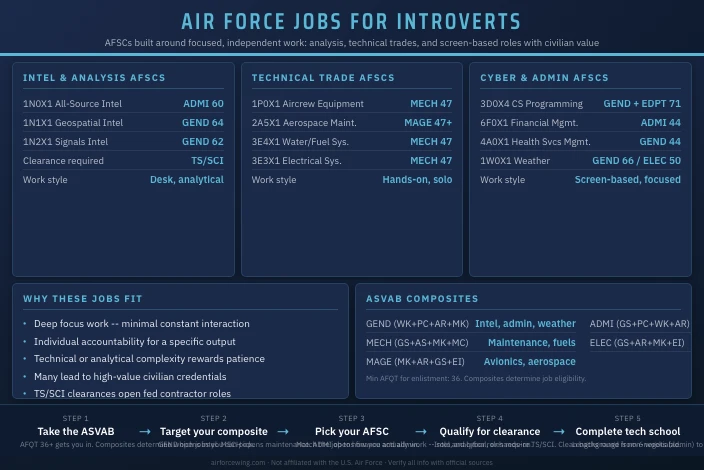
What Makes a Job a Good Fit for Introverts
Before diving into specific AFSCs, it’s worth being precise about what “introvert-friendly” actually means in an Air Force context.
The most relevant factors are:
- How much of the job is collaborative vs. individual: Some roles require constant coordination with crews, patients, or customers. Others require you to sit with a problem for hours and produce an output independently.
- Whether the work is reactive or self-paced: Reactive work (answering phones, helping walk-ins, running customer service desks) drains people who need focus. Self-paced technical work plays to a different strength set.
- Physical proximity to others: Open bay maintenance floors are loud and social. Imagery analysis bays are quiet. This matters more than most recruits expect.
- Whether the AFSC rewards depth over breadth: Jobs that require mastery of a narrow technical domain reward the kind of concentrated study that introverts often prefer.
None of the jobs in this post are zero-interaction. The Air Force doesn’t work that way. But each one gives you long stretches of independent, focused work as a core feature of the daily job.
Intelligence and Analysis: The Best Fit by Design
Intelligence work is structured around individual analysis. Airmen in the 1N career group spend most of their day reading, processing, and writing, not coordinating. The output is a finished product: a report, a briefing, a target package. The work requires sustained concentration, and the environment reflects that.
1N0X1 All-Source Intelligence Analyst
All-Source Intelligence analysts pull reporting from multiple collection disciplines, signals, imagery, human sources, open-source material, and fuse it into a coherent assessment. Tech school is approximately 13 weeks at Goodfellow AFB, Texas. The ASVAB minimum is ADMI 60, and a Top Secret/SCI clearance is required before training begins.
The daily routine is desk-based. Analysts read classified reporting, apply analytical frameworks, and write finished products for commanders. Briefings happen, but the core of the job is solitary cognitive work. Post-service, this background maps directly to intelligence analyst and research roles across the federal government and defense contracting sector.
1N1X1 Geospatial Intelligence Analyst
1N1X1 Airmen interpret satellite and aerial imagery to identify military facilities, terrain features, and activity patterns. The work is visual and methodical, a form of structured observation that plays to pattern recognition and attention to detail. The ASVAB minimum is GEND 64.
A geospatial analyst at a workstation is about as independent as Air Force enlisted work gets. You’re looking at imagery, building products, and working through an analytical problem. Teammates exist, but the job doesn’t depend on constant group interaction to produce results. Civilian demand for cleared imagery analysts at the National Geospatial-Intelligence Agency and defense contractors is steady.
1N2X1 Signals Intelligence Analyst
SIGINT analysts characterize adversary capabilities by analyzing the electronic emissions from radar systems, communication networks, and electronic devices. The ASVAB floor is GEND 62, and a TS/SCI clearance is required. Tech school runs at Goodfellow AFB.
The work requires patience and a methodical mindset. SIGINT analysis often involves working through ambiguous data until a pattern emerges, exactly the kind of task that rewards introverts who can sustain concentration across long sessions. The civilian demand for cleared SIGINT specialists in defense contracting is among the strongest of any intelligence specialty.
Technical Maintenance: Independent Work With Hands
Maintenance AFSCs are often mischaracterized as highly social. In practice, many maintenance roles assign Airmen direct responsibility for specific aircraft or systems, and the work is done in close, methodical detail with a small team or solo. The job is less about socializing and more about getting the aircraft or equipment to standard.
1P0X1 Aircrew Flight Equipment
Aircrew Flight Equipment specialists maintain the gear that keeps pilots alive, ejection seats, parachutes, oxygen systems, survival vests, and emergency equipment. The ASVAB minimum is MECH 47. Tech school runs approximately 10 weeks at Lackland AFB, Texas.
This job is inspection-heavy and procedurally precise. Specialists work through detailed checklists, test individual components, and certify that safety-critical gear meets exact standards before a crew member touches it. The work is independent and methodical by design, rushing or cutting corners is not compatible with the mission. If you prefer deliberate, precision-focused work over fast-paced customer interaction, this AFSC suits that style well.
2A5X1 Aerospace Maintenance
2A5X1 covers the crew chief and specialist roles that keep Air Force aircraft flyable. Sub-specialties focus on specific systems: hydraulics, avionics, engines, fuel. The ASVAB minimum varies by sub-AFSC but typically requires MAGE 47 or higher. Some sub-specialties require ELEC 70.
Aircraft maintenance is technical, precise, and largely independent within assigned tasks. A crew chief owns the condition of their jet. That level of individual responsibility is exactly what many technically-minded introverts find satisfying, you are accountable for a specific, measurable output, and the quality of your work is directly visible. The maintenance career group covers all 2A and 2M sub-specialties in detail.
3E3X1 Electrical Systems
Electrical Systems specialists maintain power generation, distribution, and control systems on Air Force installations. The ASVAB minimum is MECH 47, and tech school runs at the Air Force Civil Engineer Center. The work involves reading electrical schematics, troubleshooting faults in high-voltage systems, and performing repairs methodically according to technical orders.
Much of the job is done in equipment rooms, generator facilities, and utility vaults, not open-plan offices or customer-facing positions. Civilian journeyman electricians who hold military training experience can earn strong wages, and the Air Force training background may qualify toward a state licensing apprenticeship.
Cyber and Technology: Screen-Based, High-Value Work
Cyber AFSCs attract the highest ASVAB requirements in the enlisted force, and for good reason: the work is technically demanding and operates on systems that connect to real-world Air Force missions. The environment is screen-based, the work is focused, and the output is measurable.
3D0X4 Computer Systems Programming
Air Force programmers write, test, and maintain software for Air Force systems. The ASVAB requirement is a qualifying GEND score plus an EDPT score of 71: the Air Force Electronic Data Processing Test filters for logical reasoning and programming aptitude before you even get to tech school. Training runs approximately 70 days at Keesler AFB, Mississippi.
The daily routine for a programmer looks a lot like a civilian software development role: working through a problem, writing code, testing output, fixing bugs. It’s a screen-based, cognitively intensive job with a development cycle that rewards patience and precision over speed. Veterans from this AFSC pursue civilian software development careers with significant built-in advantages. See the full cyber career group overview for how this role compares to the other cyber AFSCs.
Analytical and Administrative: Quiet but High-Stakes
Not every quiet job is in intelligence or maintenance. Several Air Force administrative and support AFSCs involve focused analytical work with minimal customer interaction, standard hours, and strong civilian career parallels.
1W0X1 Weather
Weather Airmen produce meteorological and climatological products for flight operations and commanders. The ASVAB requirement is a dual composite, GEND 66 and ELEC 50: the highest combined threshold in the operations career group. Tech school runs 15 weeks at Keesler AFB.
The job involves processing upper-air soundings, analyzing atmospheric data, and writing aviation weather forecasts. Briefings happen before sorties, but the analytical work between those briefings is done independently. Weather Airmen who support space operations or polar assignments often work in small, self-directed units where individual expertise carries the entire mission. Post-service paths include the National Weather Service, private forecasting companies, and federal science agencies.
6F0X1 Financial Management
Financial Management Airmen handle military pay processing, travel vouchers, and installation budget actions. The ASVAB minimum is ADMI 44. Tech school runs approximately 6 weeks at Keesler AFB.
The work is desk-based, largely non-customer-facing at the transaction level, and built around processing financial data accurately. Most Finance offices run standard business hours with limited shift work. Deployments happen but at a lower tempo than operational career fields. Federal financial management and accounting roles are the natural post-service path, with strong hiring demand across the Department of Defense civilian workforce.
4A0X1 Health Services Management
Health Services Management Airmen run the administrative operations of Air Force medical facilities, processing appointments, managing patient records, coordinating referrals, and handling medical coding. The ASVAB minimum is GEND 44, and tech school runs approximately 9 weeks at the Medical Education and Training Campus (METC) at Fort Sam Houston, Texas.
The role involves more patient contact than pure admin jobs, but the core work is data management and process coordination rather than clinical interaction. Hours are closer to standard business hours than most operational AFSCs. Medical billing and coding expertise carries direct civilian market value as healthcare systems continue expanding.
Comparing Your Options
The table below summarizes ASVAB minimums and work styles for the AFSCs covered in this post.
| AFSC | Title | ASVAB Minimum | Work Style | Clearance |
|---|---|---|---|---|
| 1N0X1 | All-Source Intel Analyst | ADMI 60 | Desk, analytical | TS/SCI |
| 1N1X1 | Geospatial Intel Analyst | GEND 64 | Visual analysis | TS/SCI |
| 1N2X1 | Signals Intel Analyst | GEND 62 | Technical analysis | TS/SCI |
| 1P0X1 | Aircrew Flight Equipment | MECH 47 | Precision maintenance | Secret |
| 2A5X1 | Aerospace Maintenance | MAGE 47+ | Hands-on, independent | Secret |
| 3D0X4 | Computer Systems Programming | GEND + EDPT 71 | Software development | Secret |
| 1W0X1 | Weather | GEND 66 / ELEC 50 | Analytical, data-driven | Secret |
| 6F0X1 | Financial Management | ADMI 44 | Finance, admin | None required |
| 4A0X1 | Health Services Management | GEND 44 | Admin, data management | None required |
The intelligence AFSCs demand the most from your ASVAB prep. GEND 60+ requires strong performance across vocabulary, reading comprehension, arithmetic, and math knowledge. If one of those 1N roles is your target, the time spent on ASVAB preparation directly determines whether you qualify. Air Force ASVAB test prep covers the section-by-section breakdown and the study framework for each composite.
ASVAB Scores: Where to Focus
Your composite score, not your AFQT alone, determines which of these jobs is available to you. Each composite draws from specific ASVAB subtests:
- GEND: Word Knowledge + Paragraph Comprehension + Arithmetic Reasoning + Mathematics Knowledge. Opens intel, weather, programming, and admin roles.
- ADMI: General Science + Paragraph Comprehension + Word Knowledge + Arithmetic Reasoning. Opens finance, personnel, and some intel roles.
- MECH: General Science + Auto/Shop + Mathematics Knowledge + Mechanical Comprehension. Opens maintenance, electrical, and fuels roles.
- ELEC: General Science + Arithmetic Reasoning + Mathematics Knowledge + Electronics Information. Required for some cyber and weather roles.
- MAGE: Mathematics Knowledge + Arithmetic Reasoning + General Science + Electronics Information. Required for avionics and aerospace maintenance sub-specialties.
The highest-ceiling jobs in this post, 1N0X1, 1N1X1, 1W0X1, all require GEND or ADMI scores well above the entry floor. If you’re targeting any of these, treat the ASVAB as the real gate, not a box to check.
Matching the Job to How You Actually Work
Two questions matter most when choosing between these AFSCs.
First: do you prefer working with data, equipment, or code? Intelligence roles are data-intensive. Maintenance roles are hands-on. Cyber and weather roles sit in between. The daily texture of the job is different even when all three share the same low-interaction environment.
Second: are you willing to go through a security clearance investigation? The intelligence AFSCs require TS/SCI, which involves a Single Scope Background Investigation. The process takes time and scrutinizes your background, finances, and associations thoroughly. It’s not a disqualifier for most people, but it’s not trivial either. Jobs like financial management and health services skip the clearance requirement entirely, which simplifies the enlistment timeline.
Browse all enlisted career groups and full AFSC profiles at Air Force enlisted careers.
This site is not affiliated with the U.S. Air Force or any government agency. Verify all information with official Air Force sources before making enlistment or career decisions.
You may also find the best Air Force jobs overview and Air Force ASVAB test prep helpful.