Best Air Force Jobs for 2026
The Air Force has over 130 enlisted AFSCs. A 17-year-old researching careers online will find lists ranking them every which way, usually based on nothing more concrete than the author’s personal experience in a single career field. This post takes a different approach. We evaluated enlisted jobs across five practical criteria, pay and allowances, civilian career transfer, training quality, job security, and day-to-day work environment, and surfaced the AFSCs that consistently score well across more than one category.
No single job wins every category. But if you’re about to commit three to six years of your life, you deserve a real comparison.
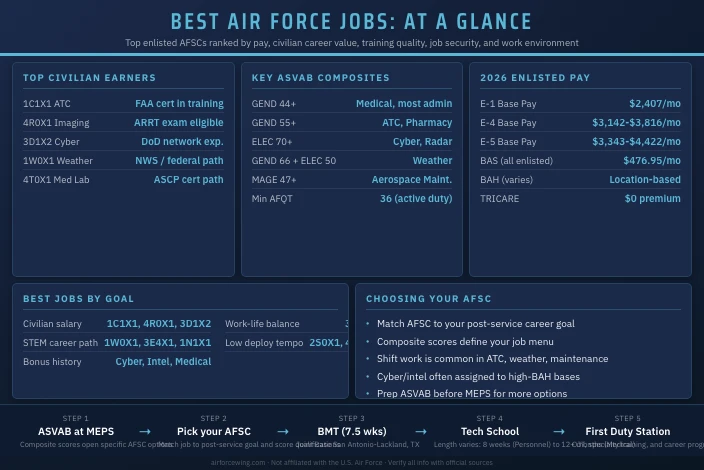
How We Ranked These Jobs
Every AFSC evaluated here was scored against five factors:
- Pay and bonuses: Base pay is identical across all enlisted grades, but some AFSCs carry enlistment bonuses or special duty pay that changes the math in the first enlistment.
- Civilian career value: Does the job produce a credential, a license, or in-demand experience that civilian employers recognize?
- Training pipeline: Is the tech school education genuinely useful? Long, rigorous pipelines often indicate serious skill development.
- Job security: High-demand AFSCs in fields the military consistently under-mans tend to get better bonus offers and faster promotion.
- Work environment: Shift work, deployment tempo, physical demands, and whether the daily work is engaging or repetitive.
The minimum AFQT for Air Force enlistment is 36 (or 65 with a GED). Every job below requires a score above that floor, and most require specific composite line scores. Your ASVAB composite scores, not your AFQT alone, are what determine which AFSCs you qualify for.
Best Jobs for High Civilian Earning Potential
These AFSCs produce credentials that directly translate to licensed civilian careers. The Air Force pays for the training; you leave with the qualification.
1C1X1 Air Traffic Control
Air Traffic Control consistently earns the strongest post-service salary among enlisted Air Force jobs. FAA air traffic controllers rank among the highest-paid licensed workers in the federal system, with median annual wages well above six figures in major facility categories. The military path earns you FAA certification during a 16-week tech school at Keesler AFB, Mississippi. No civilian program gets you there faster.
The ASVAB requirement is GEND 55: a composite built from verbal and math subtests. A Secret clearance is required. The job involves shift work and real-time decision-making under pressure, which suits some people well and burns others out quickly. But if you score high enough and you’re willing to work the rotational schedule, this is one of the most valuable career-building AFSCs in the enlisted Air Force.
4R0X1 Diagnostic Imaging Technician
4R0X1 Airmen operate X-ray, CT, and fluoroscopy systems at Air Force medical facilities. Tech school at the Medical Education and Training Campus (METC) at Fort Sam Houston runs approximately 11 months. At the end of that pipeline, graduates are eligible to sit for the ARRT certification exam, the same credential that civilian hospitals require for staff radiographers.
The ASVAB floor is GEND 44, relatively accessible. A two-year associate’s degree in diagnostic imaging costs $15,000-$30,000 at most community colleges. The military route replaces that cost entirely while paying you a salary and full benefits throughout. Civilian radiologic technologist wages are stable and growing as healthcare demand outpaces the supply of trained techs.
3D1X2 Cyber Systems Operations
3D1X2 Airmen manage, maintain, and secure Air Force network infrastructure. They configure servers, monitor systems, and respond to network outages and intrusions. Tech school is at Keesler AFB and runs approximately 16 weeks. The hands-on experience in a live government network environment is something a classroom certification program cannot replicate.
The minimum composite is ELEC 70: the highest in the communications group and a real filter. Veterans from this field pursue CompTIA Security+, Network+, and Cisco certifications post-service. Federal contractors, defense firms, and commercial enterprises actively recruit from this pool. Cyber roles consistently appear on Air Force critical manning lists, which translates to bonus eligibility in many enlistment cycles.
Best Jobs for Work-Life Balance
Not everyone wants the most demanding career field. These AFSCs offer competitive training, reasonable deployment tempo, and work environments that support a normal life outside the job.
3F0X1 Personnel
3F0X1 Force Support (Personnel) Airmen manage military personnel records, orders, pay actions, evaluations, and assignment processing. The work is administrative, but it runs on secure HR systems used across the entire Department of Defense. Tech school is at Keesler AFB and runs approximately 8 weeks.
Deployment is possible but less frequent than in operational career fields. The civilian parallel is human resources administration, and DoD HR experience is valued in both federal civilian positions and private-sector HR shops. The ASVAB requirement is ADMI 44, which makes this one of the more accessible high-quality AFSCs for enlisted applicants building toward a management or business career.
4A0X1 Health Services Management
4A0X1 Airmen manage the administrative operations of Air Force medical facilities. They process appointments, manage patient records, handle medical coding, and coordinate care across Air Force medical groups. Tech school runs approximately 9 weeks at METC.
The work is indoors, regular hours dominate over shift work, and the medical administration field is one of the more stable civilian sectors for post-service employment. Medical billing and coding expertise is increasingly in demand as healthcare systems manage growing patient volumes. The ASVAB floor is GEND 44.
Best Jobs for STEM Careers After Service
These AFSCs build technical skills that map to engineering, science, or technology roles in the private sector.
1W0X1 Weather
1W0X1 Weather Airmen forecast conditions, conduct surface observations, and brief flight crews before every sortie. The role requires dual composites: GEND 66 and ELEC 50, the highest combined threshold in the operations group. Tech school runs 15 weeks at Keesler AFB.
The rigorous entry bar reflects what the job demands. Weather Airmen process upper-air soundings, write aviation forecasts, and support both training and combat operations. After service, veterans qualify for positions at the National Weather Service, private forecasting companies, and federal science agencies. Those who complete assignments supporting space weather operations often hold Top Secret clearances that open even more specialized post-service options.
3E4X1 Water and Fuel Systems Maintenance
3E4X1 Airmen operate and maintain potable water systems, wastewater treatment, and fuels infrastructure on Air Force installations. The ASVAB requirement is MECH 47: a composite that rewards strong mechanical aptitude. Tech school is at the Air Force Civil Engineer Center at Tyndall AFB and covers hydraulics, pump systems, and environmental compliance.
This job maps directly to water treatment operator and fuel systems technician positions in the civilian sector. Environmental engineering firms, municipal utilities, and energy companies hire regularly from this background. The EPA’s water operator licensing program recognizes military training for several certification paths.
1N1X1 Geospatial Intelligence
1N1X1 Airmen analyze satellite and aerial imagery to support mission planning and intelligence collection. The work is analytical, detail-intensive, and often classified. The ASVAB floor is GEND 64: the imagery analysis tasks demand both strong reading comprehension and pattern recognition.
The civilian equivalent is a geospatial intelligence analyst or imagery analyst, roles in high demand across the Intelligence Community and defense contracting sector. Veterans often leave this AFSC into positions with federal agencies, private defense firms, or commercial satellite imagery companies. The analytical training background also transfers well into data science and remote sensing roles.
Best Jobs for Pay and Bonuses
Base pay is the same for all enlisted Airmen at the same grade and years of service. Where these AFSCs stand out is in bonus eligibility and special pays that supplement base pay during or after enlistment.
| AFSC | Composite | Key Bonus Driver |
|---|---|---|
| 3D0X4 Cyber Transport | ELEC 70 | Critical manning bonus eligibility |
| 1A0X1 In-Flight Refueling | MECH 47 | Aviation career incentive pay |
| 1B4X1 Cyber Operations | GEND 64 | Cyber duty and re-enlistment bonuses |
| 6C0X1 Contracting | ADMI 44 | Acquisition workforce bonus |
| 14NX Intelligence Officer | Officer | Career field incentive pay |
Bonus amounts and eligible AFSCs change on a fiscal year cycle. The Air Force publishes updated bonus authorization lists through its personnel center. An Air Force recruiter can confirm which career fields carry bonuses in the current enlistment cycle.
Enlisted monthly base pay in 2026 runs from $2,407 at E-1 through $5,044 at E-6 with 12 years. Add BAS ($476.95/month for all enlisted members), plus BAH if you live off base. BAH varies by duty location and dependency status but can add $1,300-$1,900 or more per month at many major Air Force installations.
Best Jobs for Introverts and Independent Workers
Some people do their best work without constant team interaction. These AFSCs are structured around focused, individual work rather than constant interpersonal coordination.
1N0X1 All-Source Intelligence analysts process classified information from multiple collection disciplines, write finished intelligence products, and brief decision-makers. The work is mentally demanding and largely desk-based. ASVAB minimum is GEND 64. A Top Secret clearance is standard.
2A5X1 Aerospace Maintenance covers hands-on aircraft systems maintenance. Crew chiefs and specialists work on specific aircraft components, from avionics to fuel systems, and are largely responsible for the condition of their assigned aircraft. The work is methodical and technically detailed. ASVAB minimum varies by sub-AFSC but typically requires MAGE 47 or higher.
1P0X1 Aircrew Flight Equipment Airmen maintain life support and survival equipment, ejection seats, parachutes, oxygen systems, and personal protective gear. The job is a mix of precision maintenance and detailed inspections, done largely independently. The ASVAB minimum is MECH 47.
A dedicated post, best Air Force jobs for introverts, goes deeper on these AFSCs and others that suit independent, analytical, or technically focused workers.
Best Jobs for Staying in the US
Not every Air Force Airman wants to deploy. Some AFSCs are structured around fixed installation assignments with lower overseas and combat rotation requirements.
2S0X1 Materiel Management Airmen manage Air Force supply chains, ordering, tracking, and issuing equipment and parts across Air Force installations. The job is warehouse and inventory management with military precision. Most assignments are CONUS-based. ASVAB minimum is ADMI 44.
4P0X1 Pharmacy Technician work is almost entirely clinic-based. Pharmacy operations on most bases are fixed facilities with standard business hours. Deployments happen but are less frequent than in operational fields. GEND 55 is the floor.
6F0X1 Financial Management Airmen process military pay, travel vouchers, and budget actions. The work is entirely administrative, centered on finance offices at Air Force installations. ASVAB minimum is ADMI 44. The civilian parallel, federal financial management or accounting, is a strong post-service path for anyone building toward a business career.
A full breakdown of deployment frequency by career field is in Air Force jobs that don’t deploy often.
Best Jobs for Transition to Civilian Careers
Military-to-civilian career transitions work best when the job teaches a skill that civilian employers actually need to hire for.
| AFSC | Civilian Career | What Makes It Transfer |
|---|---|---|
| 1C1X1 Air Traffic Control | FAA Air Traffic Controller | FAA cert earned in military training |
| 4R0X1 Diagnostic Imaging | Radiologic Technologist | ARRT exam eligibility after separation |
| 4T0X1 Medical Lab | Medical Laboratory Technician | ASCP certification path |
| 3D1X2 Cyber Systems | Network/Security Analyst | DoD network experience + certifications |
| 1W0X1 Weather | Meteorological Technician | NWS, private forecasting, federal agencies |
| 3E3X1 Electrical Systems | Electrician / Power Systems Tech | Journeyman apprenticeship credit |
| 3E4X1 Water/Fuel Systems | Water Treatment Operator | EPA licensing recognition |
The pattern here: jobs that teach a licensed or credentialed skill have the clearest civilian value. Jobs that are purely military-specific, certain intelligence roles, command and control positions, require more deliberate translation when you leave. For a focused analysis of which AFSCs produce the strongest post-separation employment outcomes, see Air Force jobs that transfer to civilian careers.
ASVAB Scores: What You Need to Know Before Choosing
The AFQT gets you through the door. Your composite line scores determine which jobs are actually available to you. Every AFSC in this post has a composite minimum, and if you don’t hit that score on the ASVAB, the job isn’t on the table regardless of your recruiter’s preferences or your interest in the field.
Here’s what drives the key composites:
| Composite | Subtests | Jobs It Opens |
|---|---|---|
| GEND | WK + PC + AR + MK | Medical, Intel, Operations, most admin |
| ELEC | GS + AR + MK + EI | Cyber, Radar, Electronics |
| MECH | GS + AS + MK + MC | Maintenance, Engineering, Fuels |
| ADMI | GS + PC + WK + AR | Personnel, Finance, Supply |
| MAGE | MK + AR + GS + EI | Avionics, Aerospace Maintenance |
If your target job has an ELEC or MECH requirement, electronics, general science, and auto/shop subtests are where you need to focus your preparation. GEND-gated jobs, the largest group, reward time spent on vocabulary, reading comprehension, and arithmetic.
Getting your scores up before MEPS gives you negotiating power at the recruiter’s office. Air Force ASVAB test prep has the study framework, section-by-section breakdown, and score targets for each composite.
The Highest-Paying Enlisted Jobs
Every Airman at E-5 with four years in earns roughly the same base pay regardless of AFSC. But total compensation can differ based on bonuses, special pays, and the duty locations that come with certain career fields.
High-cost-of-living bases produce higher BAH, which adds real dollars to monthly take-home even though the rates aren’t tied to your job. Cyber and intel AFSCs are frequently assigned to installations in high-cost areas. Northern Virginia, the DC metro, Honolulu, where BAH rates are substantially higher than at inland bases.
The AFSCs with the most consistent bonus history include cyber career fields (3D0X4, 1B4X1), certain intelligence roles, and medical specialties that the Air Force consistently under-mans. A full breakdown with dollar figures is in highest-paying Air Force AFSC jobs.
Choosing Your Career Field
The right AFSC is the one that fits where you’re going, not just where you are right now. A few questions that clarify the choice quickly:
- Do you have a post-service career in mind? Match the AFSC to the credential or experience that career requires. Don’t pick a job because it sounds interesting if it has no civilian application.
- What are your ASVAB scores? Your composite scores define the menu. If you haven’t tested yet, prep first. Higher scores mean more options, not just a better AFQT.
- How do you feel about shift work? Controllers, weather, command post, and many maintenance jobs run 24-hour rotations throughout the career. Medical clinic jobs and most administrative roles work closer to standard hours.
- Do you want overseas assignments or prefer CONUS? Some AFSCs, special warfare, certain intel fields, cyber, rotate to overseas locations frequently. Supply, finance, and many medical roles are more CONUS-stable.
Browse all 18 enlisted career groups with full AFSC profiles at Air Force enlisted careers.
This site is not affiliated with the U.S. Air Force or any government agency. Verify all information with official Air Force sources before making enlistment or career decisions.
You may also find Air Force ASVAB test prep and highest-paying Air Force AFSC jobs helpful.