Best Air Force Engineering AFSC for Civilian Licensing
A four-year enlistment in a civil engineering AFSC can put a licensed trade credential in your hand the day you separate. Not a resume line, an actual state license or nationally recognized certification that civilian employers require. Four AFSCs in the 3E career group have particularly clear paths: 3E0X1 Electrical Systems, 3E1X1 HVAC and Refrigeration, 3E7X1 Fire Protection, and 3E2X1 Pavements and Construction Equipment. Here is how each one works.
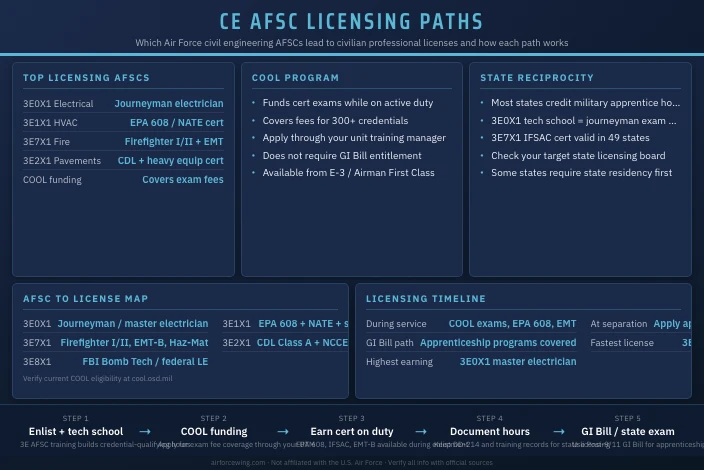
How Military Training Becomes a Civilian License
The gap between military training and civilian credentials used to be wide. States often rejected military experience entirely, forcing veterans to repeat apprenticeship hours they had already served. That has changed substantially. Most states now count military trade training toward the apprenticeship hour requirements that gates licensing exams.
Two programs matter most.
The COOL program (Credentialing Opportunities On-Line) funds certification exam fees for active-duty Airmen. It covers more than 300 credentials across dozens of career fields. You apply through your unit training manager, it doesn’t draw from GI Bill entitlement, and it’s available starting at the Airman First Class (E-3) paygrade. The Air Force funds the exam; you just have to show up and pass.
The Post-9/11 GI Bill covers registered apprenticeship programs, which matters for trades like electrical where the path to a journeyman or master license runs through a multi-year apprenticeship after separation. Monthly housing allowance still pays during an apprenticeship, it’s not just for college.
State reciprocity rules vary, but the trend is in veterans’ favor. Many states have passed legislation specifically directing licensing boards to credit military training hours. Before you separate, request a DD-214 with full training details and gather copies of your course completion records. Those documents are what state licensing boards will ask for.
The AFSC-to-License Table
| AFSC | Title | Primary Licenses and Certs | When You Can Earn Them |
|---|---|---|---|
| 3E0X1 | Electrical Systems | Journeyman electrician (state), master electrician | At separation (via state exam) |
| 3E1X1 | HVAC and Refrigeration | EPA 608, NATE certification, state HVAC contractor | EPA 608 during service; contractor at separation |
| 3E7X1 | Fire Protection | IFSAC Firefighter I/II, EMT-Basic, Haz-Mat Operations | During service via COOL and cross-training |
| 3E2X1 | Pavements and Construction Equipment | CDL Class A, NCCER heavy equipment operator | CDL during service; NCCER at separation |
| 3E8X1 | Explosive Ordnance Disposal | FBI Bomb Technician program, federal law enforcement | Post-service application |
EOD (3E8X1) earns its own section at the end. Its civilian path is distinct from the trade licensing routes above, more federal career track than state license.
3E0X1 Electrical Systems: The Strongest Licensing Path in CE
Of all the 3E AFSCs, 3E0X1 offers the most direct route to a high-earning licensed trade. Tech School runs 99 days at Sheppard AFB, TX. The curriculum covers wiring, power distribution systems, generators, airfield lighting, and exterior electrical infrastructure, content that aligns closely with the National Electrical Code training required for state licensing exams.
Most states require a combination of classroom hours and field experience before you can sit for the journeyman exam. The 3E0X1 tech school typically satisfies the classroom hour requirement. Your years of on-base electrical maintenance count as the field experience. When you separate, you go to the state licensing board with documentation of both, and most states will allow you to sit for the journeyman exam directly.
The master electrician license usually requires additional years as a journeyman, but that timeline starts from day one of your civilian career. The earnings ceiling is high. Journeyman electricians earn a median salary around $61,000 nationally per Bureau of Labor Statistics data, and licensed electrical contractors running their own operations regularly earn over $100,000.
Demand is not going away. The BLS projects electrician employment to grow faster than the average for all occupations through the decade, driven by electrical grid upgrades and new construction.
ASVAB requirement: MECH 35 and ELEC 35. Both composites must be met. The dual threshold is the main filter for this AFSC.
3E1X1 HVAC and Refrigeration: Two Credentials During Service
3E1X1 is the only 3E AFSC where you can earn a nationally recognized certification while still on active duty: without even using COOL funding. The EPA Section 608 certification is required by federal law for anyone who purchases or handles refrigerants. There is no apprenticeship hour requirement and no employer sponsorship needed. You study, pay the exam fee (or get it covered through COOL), and take a proctored test.
Tech School is 98 days at Sheppard AFB. The training covers refrigeration cycles, airside HVAC systems, and mechanical troubleshooting. That content maps directly onto what the EPA 608 exam tests.
NATE certification (North American Technician Excellence) is the other credential worth pursuing during service. NATE is the most widely recognized performance standard for HVAC technicians in the commercial and residential market. Employers often prefer or require it. Like EPA 608, there’s no mandatory apprenticeship, it’s an exam you can take at any point once you have the relevant knowledge.
State HVAC contractor licenses are the next step after separation. Requirements vary significantly by state: some require as little as one year of experience, while others require two to four years plus a business and law exam on top of the technical exam. Either way, the 3E1X1 training hours apply toward the experience threshold in most states.
HVAC technician median pay runs around $57,000 nationally per BLS, but commercial HVAC specialists in high-cost metro areas, and those who run their own contracting businesses, regularly exceed that by a wide margin.
ASVAB requirement: MECH 47 or ELEC 28. The “or” structure makes this one of the more accessible mechanical AFSCs. A weaker electronics score doesn’t disqualify you if your MECH composite is solid.
3E7X1 Fire Protection: Three Certifications, All Earnable on Active Duty
Fire Protection has the most concentrated credential-earning opportunity of any 3E AFSC. Three credentials are routinely earned during service, not after: Firefighter I and Firefighter II (IFSAC/ProBoard), EMT-Basic, and Hazardous Materials Operations.
Tech School runs roughly 14 weeks at Goodfellow AFB, TX. The Air Force fire protection curriculum is designed to meet IFSAC accreditation standards. IFSAC (International Fire Service Accreditation Congress) certifications are accepted in 49 states, you don’t need to requalify when you cross state lines or separate from service.
EMT-Basic is typically earned during training or early in the first duty assignment. Many bases have cross-training agreements with local fire departments and emergency medical services, which means 3E7X1 Airmen accumulate civilian call experience on top of the base response mission.
When a 3E7X1 Airman walks into a civilian fire department hiring process, they carry certifications that most applicants spend two to four years earning at community colleges. That’s the real advantage, the credential timeline is compressed into the enlistment rather than spread across post-service education.
Municipal firefighter salaries vary widely by location but average around $58,000 nationally per BLS data, with major metro departments and those with hazardous materials or technical rescue assignments paying considerably more.
ASVAB requirement: GEND 38, the lowest threshold in the 3E group. The score is the easy part of qualification. Color vision standards, physical fitness, and medical screening filter applicants beyond the test.
3E2X1 Pavements and Construction Equipment: The CDL Path
3E2X1 Airmen operate heavy construction equipment: bulldozers, asphalt pavers, motor graders, compactors, scrapers, building and repairing runways and base infrastructure. The civilian credential that matters most here is the Commercial Driver’s License (CDL) Class A.
A CDL can often be obtained during service through the military’s CDL program. Airmen who operate vehicles over 26,000 pounds as part of their assigned duties may qualify for a military CDL waiver, which allows them to convert their military driving experience directly to a civilian CDL at separation without taking the full skills test. Requirements vary by state.
The NCCER (National Center for Construction Education and Research) credentials are the other major civilian standard for heavy equipment operators. NCCER offers craft certifications recognized across the construction industry. Some bases and training programs offer NCCER testing on-site, and COOL may cover the exam fees.
Heavy equipment operators in the civilian market earn a median around $52,000 nationally, per BLS. Union operators in metropolitan areas, particularly those with runway and airfield experience, earn considerably more. The airfield experience 3E2X1 Airmen accumulate is specific and valued, civilian airport construction and maintenance contracts require operators who know airfield safety requirements, and there are fewer of those than general construction operators.
ASVAB requirement: MECH 40. One composite, no dual threshold. It’s the most accessible score requirement for a mechanical AFSC in the CE career group.
The COOL Program in Practice
COOL isn’t automatic. You have to request it through your unit training manager, identify which credential you’re pursuing, and confirm the exam is on the approved list. The list is maintained at the Department of Defense COOL website. Not every credential is covered, and the program has annual funding limits that can affect availability.
How to use COOL effectively:
- Identify your target credential as early as your first duty assignment
- Confirm it appears on the approved COOL list before building your study plan
- Submit your request with enough lead time, processing can take several weeks
- COOL covers exam fees, not study materials; budget separately for prep courses or books
- You can apply for multiple credentials over the course of a contract if they’re on the approved list
COOL is particularly well suited for EPA 608, IFSAC certifications, and EMT licensing because those exams have clear study paths and defined test formats. For trade licenses with an apprenticeship-hour component (like electrical), COOL covers any associated exam fees, but the state licensing process still depends on documenting your service experience separately.
GI Bill for Trade Apprenticeships
Veterans pursuing electrical or HVAC contractor licenses after separation have a specific GI Bill benefit worth knowing: the Post-9/11 GI Bill covers registered apprenticeship programs, not just college degrees.
A licensed electrician apprenticeship through a union hall or employer pays a training wage. The GI Bill supplements that with a monthly housing allowance at the E-5 with dependents BAH rate for the school’s ZIP code, in 2026, the online-only rate is $1,169 per month, and in-person apprenticeship programs receive the local BAH rate, which is higher in most major cities. That’s income on top of the apprenticeship wage while you’re working toward your journeyman hours.
The 36 months of entitlement covers a standard four-year electrical apprenticeship with time to spare. For veterans who want to run their own electrical or HVAC contracting business eventually, the apprenticeship route combined with GI Bill housing allowance is one of the most financially efficient paths available.
3E8X1 EOD: A Different Kind of Credential Path
EOD doesn’t produce a state trade license. The civilian path is different in character, federal employment and law enforcement rather than licensed contracting.
The FBI Bomb Technician program draws significantly from the same curriculum that Navy school EOD technicians complete at NAVSCOLEOD. Air Force EOD graduates who move into federal or state law enforcement bomb squad positions bring directly transferable technical knowledge. Federal explosive safety specialists at DoD contractors and Department of Energy facilities are another common destination.
EOD’s ASVAB threshold, MECH 60 and GEND 64: is the highest dual requirement in the 3E career group. The training pipeline runs close to ten months. A Secret clearance is required before the pipeline begins. These filters are worth noting because if EOD is your target, the path to a post-service credential is built on federal hiring eligibility, not state licensing boards.
This site is not affiliated with the U.S. Air Force or any government agency. Credential and licensing requirements change. COOL program availability, state licensing reciprocity rules, and GI Bill rates are subject to change. Verify current details with your unit training manager, your state licensing board, and the VA education office before making decisions based on this content.
Which AFSC Fits Your Goal
The right answer depends on what kind of credential you want and when you want it.
If earning income from your license as fast as possible matters most, Fire Protection (3E7X1) delivers IFSAC certifications and an EMT credential during service, before you ever separate. You walk into civilian hiring with credentials most applicants spend years acquiring.
If long-term earning potential is the priority, Electrical Systems (3E0X1) has the highest ceiling. A master electrician license or an electrical contracting business in a major metro area produces income that outpaces most trades over time.
If you want to start a business, HVAC (3E1X1) has the lowest barrier. EPA 608 is the baseline credential, NATE certification adds credibility, and the startup cost for an HVAC service business is lower than electrical contracting because it doesn’t require a master license to operate in most states.
If heavy equipment and construction appeal more than building systems, 3E2X1 puts you in a CDL Class A seat and builds airfield-specific operator experience that commands a premium in civil aviation and airport construction markets.
Browse all seven AFSC profiles and training timelines at the Air Force civil engineering career group. For help building your MECH and ELEC composite scores before MEPS, the Air Force ASVAB test prep guide covers the mechanical and electronics subtests that qualify you for most of these roles.