ASVAB Scores for Every Air Force AFSC
Every Air Force job has a minimum ASVAB line score attached to it. Miss that score by one point and a recruiter cannot put you in that job, no matter how much you want it. This page maps every major career group to its composite requirements so you can set a real target before you sit down to test.
How Air Force ASVAB Scores Work
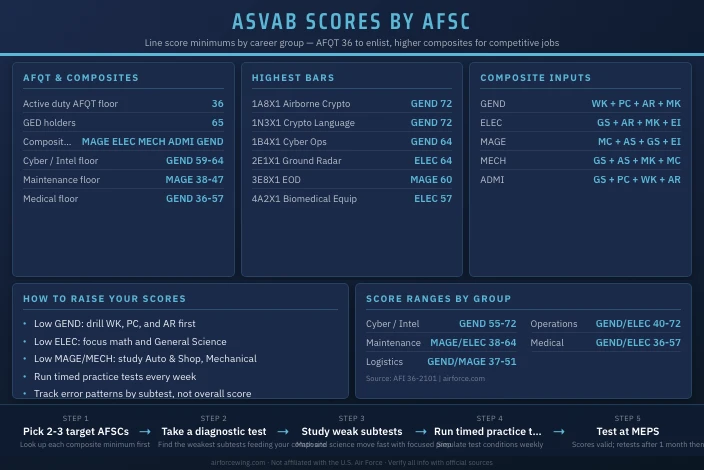
The Air Force does not use the ASVAB the same way the Army does. Instead of 10 separate line scores, it groups subtest raw scores into five composite areas called Qualified Mental Aptitude Area (QMAA) line scores. Those composites are:
| Composite | Subtest Inputs |
|---|---|
| MAGE | Mechanical Comprehension + Auto & Shop + General Science + Electronics |
| ELEC | General Science + Arithmetic Reasoning + Mathematics Knowledge + Electronics |
| MECH | General Science + Auto & Shop + Mathematics Knowledge + Mechanical |
| ADMI | General Science + Paragraph Comprehension + Word Knowledge + Arithmetic Reasoning |
| GEND | Word Knowledge + Paragraph Comprehension + Arithmetic Reasoning + Mathematics Knowledge |
Each AFSC specifies which composite applies and the minimum score required on that composite. An AFSC might require GEND 44 or ELEC 70: the label tells you which subtest cluster matters, and the number tells you the floor.
Your AFQT score (Armed Forces Qualification Test) determines whether you can enlist at all. The Air Force requires an AFQT of 36 for high school diploma holders and 65 for GED holders. Passing the AFQT gets you through the door; your line scores determine which doors open from there.
Higher line scores also matter for bonus eligibility, the high-demand, high-paying AFSCs tend to have the strictest composite requirements. See Air Force enlistment bonuses for how that connection plays out.
For a deeper breakdown of how each composite is calculated, see ASVAB Line Scores Explained.
Operations AFSCs
Operations careers cover air traffic control, aircraft loadmaster, boom operator, and the aircrew life support roles that keep airmen alive in the air. Most require mid-range MAGE or GEND scores, with a few standouts on the high end.
| AFSC | Title | Composite | Minimum |
|---|---|---|---|
| 1C1X1 | Air Traffic Control | GEND | 55 |
| 1A2X1 | Aircraft Loadmaster | MAGE | 40 |
| 1A3X1 | Airborne Mission Systems | ELEC | 60 |
| 1A6X1 | Flight Attendant | ADMI | 44 |
| 1A8X1 | Airborne Cryptologic Language Analyst | GEND | 72 |
| 1C5X1 | Command and Control Battle Management | GEND | 55 |
| 1C7X1 | Airfield Management | GEND | 44 |
| 1T2X1 | Pararescue | GEND | 44 |
| 1W0X1 | Weather | GEND | 51 |
The 1A8X1 Airborne Cryptologic Language Analyst sits at the top of this group with a GEND 72 requirement. It also requires a Defense Language Aptitude Battery (DLAB) score, a Top Secret/SCI clearance, and language training that can run over a year. The ASVAB is just the first gate.
Detailed career profiles are in the Air Force Operations career group.
Intelligence AFSCs
Intelligence jobs demand verbal and analytical strength. The GEND composite, which pulls from Word Knowledge, Paragraph Comprehension, Arithmetic Reasoning, and Math Knowledge, drives most of these requirements.
| AFSC | Title | Composite | Minimum |
|---|---|---|---|
| 1N0X1 | Operations Intelligence | GEND | 59 |
| 1N1X1 | Geospatial Intelligence | GEND | 59 |
| 1N2X1 | Signals Intelligence | ELEC | 60 |
| 1N3X1 | Cryptologic Language Analyst | GEND | 72 |
| 1N4X1A | Fusion Analyst | GEND | 55 |
The baseline for most Intel AFSCs is GEND 59, which is meaningfully above the enlistment floor. Cryptologic Language Analysts share the same 72 threshold as their Operations counterpart. Every Intel AFSC also requires a security clearance, at least Secret, often Top Secret/SCI.
Read the focused breakdown in Best ASVAB Scores for Intelligence AFSC Jobs for guidance on which subtests to prioritize.
Cyber AFSCs
Cyber is the Air Force’s most academically demanding enlisted career field. The 1B4X1 Cyber Operations Specialist is among the highest-bar AFSCs in the entire inventory.
| AFSC | Title | Composite | Minimum |
|---|---|---|---|
| 1B4X1 | Cyber Operations | GEND | 64 |
| 3D0X2 | Cyber Systems Operations | GEND | 64 |
| 3D0X4 | Computer Systems Programming | GEND | 64 |
| 3D1X2 | Cyber Transport Systems | ELEC | 60 |
| 3D1X3 | RF Transmission Systems | ELEC | 57 |
A GEND 64 puts you roughly in the 60th percentile nationally on the verbal and math subtests that feed the General composite. All cyber jobs require a Secret clearance as a minimum, and 1B4X1 typically requires a TS/SCI with a polygraph.
See the detailed entry requirements in Best ASVAB Scores for Cyber AFSC Jobs and the Air Force Cyber career group.
Space Operations AFSCs
Space jobs bridge the gap between operations and technical fields. Most require a strong MAGE or ELEC composite.
| AFSC | Title | Composite | Minimum |
|---|---|---|---|
| 1C6X1 | Space Systems Operations | MAGE | 55 |
| 1C6X1A | Space Surveillance | MAGE | 55 |
| 3C0X1 | Communications | GEND | 44 |
| 3D1X1 | Client Systems | GEND | 44 |
See the satellite breakdown in Best ASVAB Scores for Space Operations AFSC Jobs.
Special Warfare AFSCs
Special Warfare jobs are physically the hardest in the Air Force. The ASVAB requirements are not the primary obstacle, the selection pipelines, PAST physical fitness test, and attrition rates are. But you still need to clear the score threshold to be considered.
| AFSC | Title | Composite | Minimum |
|---|---|---|---|
| 1T2X1 | Pararescue (PJ) | GEND | 44 |
| 1T4X1 | Special Reconnaissance | GEND | 44 |
| 1C2X1 | Combat Control | GEND | 44 |
| 1Z4X1 | Tactical Air Control Party | GEND | 44 |
The GEND 44 floor is shared across all Special Warfare AFSCs. Physical selection standards are the real differentiator, not the ASVAB. That said, failing to hit 44 ends your candidacy immediately, so clear the threshold first.
More detail at Best ASVAB Scores for Special Warfare AFSC Jobs.
Maintenance AFSCs
Maintenance is the largest career field in the enlisted Air Force. It covers everything from jet engines to avionics to aircraft structural repair. MAGE and MECH are the dominant composites here.
| AFSC | Title | Composite | Minimum |
|---|---|---|---|
| 2A3X3 | F-16 Avionics | ELEC | 57 |
| 2A5X1 | Aerospace Maintenance | MAGE | 47 |
| 2A5X2 | Helicopter/Tiltrotor Maintenance | MAGE | 47 |
| 2A6X1 | Aerospace Propulsion | MAGE | 47 |
| 2A6X2 | Aerospace Ground Equipment | MAGE | 40 |
| 2A6X4 | Aircraft Fuel Systems | MAGE | 38 |
| 2A7X1 | Aircraft Metals Technology | MAGE | 40 |
| 2A7X2 | Nondestructive Inspection | MAGE | 44 |
| 2A7X3 | Aircraft Structural Maintenance | MAGE | 44 |
| 2A9X1 | Bomber Maintenance | MAGE | 47 |
| 2E1X1 | Ground Radar Systems | ELEC | 64 |
| 2E2X1 | Network Infrastructure Systems | ELEC | 60 |
Avionics and radar specialties push into the 60s for ELEC. Pure airframe and engine maintenance sits mostly in the 40s for MAGE. If you score well on the mechanical and science subtests, maintenance opens a wide range of options.
The full breakdown is at Best ASVAB Scores for Maintenance AFSC Jobs.
Medical AFSCs
Medical careers span patient care, lab work, dental, pharmacy, and biomedical equipment. Requirements range from moderate to high depending on how technical the work is.
| AFSC | Title | Composite | Minimum |
|---|---|---|---|
| 4A0X1 | Health Services Management | ADMI | 44 |
| 4A2X1 | Biomedical Equipment | ELEC | 57 |
| 4B0X1 | Bioenvironmental Engineering | GEND | 55 |
| 4D0X1 | Diet Therapy | GEND | 36 |
| 4E0X1 | Public Health | GEND | 44 |
| 4H0X1 | Cardiopulmonary Laboratory | GEND | 44 |
| 4J0X2 | Physical Medicine | GEND | 44 |
| 4N0X1 | Aerospace Medical Technician | GEND | 44 |
| 4P0X1 | Pharmacy | GEND | 55 |
| 4R0X1 | Diagnostic Imaging | GEND | 44 |
| 4T0X1 | Medical Laboratory | GEND | 44 |
| 4V0X1 | Optometry | GEND | 44 |
| 4Y0X1 | Dental Assistant | GEND | 44 |
Biomedical Equipment (4A2X1) stands out with an ELEC 57 requirement, it’s the most technical enlisted medical job and one of the best for civilian career translation. The 4B0X1 Bioenvironmental Engineering and 4P0X1 Pharmacy roles require GEND 55.
Profiles and qualification details are at the Air Force Medical career group. The focused score guide is Best ASVAB Scores for Air Force Medical AFSC Jobs.
Civil Engineering AFSCs
Civil Engineering covers explosive ordnance disposal (EOD), fire protection, pavements and construction, and structural fields. EOD stands apart as one of the most demanding technical and physical AFSCs in the enlisted force.
| AFSC | Title | Composite | Minimum |
|---|---|---|---|
| 3E0X1 | Electrical Systems | ELEC | 57 |
| 3E1X1 | Heating, Ventilation, AC, and Refrigeration | MAGE | 47 |
| 3E2X1 | Pavements and Construction Equipment | MAGE | 44 |
| 3E3X1 | Structural | MAGE | 40 |
| 3E4X1 | Utilities Systems | MAGE | 47 |
| 3E5X1 | Engineering | GEND | 50 |
| 3E8X1 | Explosive Ordnance Disposal | MAGE | 60 |
| 3E9X1 | Emergency Management | GEND | 36 |
| 7S0X1 | Special Investigations | GEND | 55 |
EOD (3E8X1) requires a MAGE 60, the highest mechanical composite requirement in this group. It also requires a Top Secret clearance and a physically demanding pipeline.
See Best ASVAB Scores for Civil Engineering AFSC Jobs and the Civil Engineering career group.
Communications AFSCs
Communications AFSCs cover network infrastructure, radio frequency systems, and ground radar. ELEC and GEND are the dominant composites.
| AFSC | Title | Composite | Minimum |
|---|---|---|---|
| 2E1X1 | Ground Radar Systems | ELEC | 64 |
| 2E2X1 | Network Infrastructure | ELEC | 60 |
| 3C0X1 | Communications-Computer Systems | GEND | 44 |
| 3D0X1 | Knowledge Operations Management | GEND | 55 |
| 3D0X2 | Cyber Systems Operations | GEND | 64 |
| 3D1X1 | Client Systems | GEND | 44 |
| 3D1X2 | Cyber Transport Systems | ELEC | 60 |
| 3D1X3 | RF Transmission Systems | ELEC | 57 |
Ground Radar Systems shares the ELEC 64 threshold with Cyber Operations, making it one of the highest electronics requirements in the enlisted force. See the full breakdown at Best ASVAB Scores for Communications AFSC Jobs.
Security Forces AFSCs
Security Forces is the Air Force’s law enforcement and base defense career field. Requirements are more accessible than most technical fields, making it a common choice for enlistees who want operational work without high math or science demand.
| AFSC | Title | Composite | Minimum |
|---|---|---|---|
| 3P0X1 | Security Forces | GEND | 33 |
A GEND 33 is below the AFQT enlistment floor in terms of selectivity, in practice, any candidate who qualifies on the AFQT can likely score high enough for Security Forces. The selection criteria lean harder on the background investigation and physical standards.
See the full picture at Best ASVAB Scores for Security Forces AFSC Jobs and the Security Forces career group.
Logistics AFSCs
Logistics covers supply chain, fuels, vehicle maintenance, and aerial port operations. Most logistics roles use the MAGE or ADMI composite with moderate minimums.
| AFSC | Title | Composite | Minimum |
|---|---|---|---|
| 2F0X1 | Fuels | MAGE | 38 |
| 2G0X1 | Logistics Plans | GEND | 51 |
| 2R0X1 | Maintenance Management Analysis | GEND | 44 |
| 2S0X1 | Materiel Management | GEND | 44 |
| 2T0X1 | Traffic Management | GEND | 41 |
| 2T1X1 | Vehicle Operations | GEND | 37 |
| 2T2X1 | Air Transportation | GEND | 44 |
| 2T3X1 | Vehicle Maintenance | MAGE | 47 |
Logistics Plans (2G0X1) is the standout in this group at GEND 51. The remaining roles cluster in the low-to-mid 40s. See the full guide at Best ASVAB Scores for Logistics AFSC Jobs.
Finance, Administration, and Force Support AFSCs
These fields cover finance, human resources, and quality of life programs. The ADMI and GEND composites drive requirements, reflecting the verbal and clerical nature of the work.
| AFSC | Title | Composite | Minimum |
|---|---|---|---|
| 3F0X1 | Personnel | ADMI | 44 |
| 3F1X1 | Services | ADMI | 36 |
| 3F2X1 | Education and Training | ADMI | 51 |
| 6C0X1 | Contracting | GEND | 55 |
| 6F0X1 | Financial Management | GEND | 55 |
Contracting (6C0X1) and Financial Management (6F0X1) both sit at GEND 55 and are among the better-paying enlisted tracks for civilian career translation. Education and Training requires ADMI 51.
The Finance and Contracting career group has full profile detail.
Officers and the ASVAB
Officers take the ASVAB before attending Officer Training School (OTS), but the primary selection tools are the AFOQT (Air Force Officer Qualifying Test) and GPA rather than ASVAB line scores. A strong ASVAB score still helps demonstrate academic ability during the selection process.
Rated aviation officers, pilots, Combat Systems Officers (CSOs), Air Battle Managers (ABMs), and RPA pilots, also take the TBAS (Test of Basic Aviation Skills) to generate a PCSM score. That score, combined with AFOQT pilot composite results and logged flight hours, drives rated selection boards.
See Best ASVAB Scores for Officer Careers and Best ASVAB Scores for Rated Officer Positions for how the ASVAB fits into the officer pipeline.
How to Use This Chart
Before you test, identify two or three target AFSCs. Look up their composite requirements and work backward to figure out which ASVAB subtests you need to focus on.
Use this mapping to find your weak spots:
- Low GEND score? Focus on Word Knowledge, Paragraph Comprehension, and Arithmetic Reasoning. These three subtests have the biggest impact on the composite.
- Low ELEC score? Arithmetic Reasoning, Math Knowledge, General Science, and Electronics are the inputs. Math and science study has the most impact.
- Low MAGE or MECH score? Auto & Shop, Mechanical Comprehension, and General Science are the foundation. If your mechanical knowledge is thin, start there.
For a plan that shows you how to move your scores in 30 to 60 days, read How to Raise Your ASVAB Line Scores for Air Force Jobs.
The Air Force ASVAB test prep guide covers the full study pipeline from picking a start date through final practice tests.
You may also find ASVAB Line Scores Explained and How to Raise Your ASVAB Line Scores for Air Force Jobs helpful as you build your prep plan.