ASVAB Line Scores Explained: MAGE, ELEC, MECH, ADMI, GEND
Most people treat the ASVAB like a single test with a single score. It isn’t. The Air Force pulls nine separate subtest results and recombines them into five composite scores called line scores, and those composites, not your overall AFQT, determine which jobs you can actually do. Miss the composite for a target AFSC by a few points and the recruiter’s hands are tied, regardless of your overall AFQT.
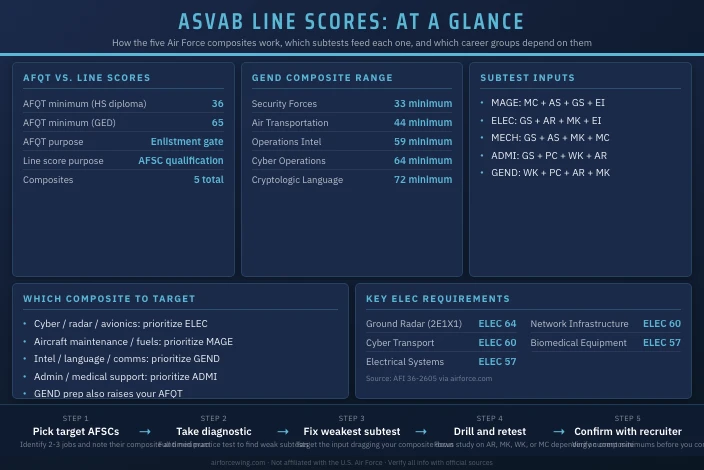
AFQT vs. Line Scores
These two scores do different things, and mixing them up wastes study time.
AFQT stands for Armed Forces Qualification Test. It is calculated from four ASVAB subtests. Arithmetic Reasoning (AR), Mathematics Knowledge (MK), Paragraph Comprehension (PC), and Word Knowledge (WK). The Air Force requires a minimum AFQT of 36 for high school diploma holders and 65 for GED holders. Passing the AFQT determines whether you can enlist. It does not determine which jobs you qualify for.
Line scores are the five composites the Air Force constructs from the full battery of subtests. Each AFSC lists a required composite and a minimum number. You need to clear both thresholds. AFQT to enlist, line score to qualify for a specific job.
Think of it this way: the AFQT is the door. Line scores are the keys to individual rooms.
The Five Air Force Composites
The Air Force uses five line score composites. Each one draws from a different set of subtests, designed to measure different clusters of ability.
| Composite | Full Name | Subtests |
|---|---|---|
| MAGE | Mechanical Aptitude | Mechanical Comprehension + Auto & Shop + General Science + Electronics |
| ELEC | Electronics | General Science + Arithmetic Reasoning + Mathematics Knowledge + Electronics |
| MECH | Mechanical | General Science + Auto & Shop + Mathematics Knowledge + Mechanical |
| ADMI | Administrative | General Science + Paragraph Comprehension + Word Knowledge + Arithmetic Reasoning |
| GEND | General | Word Knowledge + Paragraph Comprehension + Arithmetic Reasoning + Mathematics Knowledge |
Every AFSC entry requirement specifies one of these five composites and a minimum score. A job listed as ELEC 60 means you need a 60 or higher on the ELEC composite, no other composite substitutes.
MAGE: Mechanical Aptitude
MAGE draws from Mechanical Comprehension (MC), Auto & Shop Information (AS), General Science (GS), and Electronics Information (EI). It is the broadest mechanical composite, touching both hands-on technical knowledge and applied science.
Jobs that use MAGE skew toward physical systems: aircraft maintenance, fuels, munitions, and HVAC. The floor for most maintenance AFSCs sits between 38 and 47. Explosive Ordnance Disposal (3E8X1) is the outlier at MAGE 60, reflecting the technical complexity of ordnance identification and render-safe procedures.
If MAGE is your target composite, study in this order:
- Mechanical Comprehension: leverage, gears, pulleys, fluid dynamics. This subtest has the most room for improvement with focused drill.
- Auto & Shop: engine parts, tools, vehicle systems. Strong for anyone with hands-on maintenance experience.
- General Science: physics, chemistry, biology basics. Broad but learnable.
- Electronics: circuits, current, basic electrical theory.
ELEC: Electronics
ELEC measures aptitude for electronic and electrical systems. The inputs are General Science (GS), Arithmetic Reasoning (AR), Mathematics Knowledge (MK), and Electronics Information (EI).
This composite leans harder on math than MAGE does. AR and MK together make up half the composite inputs, which means solid arithmetic and algebra skills matter as much as electronics knowledge. Jobs that require ELEC tend to be more specialized and more academically demanding.
High ELEC requirements appear across multiple career groups:
| AFSC | Title | Required |
|---|---|---|
| 2E1X1 | Ground Radar Systems | ELEC 64 |
| 3D0X2 | Cyber Systems Operations | GEND 64 |
| 2E2X1 | Network Infrastructure | ELEC 60 |
| 4A2X1 | Biomedical Equipment | ELEC 57 |
| 3E0X1 | Electrical Systems | ELEC 57 |
Boosting ELEC means improving both math and electronics simultaneously. Start with Arithmetic Reasoning, it feeds into ELEC and GEND, so gains there pay off in two composites at once.
MECH: Mechanical
MECH is a close cousin of MAGE, but the subtest mix differs. It combines General Science (GS), Auto & Shop (AS), Mathematics Knowledge (MK), and Mechanical Comprehension (MC), dropping Electronics and adding Math Knowledge instead.
The MECH composite appears less frequently than MAGE in Air Force AFSC requirements, but it shows up in maintenance and engineering fields. Because MK replaces EI as an input, strong algebra skills help candidates who are mechanically inclined but weaker on electronics theory.
Study priorities for MECH are similar to MAGE, with extra attention to Mathematics Knowledge.
ADMI: Administrative
ADMI measures aptitude for clerical and administrative work. The inputs are General Science (GS), Paragraph Comprehension (PC), Word Knowledge (WK), and Arithmetic Reasoning (AR).
The General Science input might seem out of place in an administrative composite, but it reflects the Air Force’s preference for general cognitive breadth even in non-technical roles. ADMI-based jobs include personnel, education and training, services, and health services management.
| AFSC | Title | Required |
|---|---|---|
| 3F2X1 | Education and Training | ADMI 51 |
| 3F0X1 | Personnel | ADMI 44 |
| 4A0X1 | Health Services Management | ADMI 44 |
| 1A6X1 | Flight Attendant | ADMI 44 |
| 3F1X1 | Services | ADMI 36 |
Improving ADMI means focusing on vocabulary and reading comprehension. Word Knowledge and Paragraph Comprehension are both directly learnable through consistent reading and active vocabulary study.
GEND: General
GEND is the most widely used composite in the Air Force inventory. It combines Word Knowledge (WK), Paragraph Comprehension (PC), Arithmetic Reasoning (AR), and Mathematics Knowledge (MK), the same four subtests that make up the AFQT formula.
Because GEND and AFQT share the same inputs, raising your GEND score also raises your AFQT. This makes GEND prep the highest-impact study target for most candidates.
GEND requirements span dozens of AFSCs across nearly every career group:
- Security Forces (3P0X1): GEND 33
- Air Transportation (2T2X1): GEND 44
- Operations Intelligence (1N0X1): GEND 59
- Cyber Operations (1B4X1): GEND 64
- Airborne Cryptologic Language Analyst (1A8X1): GEND 72
The spread from 33 to 72 within a single composite shows how much GEND distinguishes career paths. A 39-point difference represents roughly the gap between Security Forces and one of the highest-barrier intelligence jobs in the Air Force.
How to Read an AFSC Line Score Requirement
Every AFSC profile lists one composite and one number. Here is how to interpret it:
- GEND 44: Score 44 or higher on the GEND composite.
- ELEC 60: Score 60 or higher on the ELEC composite.
- The composite tells you which subtest cluster to focus on. The number tells you the floor.
There is no partial credit between composites. An AFSC requiring ELEC 60 does not accept a MAGE 75 as a substitute. The Air Force matches the composite to the nature of the job and holds the requirement fixed.
If you score below the minimum on your target AFSC, you have two options: retake the ASVAB after a mandatory waiting period, or adjust your AFSC targets. Studying strategically to hit a specific composite is almost always faster than waiting and re-taking cold.
Which Composite Should You Target First
The answer depends on your goals, but the following logic applies to most candidates:
If you want high-tech jobs (cyber, radar, avionics, biomedical equipment): prioritize ELEC. It has the most demanding minimums and the fewest career paths that substitute another composite.
If you want maintenance or aviation support: prioritize MAGE. It covers the widest range of aircraft and systems jobs.
If you want intelligence, language, or communications: prioritize GEND. The ceiling for these AFSCs runs into the high 60s and low 70s.
If you want administrative or medical support roles: prioritize ADMI, but most ADMI jobs also benefit from GEND improvement since they share verbal subtest inputs.
The most efficient preparation strategy targets your lowest composite inputs first, not the composite with the lowest score. Look at where your individual subtest scores are dragging, and study the subtest, not the composite.
For a full list of what each Air Force AFSC requires, see ASVAB Scores for Every Air Force AFSC. You can explore all available Air Force enlisted careers to narrow down which career groups and composites matter most for your goals. The Air Force ASVAB test prep guide walks through the full study pipeline from initial diagnostic to final practice test.
You may also find How to Raise Your ASVAB Line Scores and Best ASVAB Scores for Medical AFSC Jobs helpful as you build your prep plan.