Air National Guard vs Air Force Reserve: Key Differences
Both components wear the same uniform, take the same ASVAB, and attend the same Basic Military Training at Lackland. After that, the paths split in ways most recruiters don’t explain clearly. Choosing between the Air National Guard and the Air Force Reserve isn’t just a lifestyle preference, it’s a structural decision that affects your command chain, your AFSC options, your education benefits, and when your retirement pension actually pays out.
The differences are concrete and consequential. Here’s what you need to know before you pick a component.
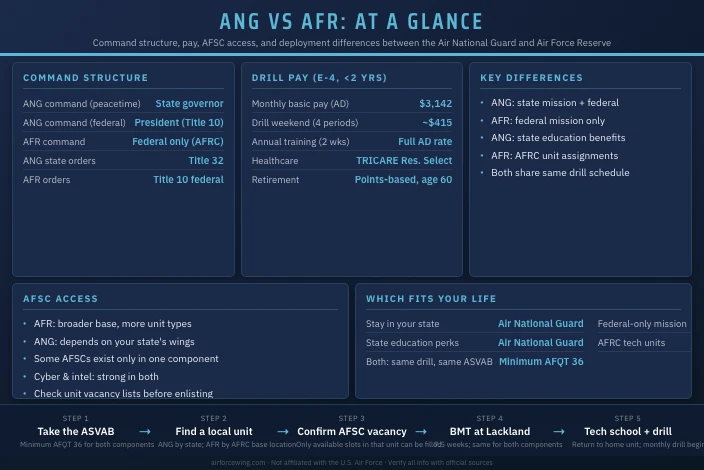
Command Structure: Federal vs Dual
The single biggest difference between the Guard and Reserve is who controls your unit.
The Air Force Reserve (AFR) is a federal-only component managed by Air Force Reserve Command (AFRC). Every mission, mobilization, and activation flows through the federal chain. There is no state layer. When you join the Reserve, you belong to a federal unit, and the only authority that can activate you is the federal government.
The Air National Guard (ANG) operates under a dual-mission structure. In peacetime, your unit answers to your state’s governor through the state adjutant general. The federal government can federalize Guard units under Title 10 orders for national missions, but Guard members can also serve on Title 32 orders, which are state-authorized but federally funded. That distinction matters for things like deployment pay treatment and certain GI Bill eligibility triggers.
Practically speaking, this means:
- Guard units can be called up for state emergencies like hurricanes, wildfires, and civil unrest, missions the Reserve has no role in
- Guard members may serve on Title 32 orders that count toward certain federal benefits but under state command
- Reserve members serve only on federal orders; there is no state-level activation
If you want to contribute to your state’s emergency response mission, the Guard is the only path. If you want a purely federal service commitment without state obligations, the Reserve fits that profile better.
AFSC Availability by Component
Neither the Guard nor the Reserve offers every career field at every location. AFSC access depends entirely on which units exist near you and what vacancies they have.
Air Force Reserve units are organized under AFRC and concentrated at specific bases across the country. Major Reserve bases include Robins AFB (GA), Wright-Patterson AFB (OH), MacDill AFB (FL), and Travis AFB (CA), among others. Reserve units tend to cluster around existing active duty installations, which means better access to technical career fields in aviation maintenance, logistics, and intelligence.
Air National Guard units exist in every state and territory, including states that have no active duty Air Force base nearby. Each state typically operates one or more wings, usually fighter wings, airlift wings, refueling wings, or a mix. The ANG has historically been strong in:
- Fighter and airlift aviation
- Cyber and intelligence (several states have dedicated cyber units)
- Combat communications and civil engineering
| Career Field | AFR Availability | ANG Availability |
|---|---|---|
| Aviation maintenance | Strong (near active duty bases) | Strong (wing-based units) |
| Cyber operations | Good | Strong (dedicated cyber wings in some states) |
| Intelligence/ISR | Good | Varies by state |
| Medical | Good | Varies; smaller states may have limited openings |
| Civil engineering | Good | Good; most wings have CE squadrons |
| Special warfare support | Limited | Limited |
The only way to know what’s available in your area is to contact your state’s Air National Guard recruiting office or the nearest AFRC unit directly and ask about current vacancies. Do this before you commit to anything.
Pay and Benefits: Where They Differ
Both components use the same drill pay structure. A standard drill weekend counts as four drill periods, and pay is based on the same active duty pay tables. An E-4 with less than two years of service earns roughly $415 per drill weekend in either component, based on the 2026 military pay tables.
Benefits start to diverge in the details.
Healthcare
Both Guard and Reserve members have access to TRICARE Reserve Select, a premium-based plan. As of 2026, the monthly premium for a member-only plan is under $60; family coverage is around $230 per month. These rates are substantially lower than civilian employer plans for comparable coverage.
Neither component provides zero-cost TRICARE Prime outside of activation periods. Full TRICARE Prime kicks in only when you’re on active duty orders.
Education Benefits
This is where the Guard has a consistent structural advantage: state education benefits.
Most states offer Guard members tuition assistance or tuition waivers for in-state public universities, separate from any federal education benefit. The value varies significantly by state. Some states waive 100% of tuition at public schools. Others provide partial waivers or smaller grant programs.
Reserve members do not receive state education benefits. They access federal programs only: the federal Tuition Assistance program (up to $4,500 per year for active-service periods) and the Montgomery GI Bill. Selected Reserve (MGIB-SR).
If you plan to go to college while serving part-time, the Guard’s state tuition programs can be worth more in real dollar value than any federal benefit, depending on your state.
Retirement
Both components use the same points-based retirement system. Drill periods, annual training days, and active duty periods all earn retirement points. The pension doesn’t start paying until age 60 (or earlier if you deployed under certain Title 10 mobilization orders).
One nuance for Guard members: time spent on Title 32 orders may or may not count toward the same federal retirement thresholds depending on the specific authority. This is a technical detail worth clarifying with your unit’s force management office if you plan to maximize your retirement eligibility.
Deployment: Different Triggers, Similar Frequency
Both Guard and Reserve members can be, and have been, deployed. The frequency depends on your AFSC and your unit’s mission, not just which component you chose.
Reserve deployments happen under Title 10 orders, meaning they are always federally authorized. AFRC manages unit readiness and deployment schedules. High-demand career fields like intelligence, medical, civil engineering, and some maintenance specialties see regular mobilizations.
Guard deployments can happen under either Title 10 (federal) or Title 32 (state-authorized, federally funded) orders. Title 10 Guard deployments look essentially the same as Reserve deployments. Title 32 activations typically involve domestic missions, border operations, disaster response, or counterdrug support.
The practical risk of international deployment is comparable between the two components in most career fields. If overseas deployment is a serious concern, the answer is the same for both: ask the specific unit about their deployment history before you sign.
Switching Between Guard and Reserve
Transferring between the Guard and Reserve is possible but not automatic. It involves:
- Separation from your current unit
- Application to a new unit in the other component
- Possible re-evaluation of medical and security clearance status
- Agreement from the gaining unit that they have a vacancy
Some airmen make this move after completing an initial term in one component. The most common path is Guard-to-Reserve when a member relocates to an area without a nearby Guard unit of the right type.
Going Reserve-to-Guard works the same way in reverse. If your state’s Guard has an opening in your AFSC and your unit releases you, the transfer is straightforward administratively.
What doesn’t transfer automatically: accumulated retirement points and service credit both carry over, but any signing bonuses may have repayment clauses if you transfer before fulfilling the contract term. Read your enlistment contract carefully.
Which Component Fits Which Situation
There is no objectively better choice. The right component depends on specifics.
Choose the Air National Guard if:
- You want to stay in your home state long-term
- Your state offers meaningful tuition benefits and you plan to use them
- You want a state-level emergency response mission alongside the federal mission
- The Guard unit in your area has your target AFSC
Choose the Air Force Reserve if:
- You’re near an AFRC base with a strong technical unit in your field
- You want a purely federal service commitment with no state obligations
- Your target AFSC doesn’t exist in your state’s Guard
- You value AFRC’s organizational structure for career progression
Both paths require the same minimum AFQT score of 36 on the ASVAB, the same BMT at Lackland, and the same tech school pipeline. Neither path is faster or easier to enter than the other.
Browse Air Force careers to see which AFSCs align with your goals across all three components. The Reserve enlistment guide covers the process for joining a part-time component. The active duty vs Reserve vs Guard comparison covers the full three-way breakdown if you’re still deciding whether part-time service fits your life at all.
You may also find Air Force Reserve Benefits: What You Actually Get and Can You Be a 4N0X1 in the Air Force Reserve helpful as you narrow down your options.
This site is not affiliated with the U.S. Air Force or any government agency. Verify all information with official Air Force sources before making enlistment or career decisions.