Air Force Weather AFSC: Career and Civilian Outlook
Before a pilot takes off, a 1W0X1 Weather specialist has already analyzed the atmosphere over the entire route. They briefed the crew, flagged any icing layers, and issued a forecast that will follow the mission until wheels-down. Get it right and no one notices. Get it wrong and the mission gets scrubbed, diverted, or worse. That’s the weight this AFSC carries every single day.
This site is not affiliated with the U.S. Air Force or any government agency. Verify all information with official Air Force sources before making enlistment or career decisions.
What the Job Actually Looks Like
Air Force Weather specialists (1W0X1) work in base weather stations, deployed field teams, and alongside Army ground units. They collect atmospheric data, interpret radar and satellite imagery, and produce forecasts that mission planners act on directly.
A typical duty day on a flying base runs something like this:
- Pull overnight observations from surface sensors and upper-air soundings
- Analyze current satellite loops and radar composites
- Prepare a terminal aerodrome forecast (TAF) for the airfield
- Brief the flying squadron’s mission planning cell before sorties launch
- Monitor conditions throughout the flying window and issue updates
- Issue severe weather watches or warnings if conditions deteriorate
The pace depends entirely on the flying schedule. During a quiet training day, the weather flight operates at a steady analytical tempo. During a large exercise or real-world contingency with multiple sorties running, that same flight may run near-continuous for days.
Shift work is the constant. Weather flights cover 24 hours a day, which means rotating days, evenings, and nights throughout a career. It’s worth factoring that into any decision to pursue this AFSC.
When the Job Goes Downrange
Some 1W0X1 billets are considerably more intense than a base weather station. Air Force Weather Airmen deploy directly with Army Ranger battalions, Special Forces groups, and other ground combat elements. They provide real-time atmospheric data at the point of need, often from a forward operating base or in the field with minimal equipment.
Those assignments require the same technical output under much harder conditions. The Space Environmental Applications track (SEI 274) and Joint Terminal Attack Controller support track (SEI 040) represent the far end of the operational spectrum for this career field.
ASVAB Line Scores Required
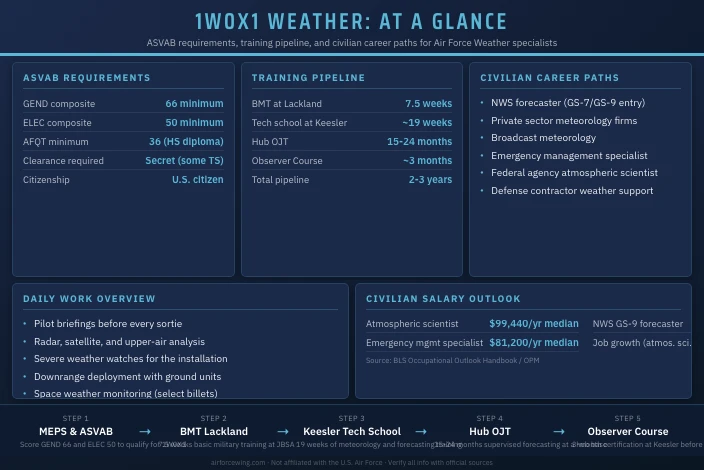
The 1W0X1 AFSC has a dual composite requirement: a minimum GEND 66 and a minimum ELEC 50. Both must be met. Falling short on either one disqualifies the application regardless of how strong the other score is.
| Composite | Minimum | Subtests Included |
|---|---|---|
| GEND | 66 | Word Knowledge, Paragraph Comprehension, Arithmetic Reasoning, Mathematics Knowledge |
| ELEC | 50 | General Science, Arithmetic Reasoning, Mathematics Knowledge, Electronics Information |
The GEND floor of 66 is among the higher thresholds in the enlisted operations career group. The dual requirement reflects what the job actually demands: clear written and verbal communication for pilot briefings, combined with quantitative and scientific reasoning for forecast analysis.
If your GEND score is below 66, focus test prep on verbal and math subtests. If ELEC is the gap, Electronics Information and General Science are where to put the time. Air Force ASVAB test prep covers both composites with practice structured around the Air Force’s specific thresholds.
Training Pipeline
Every Weather Airman starts at the same place as every other enlisted recruit. The path from enlistment to a permanent duty station is longer than most enlisted AFSCs.
The full pipeline from BMT to first permanent duty station typically runs two to three years. That’s a long time to be in transit, and it involves multiple moves. Families who start this process expecting early stability will find it frustrating. Families who plan for flexibility tend to handle it better.
Deployment and Duty Stations
Deployment tempo for 1W0X1 varies sharply by assignment type.
Standard base weather flights see sporadic short deployments, typically 90 to 180 days, supporting air operations at deployed locations in the Central or Indo-Pacific Commands. Airmen assigned to Army or special operations weather support billets see considerably higher frequency, sometimes six to nine months per year downrange.
Overseas PCS assignments are common in this career field. Weather flights exist at Yokota AB (Japan), Ramstein AB (Germany), Kadena AB (Japan), and Joint Base Pearl Harbor-Hickam (Hawaii). For many Weather Airmen, overseas tours are some of the most professionally and personally valuable of their career.
After completing the OJT and Observer Course phases, assignment preferences are factored in through the Air Force’s personnel assignment system. Popular permanent duty stations include:
- Barksdale AFB, Louisiana
- Shaw AFB, South Carolina
- Davis-Monthan AFB, Arizona
- Scott AFB, Illinois
- Joint Base Elmendorf-Richardson, Alaska
Pay at Each Rank
Weather Airmen earn the same base pay as all enlisted Airmen at equivalent grade and years of service. The figures below reflect 2026 DFAS rates.
| Grade | Title | Base Pay (under 2 yrs) |
|---|---|---|
| E-1 | Airman Basic | $2,407/mo |
| E-2 | Airman | $2,698/mo |
| E-3 | Airman First Class | $2,837/mo |
| E-4 | Senior Airman | $3,142/mo |
| E-5 | Staff Sergeant | $3,343/mo |
| E-6 | Technical Sergeant | $3,401/mo |
Pay climbs with time in service. An E-5 with six years earns $4,109/mo in base pay. Add Basic Allowance for Subsistence (BAS) of $476.95/mo plus Basic Allowance for Housing (BAH) that varies by duty location and dependent status, at JBSA-Lackland, an E-4 without dependents receives $1,359/mo in BAH.
Most Weather Airmen reach Senior Airman (E-4) around the two-year mark and Staff Sergeant (E-5) within their first four to six years, assuming solid performance and WAPS scores.
Civilian Career Options After Service
Military meteorological training translates directly into civilian atmospheric science careers. Weather Airmen leave service with verified hands-on experience: sensor operations, radar and satellite analysis, written forecast production, and non-technical briefings for commanders. That experience maps onto several stable civilian fields.
| Civilian Role | Median Annual Salary | Notes |
|---|---|---|
| Atmospheric Scientist / Meteorologist | $99,440/yr | NWS, private firms, research agencies |
| Federal Meteorologist (GS-9+) | $65,000-$100,000+ | NOAA, Air Force Civilian, federal agencies |
| Emergency Management Specialist | $81,200/yr | State and federal emergency management |
| Weather Observer | $51,680/yr | NWS observation stations |
| Environmental Science Technician | $50,700/yr | Federal and private sector |
Salary data from the BLS Occupational Outlook Handbook and OPM pay tables. National medians; figures vary by location.
The BLS projects about 6% job growth for atmospheric scientists through 2033. That’s modest but consistent, driven by demand for weather data in agriculture, energy, transportation, and defense.
The Federal Hiring Advantage
NOAA’s National Weather Service hires directly from the military weather community. GS-7 and GS-9 entry-level forecaster positions are the most common entry point for transitioning 1W0X1 Airmen, and military experience substitutes for college degree requirements in some cases. Airmen who hold an active Secret clearance at separation move through the federal hiring process faster than uncleared applicants.
The Air Force Civilian Service also hires former Weather Airmen to support contracted weather operations at installations where civilian employees manage parts of the weather mission.
Private Sector and Broadcast
Several private weather companies, including firms that serve aviation, agriculture, and energy sectors, recruit veterans with military forecasting backgrounds. Broadcast meteorology is another path, though it typically requires additional coursework or an AMS certification to work on air.
The American Meteorological Society (AMS) and the National Weather Association both have veteran outreach programs and certification pathways that give military training formal civilian credentials.
Reserve and Air National Guard
The 1W0X1 career field exists in all three components. The Air National Guard has a strong presence in weather, with several states maintaining Weather flights that support both state emergency management and federal deployments.
A Reserve or Guard Weather Airman works roughly 39 days per year under the standard commitment: one drill weekend per month (four Unit Training Assemblies) plus two weeks of Annual Training. Some weather units require additional training days for certification maintenance.
The Guard weather mission pairs well with civilian careers in meteorology. Several Guard Weather Airmen work simultaneously as NWS forecasters, broadcast meteorologists, or private sector analysts. The dual career approach is realistic in this AFSC in a way it isn’t in some others.
Who Thrives in 1W0X1
This AFSC rewards people who genuinely like science, not just people who score well in it. Forecasters who stay sharp on atmospheric dynamics, who ask why a system behaved differently than expected, and who push to improve their analysis tend to build reputations that follow them through the career field.
Strong communication matters just as much. A technically accurate forecast that a pilot can’t act on quickly fails the mission. Briefing skills and written clarity are evaluated throughout the career, starting at tech school.
The people who struggle tend to fall into a few categories: those who can’t adapt to irregular shift schedules, those who find the long initial pipeline demoralizing, and those who want a physically active job. The day-to-day work is cognitively demanding, not physically taxing. The exception is the special operations weather track, which requires a physically demanding separate selection pipeline.
Is the Clearance a Factor?
All 1W0X1 Airmen require at least a Secret security clearance. Assignments supporting space weather operations, national intelligence collection, or special operations forces require a Top Secret or TS/SCI clearance.
Secret adjudication typically takes three to six months. TS processing runs longer, often considerably so, depending on the complexity of the background investigation. Clearance eligibility is assessed after enlistment, not before. Airmen who cannot clear at the Secret level cannot complete tech school qualification. Anyone with significant financial issues, foreign contacts, or a criminal history should address those proactively with a recruiter before signing.
The civilian value of an active TS clearance is real. Federal contractors that support defense weather programs specifically recruit cleared veterans, and the clearance shortens the federal hiring timeline for NWS and NOAA positions.
Explore the full Air Force operations career group for related AFSC profiles. Air Force operations AFSC jobs covers all five career fields in the 1C and 1W group. You may also find Air Force ASVAB test prep helpful if the GEND 66 or ELEC 50 minimums are your next hurdle.