Air Force vs Civilian Tech Salary After Service
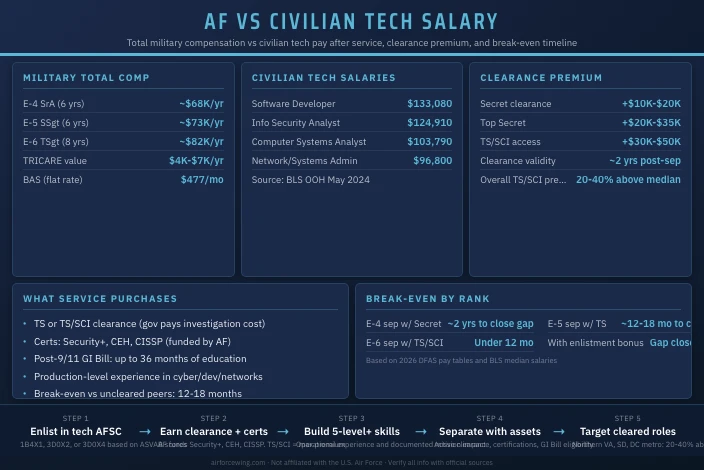
A Senior Airman doing cyber systems work earns $3,659 per month in base pay. On paper, that looks like poverty wages compared to a $100,000 civilian IT salary. But that comparison is wrong, and the people making it are leaving out roughly $24,000 in annual tax-free allowances, zero-premium healthcare, and a clearance that commands a 20 to 40 percent salary premium the day you walk out the door. Run the full numbers and the military side of the ledger looks very different.
This post does the math. It compares total military compensation for tech Airmen at the E-4 through E-6 ranks against civilian salary ranges for the same skill sets, covers the clearance premium, and maps out how long it actually takes before a civilian tech career pulls ahead financially.
What Military Tech Pay Actually Looks Like
Base pay is the number people quote when comparing military to civilian salaries. It’s the wrong number to use.
Active-duty Airmen receive three core compensation streams: base pay, Basic Allowance for Housing (BAH), and Basic Allowance for Subsistence (BAS). BAH and BAS are tax-free. That tax advantage adds real purchasing power that doesn’t show up in a base-pay comparison.
Here’s what a tech Airman actually takes home at each rank, using 2026 DFAS figures and Joint Base San Antonio BAH rates as a representative baseline:
| Rank | Grade | Base Pay (6 yrs) | BAH (single) | BAS | Monthly Total | Annual Total |
|---|---|---|---|---|---|---|
| Senior Airman | E-4 | $3,816 | $1,359 | $477 | $5,652 | $67,824 |
| Staff Sergeant | E-5 | $4,109 | $1,500 | $477 | $6,086 | $73,032 |
| Technical Sergeant | E-6 | $4,613 | ~$1,700 | $477 | $6,790 | $81,480 |
BAH figures are from DFAS 2026 tables for Joint Base San Antonio without dependents. BAH at higher cost-of-living installations like the DC metro area or California runs significantly higher, often $1,800 to $2,400 for the same grades.
That total doesn’t include everything. Stack on top of it:
- TRICARE Prime at zero cost on active duty (no enrollment fee, no deductibles, no copays). A comparable civilian health plan costs $4,000 to $7,000 per year in premiums alone, before any deductibles.
- Tuition Assistance, up to $4,500 per year, available while you’re still serving.
- TSP government contributions, starting at 1% automatic after 60 days plus matching up to 4% of base pay under the Blended Retirement System.
- 30 days paid leave per year, worth roughly $4,000 to $6,000 in equivalent civilian time-off value depending on your pay grade.
A Staff Sergeant doing cyber systems work, including TRICARE value, TSP matching, and leave, has total compensation closer to $85,000 to $90,000 annually. That’s before considering the education benefits that start accruing during service and fully activate at separation.
Civilian Tech Salaries for the Same Skill Sets
When Air Force tech Airmen separate, they compete for four main job categories. The salary data below comes from the Bureau of Labor Statistics Occupational Outlook Handbook, May 2024.
| Civilian Role | Median Annual Salary | Job Growth (2024-2034) |
|---|---|---|
| Information Security Analyst | $124,910 | +29% |
| Software Developer | $133,080 | +15% |
| Computer Systems Analyst | $103,790 | +9% |
| Network/Systems Administrator | $96,800 | -4% (but ~14,300 openings/year) |
These are national medians. The actual salary a separating Airman lands depends heavily on two factors: location and clearance status.
Tech salaries in major metro markets run 20 to 40 percent above national medians. A cybersecurity analyst earning the $124,910 median nationally can expect $145,000 to $165,000 in the DC metro area, Northern Virginia, or the San Francisco Bay area. Those three markets also happen to employ the highest concentration of cleared government contractors in the country.
The Clearance Premium
This is the variable that changes everything.
A TS/SCI clearance takes the government an average of three to six months to process and costs the government several thousand dollars to complete. Employers who need cleared personnel must either wait for that investigation to complete or hire someone who already holds it. That scarcity drives up salaries.
Cleared cybersecurity and IT professionals consistently earn 20 to 40 percent more than their uncleared counterparts in the same roles. On a $124,910 median, that premium translates to roughly $25,000 to $50,000 in additional annual salary. A 1B4X1 Cyber Warfare Operator with a TS/SCI clearance and four to six years of operational experience can realistically target $150,000 to $180,000 at a defense contractor in the first year after separation.
The clearance premium applies at every level, not just the most specialized roles:
- Secret clearance (3D0X4 Computer Systems Programmers, 3D0X2 Cyber Systems Operations) typically adds $10,000 to $20,000 above uncleared equivalents
- Top Secret clearance adds $20,000 to $35,000 in most tech markets
- TS/SCI access adds $30,000 to $50,000, particularly in defense, intelligence, and federal IT sectors
The clearance doesn’t depreciate immediately after separation. As long as there’s been no significant break in classified access, a recently separated Airman maintains their clearance for roughly two years. Most contractors bring cleared separatees on before that window closes, which preserves the premium.
The Break-Even Timeline
Here’s the honest version of this comparison.
During a first enlistment, military total compensation for a tech Airman lands between $67,000 and $82,000 annually depending on rank and location. That’s below the civilian median for most of the equivalent roles. The gap at E-4 against an uncleared civilian information security analyst is real: roughly $45,000 to $55,000 per year in direct comparison.
But that comparison ignores what the military period actually purchases:
- A TS or TS/SCI clearance that takes years and tens of thousands of dollars to obtain independently
- Industry certifications (CompTIA Security+, CEH, CISSP in some cases) that cost $1,000 to $5,000 each and the Air Force pays for
- Production-level technical experience with systems most civilian entry-level candidates don’t touch until year three or four of their career
- A Post-9/11 GI Bill covering up to 36 months of education after separation, worth $50,000 to $100,000+ depending on the school
A realistic break-even analysis looks like this. An Airman separates after four years at E-4/E-5, having earned roughly $72,000 in total compensation annually. They take a cleared cybersecurity analyst role at $135,000. Within 12 to 18 months, they’ve fully recovered the income gap from the lower military pay years, assuming no enlistment or reenlistment bonuses were paid. If bonuses were part of the picture, the break-even shortens further.
The Airmen who come out ahead financially are the ones who separate with:
- An active clearance at the highest level they earned
- At least one DoD-recognized certification already held
- A concrete technical specialty, offensive cyber, network defense, or software development, that maps to a specific civilian job title
Vague “I worked in IT” is worth much less than “I held a TS/SCI clearance, completed the Intermediate Network Warfare Training course, and worked on Cyber Mission Force teams at 16th Air Force.”
What E-4 Through E-6 Tech Airmen Should Track
The gap in total compensation isn’t equal across ranks. It narrows significantly as you move from E-4 to E-6, and the clearance premium compounds on top of a rising civilian salary floor.
At E-4 (Senior Airman): The salary gap is widest. Total military compensation runs approximately $67,000 to $70,000. Entry-level civilian tech roles without a clearance start around $65,000 to $75,000. A Secret clearance bumps that to $80,000 to $90,000. The military period is essentially break-even in dollars but purchases credentials and clearance, which is a good deal.
At E-5 (Staff Sergeant): Military total compensation climbs to roughly $73,000 to $80,000 in most markets. An E-5 with six years of technical experience in a cyber AFSC holds a 5-level qualification, is likely working toward or already holds a 7-level, and has completed real operational cycles. That maps to mid-level civilian roles paying $95,000 to $125,000 with a clearance. The gap exists but is smaller than the base pay comparison suggests.
At E-6 (Technical Sergeant): At eight to twelve years of service, base pay ranges from $4,613 to $5,044 per month. Total compensation with BAH and BAS lands around $82,000 to $88,000 in a mid-cost installation. A TSgt with a TS/SCI clearance and operational cyber experience targets senior analyst or team lead roles starting at $130,000 to $160,000. This is where the break-even timeline compresses to under a year.
The pattern is clear. The longer you serve in a tech AFSC, the more credentials and clearance depth you accumulate, and the faster the income gap closes after separation.
Where the Math Gets Complicated
Not every separating tech Airman lands in the same position.
Location matters more than most people account for. A cybersecurity analyst in a small CONUS market with limited defense contracting presence may earn $85,000 to $95,000, which closes much more slowly against the military compensation picture than the same role in Northern Virginia or San Diego. Cleared tech jobs are geographically concentrated, and some Airmen separate into markets where the clearance premium is nearly zero because demand is low.
Timing within a career also affects the calculation. An Airman who separates at exactly four years, before completing a 5-level qualification and without a TS/SCI, leaves with less negotiating power than one who extends to six years, completes the upgrade, and picks up advanced certifications the Air Force paid for.
The GI Bill is a real variable too. An Airman who uses the Post-9/11 GI Bill to complete a bachelor’s or master’s degree in computer science or cybersecurity after separation enters the civilian market at a higher pay band than one who goes directly to work. The 36 months of benefits, covering full in-state tuition at public schools, is worth taking seriously before choosing the fastest exit from service.
This site is not affiliated with the U.S. Air Force or any government agency. Verify all information with official Air Force sources before making enlistment or career decisions.
The Air Force STEM jobs and civilian tech careers pillar covers which specific AFSCs produce the strongest civilian outcomes. For a detailed look at which certifications each AFSC earns and what they pay civilian-side, see Air Force cyber certifications. If you’re choosing a career field, Air Force cyber careers has profiles on every enlisted cyber AFSC, and the ASVAB study guide covers the line scores you need to qualify.