Air Force vs Civilian Pay: The Real Comparison
A new Senior Airman earns around $3,142 per month in base pay. That looks modest against a $50,000 civilian salary, until you add tax-free housing, free healthcare, and a government-matched retirement account. The comparison shifts significantly once you count everything.
This post runs the full numbers side by side so you can see where the Air Force wins, where it doesn’t, and what actually matters for your decision.
What “Pay” Means in the Military
Civilian compensation is usually one number: your salary or hourly rate. Military compensation has three main layers, and the first layer is the only one that gets quoted in recruiting conversations.
Basic pay is the taxable base. It’s set by Congress and applies across all military branches. The 2026 pay table reflects a 3.8% raise effective January 1, 2026. Entry-level enlisted members start here:
| Rank | Grade | Monthly Basic Pay |
|---|---|---|
| Airman Basic (AB) | E-1 | $2,407 |
| Airman (Amn) | E-2 | $2,698 |
| Airman First Class (A1C) | E-3 | $2,837 |
| Senior Airman (SrA) | E-4 | $3,142 |
| Staff Sergeant (SSgt) | E-5 | $3,343 |
Basic Allowance for Subsistence (BAS) is a flat monthly payment toward food. Enlisted members get $476.95/month. It’s the same amount regardless of where you’re stationed or how many people are in your household. It’s not taxed.
Basic Allowance for Housing (BAH) is where the comparison with civilian pay starts to shift. If you live off base, the Air Force pays your rent, or most of it. The exact amount depends on your rank, your duty station, and whether you have dependents. At Joint Base San Antonio, an E-4 without dependents gets $1,359/month, and an E-4 with dependents gets $1,728/month. Neither amount is taxable income.
The total for an entry-level E-4 with dependents at JBSA: $3,142 + $477 + $1,728 = $5,347/month before any other benefits. That’s closer to $64,000 annually in compensation, and a significant portion of it is tax-free.
The Real Civilian Equivalent
Most salary comparisons fail because they line up military basic pay against a civilian salary without adjusting for the tax advantage or the benefits that civilians pay for out of pocket.
To compare fairly, you need to account for three things civilians typically pay for themselves:
- Health insurance: A family plan through an employer runs $600 to $1,000/month in premiums before deductibles and copays. Active duty families on TRICARE Prime pay nothing. Zero premium, zero deductible, zero copays at military treatment facilities.
- Rent: BAH covers this entirely for most Airmen in mid-cost cities. A civilian earning $50,000 might spend $15,000 to $20,000 per year on housing out of pocket.
- Retirement contributions: Most civilian employers match 3-4% of salary in a 401(k). The Air Force matches up to 5% of basic pay through the Thrift Savings Plan (TSP), including a 1% automatic contribution that requires nothing from you.
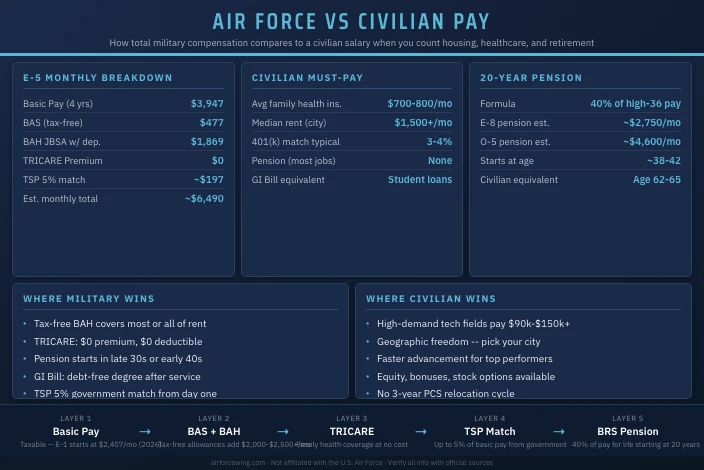
Here’s what a realistic comparison looks like for an E-5 Staff Sergeant at four years of service, stationed at JBSA with dependents:
| Component | Military Value | Civilian Must-Pay |
|---|---|---|
| Basic Pay (E-5, 4 yrs) | $3,947/mo | Salary |
| BAS | $477/mo (tax-free) | Out of pocket |
| BAH (JBSA, w/ dependents) | $1,869/mo (tax-free) | Out of pocket |
| TRICARE Prime (family) | $0/mo | ~$700-800/mo |
| TSP 5% match | ~$197/mo | Varies by employer |
| Total estimated monthly | ~$6,490 |
A civilian earning $60,000 per year ($5,000/month) who pays $800/month in health insurance premiums and $1,500/month in rent has $2,700/month left for everything else. The E-5 in this scenario takes home more actual purchasing power, despite a lower headline salary number.
Where Civilian Pay Wins
The comparison doesn’t go one way entirely. Several scenarios favor civilian compensation.
High-paying technical fields. An experienced software engineer or nurse practitioner can earn $90,000 to $150,000 or more, with benefits that still include employer health coverage. No BAH closes that gap entirely. If you have in-demand technical skills today, the ceiling in the civilian market is higher than military pay grades allow.
Geographic freedom. Military assignments are directed by the Air Force, not by your preferences. If you want to live in a specific city, accept a higher-paying job offer, or avoid relocating your family every three years, civilian employment gives you that control. The Air Force does not.
Advancement speed. In most civilian careers, strong performers can move up quickly. Military promotions above E-5 are competitive and time-gated. Making E-7 Master Sergeant typically takes 10 to 14 years of consistent performance. You can’t negotiate your way to a faster timeline.
Equity and variable compensation. Tech companies, startups, and some financial firms offer stock options, bonuses, and profit-sharing that military pay never replicates. A civilian who joined a growing company at 22 and received stock options may have assets that dwarf any military pension by their mid-30s.
Education: The Delayed Civilian Advantage
The Air Force’s education benefits change the long-term math in ways that civilian job packages rarely match.
While on active duty, Tuition Assistance (TA) covers up to $4,500 per year toward college courses ($250 per semester hour), paid directly to the school. That’s usable while you’re earning a paycheck and gaining promotable experience.
After separating, the Post-9/11 GI Bill pays full in-state tuition at public universities with no cap. At private schools, the annual cap is $29,920.95 for the 2025-2026 academic year. The GI Bill also provides a monthly housing allowance while you’re in school, based on local BAH rates.
A civilian who never serves pays full tuition out of pocket or takes on student loan debt. An Airman who serves four years and uses the GI Bill afterward can graduate from a public university debt-free, with a military job history that translates well to civilian hiring.
The benefits guide covers how to maximize both TA and the GI Bill across different career lengths.
The Retirement Difference
This is where the Air Force’s total compensation advantage is hardest to replicate in civilian employment.
Serve 20 years and receive an honorable discharge, and you qualify for a pension for life. The formula under the Blended Retirement System (BRS): 2% x years of service x your average highest 36 months of basic pay. At 20 years, that’s 40% of your high-36 average paid monthly until you die, starting in your late 30s or early 40s.
An E-8 Senior Master Sergeant retiring at 20 years earns roughly $2,700 to $2,800 per month in pension. An O-5 Lieutenant Colonel at 20 years earns around $4,600/month. These payments don’t stop. They’re not subject to market risk. They start the month after retirement.
Very few civilian employers offer defined-benefit pensions anymore. Those who receive one through a large employer typically wait until age 62 to 65 to collect. A military retiree at 40 collects for 25 to 30 additional years compared to a civilian in the same situation.
The TSP match compounds the advantage. At 5% of basic pay in total government contributions, an E-5 contributes roughly $2,400 per year in government-funded growth. Over a 20-year career with investment returns, that’s a substantial account alongside the pension.
Career Field Matters More Than Branch
The most honest answer to “Air Force vs civilian pay” is that it depends heavily on what job you’re doing.
An Air Force Cyber Warfare Operator (1B4X1) who spends four years building network defense skills, earns a security clearance, and separates at 25 can often step directly into a federal contractor or tech role paying $80,000 to $120,000. The military pay during those four years was the training ground, not the ceiling.
An Air Force Aerospace Medical Technician (4N0X1) gains clinical experience that accelerates EMT or nursing careers. The certification value combined with the GI Bill can lead to civilian salaries well above what the basic pay numbers suggest.
In contrast, someone in a highly specialized military job with no direct civilian equivalent may find the transition harder and the compensation comparison less favorable.
Browse Air Force enlisted careers to see which AFSCs build the most transferable civilian credentials alongside their military compensation.
What the Numbers Mean Together
No single comparison captures everything, but here’s a realistic snapshot across three career stages:
| Stage | Military (Enlisted) | Civilian Equivalent Needed |
|---|---|---|
| Entry level (E-4, 2 yrs) | ~$5,300/mo total comp | ~$55,000 salary + benefits |
| Mid-career (E-5, 4 yrs) | ~$6,490/mo total comp | ~$68,000 salary + benefits |
| 20-year retirement | ~$2,700-$2,800/mo pension | Private savings required |
The civilian equivalent column assumes the civilian is paying their own rent, health insurance, and saving for retirement independently. At the entry and mid-career levels, the military package competes with median civilian salaries in most U.S. markets.
What you give up is flexibility, geographic choice, and the civilian earnings ceiling in high-demand technical fields. What you gain is stability, full benefits from day one, education funding, and a retirement system that no employer-sponsored 401(k) fully replicates.
The complete Air Force pay and benefits breakdown has the full numbers across every rank. For more on what daily life actually looks like alongside this compensation, see What Air Force Life Is Really Like.
This site is not affiliated with the U.S. Air Force or any government agency. Verify all information with official Air Force sources before making enlistment or career decisions.