How Air Force Technical Training Transfers to Defense Contractor Jobs
Defense contractors don’t hire veterans out of patriotism. They hire Air Force tech veterans because they need cleared, mission-experienced people and the alternative is paying six figures to train someone from scratch. A 1B4X1 Cyber Warfare Operator with a Top Secret/SCI clearance and four years of offensive network operations is worth more to Lockheed Martin, Leidos, or Booz Allen Hamilton on day one than a new computer science graduate is worth after two years on the job. The pipeline from Air Force tech training to a contractor badge is shorter, more direct, and more lucrative than most separating Airmen realize.
Why Defense Contractors Recruit Air Force Veterans First
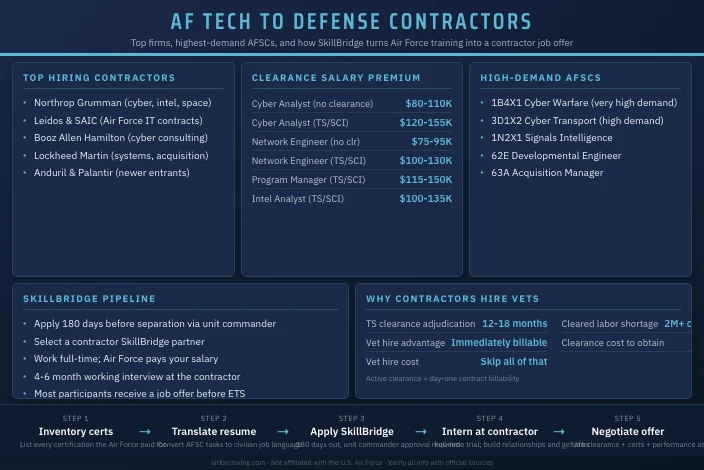
The cleared labor shortage is real. The government estimates that more than 2 million people hold active security clearances, but the demand from contractors consistently outpaces that supply. Top Secret clearances take 12-18 months and thousands of dollars to adjudicate. A contractor that hires a cleared veteran skips that entire process.
Air Force tech veterans bring three things that civilian candidates cannot easily replicate:
- Active clearance: TS or TS/SCI, already adjudicated, immediately billable on government contracts
- Mission experience: Actual operational work on real systems, not labs or simulations
- Government network fluency: Familiarity with NIPR, SIPR, and JWICS environments that contractors support under contract
Contractors who win Department of Defense and intelligence community contracts must staff them with cleared personnel. The fastest way to staff a contract is to hire veterans who already have what the contract requires.
The Eight Contractors That Recruit Most Heavily From Air Force Ranks
Not all defense contractors are the same. Some focus on hardware platforms. Others run IT services contracts. A few are newer entrants with very different cultures from the legacy primes. Knowing which firm fits your background and goals matters as much as knowing how to apply.
Lockheed Martin is the largest U.S. defense contractor by revenue. Its focus on aircraft platforms, missile systems, and C2 software means it recruits heavily from maintenance, avionics, and acquisition AFSCs. Mission systems engineers and program managers with Air Force acquisition backgrounds are a strong fit. Roles tend to be structured and process-heavy, which suits veterans accustomed to formal Air Force procedures.
Raytheon/RTX specializes in radar, missiles, and electronic warfare systems. Former 1E7X1 (ground electronics) Airmen and electronic warfare officers find natural landing spots here. RTX also runs substantial cybersecurity programs through its intelligence and space division. The company is large enough that the culture varies significantly by business unit.
Northrop Grumman is the go-to for space systems, cyber operations, and classified intelligence programs. Cyber warfare operators, signals intelligence specialists (1N2X1), and space systems operators have the closest skill match. Northrop Grumman is consistently among the top employers of cleared professionals and runs dedicated veteran hiring programs.
Booz Allen Hamilton operates differently from the hardware primes. It’s a consulting and services firm that runs IT, cybersecurity, and analytics programs for federal agencies. Air Force cyber and communications veterans fit well here. The work is contract-based, which means more variety in assignment and client than you’d find inside a single product program at a larger prime.
Leidos is one of the largest IT service providers to the federal government. It runs major Air Force IT contracts, health system modernization work, and intelligence support programs. Network engineers, systems administrators, and communications specialists from the 3DXXX/1D7XX career fields fill a significant share of Leidos’s Air Force-aligned workforce.
SAIC (Science Applications International Corporation) focuses on C4ISR, logistics modernization, and IT services. It recruits broadly from Air Force tech backgrounds and has a large veteran workforce. The company’s culture tends to be pragmatic and process-oriented, familiar to anyone who has worked inside a numbered air force.
Palantir is a newer entrant compared to the legacy primes, but it has grown rapidly inside the defense and intelligence community. Its platforms power data analytics and operational intelligence programs across multiple combatant commands. Palantir tends to recruit Air Force veterans with intelligence, cyber, and data backgrounds who can bridge the gap between its commercial software and government operational requirements.
Anduril Industries is the most distinctive firm on this list. Founded in 2017, it builds autonomous systems, sensor networks, and counter-drone technology. Anduril actively recruits Air Force veterans with operational backgrounds, specifically because it needs people who understand the mission environment its products operate in. The culture is faster-moving and less bureaucratic than legacy primes. Veterans who found Air Force bureaucracy frustrating often find Anduril’s pace a better fit.
Which AFSCs Contractors Recruit Hardest For
Not every technical AFSC carries equal weight in the contractor market. The ones that translate most directly are the ones built on skills the contractor needs to staff government contracts.
| AFSC | Contractor Demand | Primary Contractor Fit |
|---|---|---|
| 1B4X1 Cyber Warfare Operations | Very high | Northrop Grumman, Booz Allen, Palantir |
| 3D1X2 Cyber Transport Systems | High | Leidos, SAIC, Booz Allen |
| 1N0X1 All-Source Intelligence | High | Northrop Grumman, Leidos, Palantir |
| 1N2X1 Signals Intelligence | Very high | NSA mission primes, Northrop Grumman |
| 14N Intelligence Officer | Very high | All intelligence-focused primes |
| 62E Developmental Engineer | High | Lockheed Martin, RTX, Northrop Grumman |
| 63A Acquisition Manager | Moderate | All major primes, program management roles |
The clearance matters more than the job title. A 3D1X2 Airman with a TS/SCI and four years of network engineering experience will outcompete an uncleared civilian network engineer with a bachelor’s degree at most contractor firms running government IT contracts. If you’re still qualifying for these AFSCs, the ASVAB line score requirements for cyber and communications roles are among the highest in the enlisted force. Our ASVAB study guide for the Air Force covers what to target for the ELEC composite.
How SkillBridge Works as a Contractor Hiring Pipeline
The DoD SkillBridge program lets servicemembers work full-time for a civilian employer during the last 180 days of their service obligation. The Air Force pays the Airman’s salary. The contractor gets a free trial employee. Most SkillBridge participants receive a job offer before their separation date.
For Air Force tech veterans, the practical steps look like this:
The main limitation is that SkillBridge positions are not always available at the specific contractor or location you want. High-demand contractors like Booz Allen, Leidos, and Northrop Grumman run active SkillBridge programs with dedicated veteran coordinators. Anduril and Palantir also participate. Apply to multiple partners simultaneously to maximize placement options.
What the Interview Process Looks Like for Cleared Veterans
Cleared veteran hiring at defense contractors runs differently from a standard corporate interview process. The clearance itself eliminates one of the most common employer concerns. What the interview tests instead is technical competence, communication, and cultural fit.
A typical process for a cyber or IT role at a mid-to-large contractor includes:
- Recruiter screen: Verifies clearance level, separation timeline, and general background; usually 20-30 minutes
- Technical interview: Scenario-based questions on networking, security architecture, or operational experience depending on the role; entry to mid-level roles often use competency questions rather than whiteboard coding
- Hiring manager interview: Focuses on mission fit, team communication, and how your Air Force experience maps to the specific contract’s requirements
- References and final offer: References from supervisors who can speak to your clearance-relevant work; salary offer follows
Veterans who struggle in contractor interviews typically fail at translating Air Force experience into civilian language. “I operated under 16th Air Force and supported USCYBERCOM missions” tells a hiring manager very little. “I identified and exploited vulnerabilities in adversary network infrastructure, documented findings, and coordinated with intelligence analysts to support operational targeting” tells them exactly what they want to know.
Prepare to explain what you did, not just where you worked.
Common Roles and Titles for Air Force Tech Veterans
The job titles contractors use rarely match Air Force AFSCs directly. Knowing the civilian equivalents for your background helps you find the right postings and write a resume that gets past automated screening.
| Air Force Background | Common Contractor Titles |
|---|---|
| 1B4X1 Cyber Warfare | Penetration Tester, Red Team Analyst, Cyberspace Operations Analyst |
| 3D1X2 Cyber Transport | Network Engineer, Systems Administrator, Network Architect |
| 1N0X1 All-Source Intel | Intelligence Analyst, Threat Intelligence Analyst, All-Source Analyst |
| Space systems operator | Mission Systems Specialist, Space Operations Analyst |
| Acquisition officer (63A/62E) | Program Manager, Systems Engineer, Defense Acquisition Specialist |
| Any cleared tech veteran | Mission Systems Engineer, Senior Technical Advisor |
“Mission systems specialist” is a common catch-all title that contractors apply to cleared veterans with operational experience who don’t fit neatly into a pure technical or pure program management box. It’s worth knowing because postings with that title often have more flexibility on specific technical background than specialized engineering roles.
Salary Ranges and the Clearance Premium
Base pay figures at defense contractors vary by firm, location, and specific program. But cleared veterans consistently earn more than civilian counterparts with comparable technical skills, because the clearance itself has real cost value.
The general market data:
| Role | Typical Range (no clearance) | With TS/SCI Clearance |
|---|---|---|
| Network Engineer (3-5 yrs) | $75,000-$95,000 | $100,000-$130,000 |
| Cybersecurity Analyst | $80,000-$110,000 | $120,000-$155,000 |
| Systems Administrator | $65,000-$85,000 | $90,000-$115,000 |
| Intelligence Analyst | $70,000-$90,000 | $100,000-$135,000 |
| Program Manager (mid) | $90,000-$120,000 | $115,000-$150,000 |
These ranges reflect defense contractor positions in the DC metro area and other major military corridors. Remote cleared roles exist but are less common than on-site contract work. Positions requiring polygraph access, particularly those supporting NSA or CIA programs, carry an additional premium beyond the TS/SCI baseline.
The other significant compensation factor is benefits. Major contractors offer competitive health insurance, 401(k) matching, and paid time off that differs from the all-in military compensation structure. A $120,000 contractor salary without BAH and TRICARE translates differently than $120,000 sounds on paper. Factor in the full benefits picture before comparing offers.
Making the Transition Work
The veterans who land the best contractor roles share one habit: they start early. Six months before separation is the minimum. A year is better.
Steps that consistently improve outcomes:
- Inventory your certifications now. CompTIA Security+, CEH, CCNA, and similar credentials are worth money. List everything the Air Force paid for.
- Update your clearance paperwork accurately. Gaps or errors in your security file can delay the contractor’s ability to put you on contract. Talk to your security manager before you start applying.
- Build a civilian resume before SkillBridge. Translate every Air Force task into civilian language. The Air Force Transition Assistance Program (TAP) offers structured workshops to help with this.
- Use your network. Most defense contractor hires come through referrals from other veterans. Find alumni from your unit on LinkedIn before you post your resume publicly.
- Target firms that match your clearance level and background. A cyber operator targeting Northrop Grumman’s intelligence programs is more competitive than the same person applying broadly across every prime contractor.
The Air Force builds skills that the defense industrial base genuinely needs. The transition is work, but it’s not a long shot. Most Air Force tech veterans who approach it deliberately walk into offers.
One final note on certifications: which specific credentials you earn during service depends heavily on your AFSC and unit. Air Force Cyber Certifications: What You Earn and What They’re Worth covers that in detail, including which certs translate best to contractor hiring.
This site is not affiliated with the U.S. Air Force or any government agency. Verify all information with official Air Force sources before making enlistment or career decisions.
For the full picture on which Air Force STEM career fields pay best on both sides of the uniform, see Best Air Force STEM Jobs for Civilian Tech Careers and Air Force vs Civilian Tech Salary After Service. If you’re still building your qualifications for a technical AFSC, Air Force cyber and communications careers are a good place to start comparing options.