Air Force TBAS Test: What Rated Officers Need to Know
Most officer candidates know the AFOQT exists. Fewer understand that a second, entirely separate test stands between them and a rated aviation slot. The Test of Basic Aviation Skills (TBAS) is a computer-based assessment required for pilot and Combat Systems Officer (CSO) candidates, and your score on it directly drives the most important number in your application package. Get a weak result, and no amount of strong grades or leadership experience fully makes up for it.
Here’s what the test actually measures, how your score turns into a PCSM number, and what you can do to put yourself in a competitive position before test day.
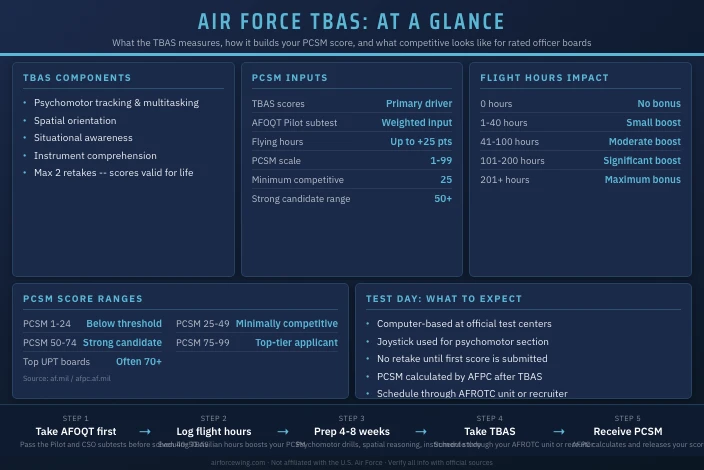
What the TBAS Actually Tests
The TBAS doesn’t measure aviation knowledge. You won’t answer questions about airspace rules, weather, or aircraft systems. It measures the underlying cognitive and psychomotor abilities that predict success in pilot training. Think of it as measuring your aptitude for flying, not your current knowledge of it.
There are four components.
Psychomotor Tracking and Multitasking
This is the heaviest-weighted section and the one that surprises most first-time test takers. You’ll use a joystick to keep a crosshair centered on a moving target while simultaneously responding to other stimuli on screen, lights, tones, or secondary tasks that demand divided attention.
The task is deceptively hard. Keeping a target centered while processing other information simultaneously is exactly what cockpit work demands. Your tracking accuracy, reaction time, and ability to hold performance on both tasks at once all feed into this score.
Spatial Orientation
Spatial orientation tests your ability to mentally rotate objects and understand position relative to a reference frame. Aircraft attitude problems appear frequently: given a horizon indicator showing a specific bank angle and pitch, you identify the aircraft’s orientation. Strong spatial reasoning is measurable and trainable, it’s not a fixed talent you either have or don’t.
Situational Awareness
This component measures how quickly you process multiple data streams and spot what needs immediate attention. You’re given a visual scene with several changing elements and must identify anomalies or answer questions about dynamic information. Pattern recognition under time pressure is the core skill. The scene changes; you have limited time to process it.
Instrument Comprehension
You’ll see cockpit instrument displays and identify the aircraft’s attitude from them. Bank angle, pitch, and heading indicators appear in various combinations. Candidates with any flight experience or time spent studying basic instrument displays have a measurable edge here. You don’t need to have flown an aircraft, you need to be able to read what the instruments show.
How PCSM Works
Your PCSM (Pilot Candidate Selection Method) score is the number selection boards actually use. It’s a composite on a scale of 1 to 99, calculated by the Air Force Personnel Center (AFPC) after you’ve completed the TBAS. You don’t receive a PCSM on test day.
Three inputs feed into it:
| Input | Role in PCSM |
|---|---|
| TBAS scores | Primary driver |
| AFOQT Pilot subtest | Weighted input |
| Flight hours | Documented civilian flying time, up to a significant bonus |
AFPC runs these through a statistical formula. The exact weighting formula isn’t published, but TBAS performance carries the most influence. A candidate with a middling AFOQT Pilot score can recover some ground with a strong TBAS showing. The reverse is also true. What you can’t do is skip the TBAS and expect your other scores to carry you.
PCSM Score Ranges and What They Mean
Selection board competitiveness shifts year to year based on how many rated training slots the Air Force funds. These ranges reflect general standing:
| PCSM Range | Competitive Standing |
|---|---|
| 1-24 | Below the threshold for most boards |
| 25-49 | Minimally competitive; everything else in your package needs to be exceptional |
| 50-74 | Strong candidate range |
| 75-99 | Top-tier applicant pool |
A PCSM of 25 is the minimum competitive score. It gets your package reviewed, not selected. Most Undergraduate Pilot Training (UPT) boards are pulling from the 50+ range. When board competition is high, top candidates frequently land in the 70s.
CSO boards typically set a lower competitive bar than pilot boards. Still, a higher PCSM distinguishes your package even for CSO slots.
Flight Hours: The Lever Most Candidates Underestimate
Flight hours are the only input to your PCSM score that you can directly control after taking the TBAS. Documented civilian flight time adds bonus points on a sliding scale:
- 0 hours: no bonus
- 1 to 40 hours: small but real gain
- 41 to 100 hours: moderate boost
- 101 to 200 hours: significant increase
- 201 or more hours: maximum bonus, up to roughly 25 additional PCSM points
A candidate sitting at a PCSM of 45 with no flight hours could move into the 60s with 200 hours of civilian flying. That’s the difference between a marginal application and a genuinely competitive one.
Getting flight time costs money. A private pilot certificate runs several thousand dollars and requires a minimum of 40 flight hours. But many candidates work toward a private certificate specifically to strengthen their PCSM before a board. The math often works in your favor: a few thousand dollars in flight training can be the difference between a commission and another board cycle.
If a full certificate isn’t feasible, even 20 to 40 hours of introductory lessons logs documented time that improves your score. You don’t need the certificate, you need the logged hours.
Retake Rules
You can take the TBAS a maximum of three times total: your initial attempt plus two retakes. Scores are valid for life once earned, so there’s no expiration pressure. However, you can’t retake the TBAS simply to try for a better score until after your first result has been submitted and processed.
The two-retake ceiling matters for strategy. If you’re considering a retake, you want to prepare differently rather than repeat the same approach. The psychomotor component in particular responds to targeted practice, going back in cold without any change in preparation rarely improves your score.
Think carefully before burning a retake. If you haven’t done any joystick training, spatial reasoning work, or instrument study between attempts, expect similar results.
When You Take the TBAS
The TBAS is administered at official test centers. Active-duty officer candidates schedule through their commissioning source (AFROTC unit, USAFA, or OTS pipeline). Civilian officer candidates working through a recruiter coordinate through the recruiter’s office.
The sequence matters. You must complete the AFOQT before scheduling the TBAS: specifically, you need to pass the Pilot and CSO subtests. AFPC won’t calculate a PCSM score without both inputs.
A typical rated officer candidate timeline:
- Complete AFOQT (Pilot and CSO subtests)
- Log as many civilian flight hours as your situation allows
- Prepare for TBAS specifically: joystick practice, spatial reasoning work, instrument comprehension study
- Take the TBAS
- Receive PCSM from AFPC and apply to rated training boards
Preparation: Where to Focus Your Time
Because the TBAS is not a knowledge test, preparation looks different than ASVAB or AFOQT study.
For the psychomotor section: Time on a flight simulator, even consumer software like Microsoft Flight Simulator or X-Plane, builds the stick control habits this component measures. An hour of practice daily for four to six weeks creates real improvement. Dual-task exercises also help: try keeping a target centered on screen while counting numbers read aloud from another source.
For spatial orientation: Work through mental rotation problems daily. Free apps and aviation test-prep workbooks both include these. The specific format to target is identifying whether a 3D object matches a reference view after rotation, exactly the cognitive pattern the TBAS uses.
For instrument comprehension: Learn to read the six basic flight instruments, starting with the attitude indicator. You can find free online resources showing instrument display formats. Spend time with them until reading bank angle and pitch from a given display is instant, not effortful.
Disclaimer: This site is not affiliated with the U.S. Air Force or any government agency. Verify all information with official Air Force sources before making enlistment or career decisions.
A full preparation framework, including section-by-section drills and a structured study timeline, is available in the TBAS study guide.
Browse Air Force officer careers to see which rated and non-rated fields your scores open up. You may also find Air Force aviation jobs and TBAS vs ASVAB: what Air Force officers need helpful for understanding how the TBAS fits into the broader rated officer application process.