Best Air Force STEM Jobs for Civilian Tech Careers
The Air Force will pay you to learn one of the most in-demand technical skill sets in the country. Four-year enlistment. Free certifications. Security clearance on the government’s dime. When you separate, you walk into a civilian job market that is actively short on people with your exact background.
That’s the pitch. But not all STEM jobs are equal. Some AFSCs produce genuinely marketable credentials after four years. Others leave you with operational experience that doesn’t survive contact with a civilian hiring manager. This post breaks down the four tech career fields with the strongest post-service value: Cyber/IT, Communications/Networking, Engineering (officer), and Space/Satellite. For each one, you’ll find specific AFSCs, the certifications you earn during service, and what those skills are worth on the civilian market.
Cyber and IT: The Highest Civilian Ceiling
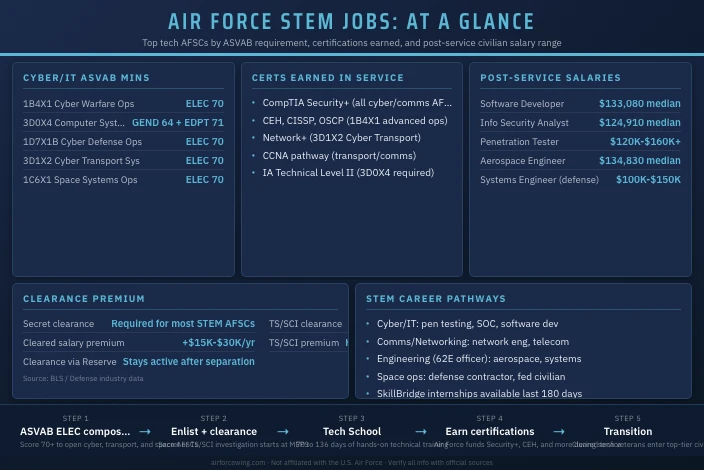
The Air Force cyber career group trains people to defend, operate, and attack digital systems at the national security level. The civilian job market for these skills is wide open. Information security analysts earn a median of $124,910 per year, with 29% projected job growth through 2034. The clearance makes that number go higher.
Three AFSCs define this category.
1B4X1 Cyber Warfare Operations is the offensive end. These Airmen operate under the 16th Air Force against adversary networks. The ASVAB bar is steep: ELEC 70, one of the highest requirements in the enlisted force. The training pipeline runs about six months at Keesler AFB. During service, the Air Force funds certifications including CompTIA Security+, CEH (Certified Ethical Hacker), and for some operators, CISSP and OSCP. The clearance is Top Secret/SCI. On separation, penetration testers and threat intelligence analysts with that background earn $120,000 to $160,000+ in most markets. Enlistment bonuses for 1B4X1 have reached $50,000 and reenlistment bonuses have hit six figures, which reflects exactly how much the private sector wants these people.
3D0X4 Computer Systems Programming is the development track. Programmers write and maintain software for Air Force mission systems. The ASVAB requirement is GEND 64, plus a passing score on the Air Force Electronic Data Processing Test (EDPT), which filters specifically for programming aptitude. Tech School is 70 days at Keesler. The Air Force requires IA Technical Level II certification for award and retention of this AFSC, typically CompTIA Security+, which it funds. Software developers earned a median of $133,080 in May 2024, with a 15% growth projection. Some 3D0X4 assignments offer exposure to cloud certifications like AWS or Azure. The Secret clearance and production coding experience together make this one of the cleanest direct transitions to civilian software development available to an enlisted Airman.
1D7X1B Cyber Defense Operations covers the network defense side: intrusion detection, incident response, security monitoring. Operators train to DoD Directive 8570 compliance standards, which means CompTIA Security+ plus higher-level certifications depending on assignment. Defense contractors and financial institutions recruit directly from this population.
| AFSC | ASVAB Minimum | Key Certifications | Civilian Role |
|---|---|---|---|
| 1B4X1 Cyber Warfare Operations | ELEC 70 | Security+, CEH, CISSP, OSCP | Penetration Tester, Threat Intel Analyst |
| 3D0X4 Computer Systems Programming | GEND 64 + EDPT 71 | Security+ (IA Tech Level II) | Software Developer, Systems Analyst |
| 1D7X1B Cyber Defense Operations | ELEC 70 | Security+, CySA+, CEH | SOC Analyst, Cybersecurity Engineer |
Explore the full picture at the Air Force cyber career hub.
Communications and Networking: Enterprise Skills, Civilian-Ready Credentials
The communications career group builds the infrastructure that makes cyber operations possible. 3D1X2 Cyber Transport Systems specialists install, configure, and maintain the enterprise networking infrastructure that connects Air Force installations globally. Voice. Data. Video. Classified circuits across continents. If a communications node goes down, these Airmen fix it.
The ASVAB requirement matches cyber: ELEC 70, with a Top Secret/SCI clearance. The training pipeline runs 136 days at Keesler AFB. That length is deliberate. The curriculum covers enterprise routing and switching, fiber optic systems, WAN architecture, and RF transmission. The equipment is production-grade: Cisco and Juniper routers, DWDM fiber systems, IP telephony platforms. Airmen leave tech school with credit toward an Electronic Systems Technology degree from the Community College of the Air Force.
The civilian translation is direct. Network engineers are in consistent demand across every industry. A cleared network engineer with enterprise-grade experience from the Air Force can expect $85,000 to $120,000 at a defense contractor, $80,000+ at a financial institution or healthcare system, or GS-9 to GS-12 federal positions in IT infrastructure. Certifications Airmen commonly pursue include CompTIA Network+, Security+, and Cisco’s CCNA.
Three communications AFSCs are worth knowing together:
- 3D1X2 Cyber Transport Systems: WAN/LAN engineering, fiber, enterprise networking (ELEC 70, TS/SCI)
- 3D1X1 Client Systems: Desktop infrastructure, account management, help desk escalation (ELEC 50, Secret)
- 3D1X3 RF Transmission Systems: Satellite uplinks, radio frequency systems, signal propagation (ELEC 60, Secret)
RF Transmission ties directly into the space and defense contractor sector, where satellite communications engineers are in high demand. Client Systems is the lower-barrier entry that still builds a clear IT support career path.
Your ASVAB score on the ELEC composite determines which of these AFSCs are available to you. The ELEC composite draws from General Science, Arithmetic Reasoning, Mathematics Knowledge, and Electronics subtests. Scores in the 60s open the mid-tier options; 70+ opens everything.
Browse the Air Force communications career hub for the full list of AFSCs in this group.
Engineering (Officer): 62E Developmental Engineer
For officers, 62E Developmental Engineer is the premier STEM career field. Where enlisted cyber Airmen operate the systems, Developmental Engineers design and acquire them. A 62E officer manages the Air Force’s weapons systems programs: fighters, satellites, directed energy weapons, command-and-control software. The work spans the full lifecycle from requirements definition to contractor evaluation to operational testing.
Commissioning requires an accredited engineering degree. AFROTC, OTS, and USAFA are the three paths. The AFOQT is the officer selection test (minimum Verbal 15, Quantitative 10), though competitive candidates score well above those floors. The 62E career field includes shredouts by engineering discipline:
- 62E1A Aeronautical: Aircraft structures, aerodynamics, propulsion
- 62E1B Astronautical: Satellites, space launch vehicles, orbital systems
- 62E1C Computer Systems: Software-intensive systems, embedded computing, cybersecurity for weapons programs
- 62E1E Electrical/Electronic: Avionics, radar, electronic warfare
The post-service picture is excellent. Aerospace engineers earn a median of $134,830 per year. Systems engineers in the defense sector run $100,000 to $150,000, more with a clearance. Engineering managers median $164,080. A 62E officer who finishes a 6-to-10 year commitment exits with program management experience, an active security clearance, and often an AFIT graduate degree funded by the Air Force. Defense contractors, NASA, and DoD civilian agencies recruit this background specifically.
Officers considering 62E who complete graduate education through the Air Force Institute of Technology (AFIT) carry an accredited graduate degree with full civilian recognition. That combination of clearance, program management depth, and graduate credentials puts 62E veterans in the top tier of the defense technology hiring market.
The Air Force acquisition career hub covers all officer career fields in this group including 62E, 63A Acquisition Manager, and 61A Operations Research Analyst.
Space and Satellite Technology: Growing Demand, Narrow Talent Pool
The space operations career field sits at the intersection of national security and commercial growth. 1C6X1 Space Systems Operations is the enlisted entry point. These Airmen operate ground systems that track satellites, detect ballistic missile launches, and execute satellite command and control. Every GPS signal, missile warning alert, and military satellite communication passes through systems that 1C6X1 operators keep running.
The ASVAB minimum is ELEC 70, same as offensive cyber and transport systems. The Top Secret clearance is required. Tech School location and length varies by mission track. The work is ops-center based, shift work, console operations, high technical vigilance. But the civilian translation is one of the most valuable in the entire enlisted force.
Here’s why: the commercial space sector is expanding faster than it can hire. SpaceX, Boeing, Northrop Grumman’s space division, and dozens of smaller launch and satellite companies are competing for people who’ve operated real space systems. Veterans who’ve run missile warning consoles or satellite C2 stations during service have direct operational experience that no civilian school can replicate.
| Civilian Role | Median Annual Salary |
|---|---|
| Aerospace Engineering Technician | $79,830 |
| Network and Computer Systems Admin | $95,360 |
| Computer Systems Analyst | $103,800 |
| Information Security Analyst | $124,910 |
Salary data from the Bureau of Labor Statistics Occupational Outlook Handbook (May 2024).
Many 1C6X1 veterans also pursue certifications like CompTIA Security+ and CISSP, which pair naturally with the security-cleared space operations background. Federal civilian positions through USAJobs are another common transition path, with space operations veterans qualifying for GS-7 through GS-11 positions depending on time in service and education level.
The most important civilian advantage in this field isn’t the technical knowledge itself. It’s the clearance combined with operational experience. Cleared space operations personnel are a narrow and sought-after talent pool. The clearance alone adds meaningful salary advantage above uncleared peers in every sector that serves the space domain.
How ASVAB Scores Determine Your STEM Options
None of these career fields are open without the right ASVAB line scores. The Air Force uses composite scores, not just the overall AFQT. For STEM AFSCs, the Electronics (ELEC) composite is the critical one. It combines four subtests: General Science, Arithmetic Reasoning, Mathematics Knowledge, and Electronics Information.
- ELEC 70: Required for 1B4X1, 3D1X2, and 1C6X1. This is a high bar. Strong math and electronics preparation is mandatory.
- ELEC 60: Opens 3D1X3 RF Transmission Systems.
- ELEC 50: Opens 3D1X1 Client Systems.
- GEND 64 + EDPT 71: Required for 3D0X4. The GEND composite is Word Knowledge, Paragraph Comprehension, Arithmetic Reasoning, and Mathematics Knowledge.
The ASVAB is the first gate for all of these fields. Scoring below the threshold for your target AFSC at MEPS means waiting for a retest or redirecting to a different career field. Preparing specifically for the ELEC and GEND composites, not just overall AFQT, gives you the most options when you sit down with a recruiter.
Security Clearance: The Hidden Asset
Every AFSC in this article requires a security clearance. Most require Secret; several require Top Secret/SCI. That clearance is not just an enlistment requirement. It’s a career asset that follows you out the door.
Defense contractors pay cleared engineers, analysts, and operators a meaningful premium above uncleared peers. The differential is real: cleared cybersecurity professionals routinely earn $15,000 to $30,000 more per year than identical uncleared candidates in comparable roles. For TS/SCI-cleared operators, the gap is higher. Maintaining Reserve or Air National Guard service after separation is one way to keep a clearance active without returning to active duty, which compounds its value indefinitely.
The clearance investigation process takes time and examines three primary areas:
- Financial history: outstanding debts, bankruptcies, and patterns of financial irresponsibility
- Foreign contacts: foreign family members, foreign travel, and foreign financial interests
- Criminal and drug record: arrests, convictions, and any drug use within the investigation window
Applicants who are clean across all three areas move through fastest. If anything in your background could complicate the process, be upfront with your recruiter before enlisting. The investigation is thorough, and omissions discovered later are treated as a more serious problem than the underlying issue.
What the Post-Service Tech Career Looks Like
Four years in a STEM AFSC doesn’t automatically translate to a six-figure salary. What it gives you is a platform: technical credentials, real production experience, an active security clearance, and a foothold in the defense technology sector.
The Airmen who convert military STEM service into strong civilian careers share a pattern. They pursue certifications during their first enlistment rather than waiting. They build network connections inside the defense contractor community before they separate. Many use SkillBridge internships during their final 180 days on active duty to gain civilian work experience while still drawing military pay. The Air Force Transition Assistance Program (TAP) is mandatory for separating Airmen and includes job search and resume resources, but the Airmen who land best use it as a starting point, not the whole plan.
The four support posts in this cluster go deeper on each piece of that picture:
- What Air Force cyber certifications are worth on the civilian market
- Air Force versus civilian tech salary comparison after service
- Space and satellite technology careers from Air Force service
- How Air Force tech training transfers to defense contractor jobs
This site is not affiliated with the U.S. Air Force or any government agency. Verify all information with official Air Force sources before making enlistment or career decisions.
Explore the Air Force cyber career group and the Air Force communications career group to compare the specific AFSCs covered in this post.