Air Force Special Warfare vs Army Special Operations
Both communities train harder than almost anyone else in the military. Both deploy frequently and operate in hostile environments where the margin for error is zero. But Air Force Special Warfare and Army Special Operations are built around fundamentally different ideas of what a special operator should be, and understanding that difference matters before you commit to either path.
This site is not affiliated with the U.S. Air Force or any government agency. Verify all information with official sources before making enlistment or career decisions.
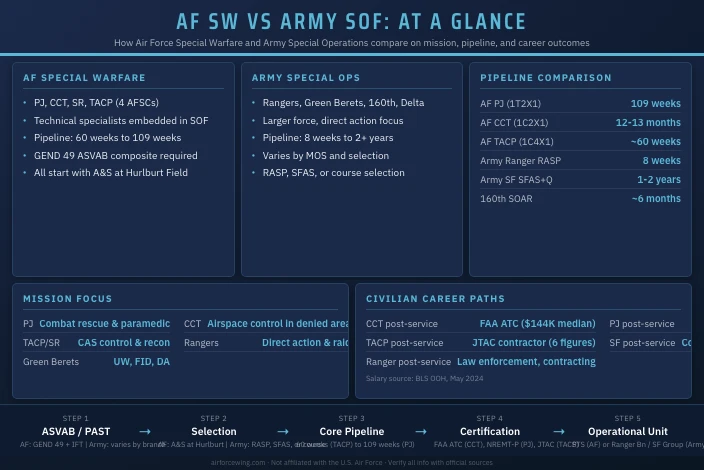
What Each Community Is Built to Do
Army Special Operations Forces (ARSOF) form the largest special operations enterprise in the U.S. military. The Rangers, Special Forces (Green Berets), 160th Special Operations Aviation Regiment, Civil Affairs, and Psychological Operations units represent tens of thousands of personnel organized around large-force direct action, unconventional warfare, and foreign internal defense.
Air Force Special Warfare (AFSPECWAR) operates at a fraction of that scale. Four enlisted AFSCs make up the core: 1T2X1 Pararescue (PJ), 1C2X1 Combat Control (CCT), 1W0X2 Special Reconnaissance (SR), and 1C4X1 Tactical Air Control Party (TACP). Each AFSC is a technical specialist category. PJs recover downed aircrew and provide emergency medical care. CCTs control airspace in denied environments. SR Airmen collect environmental intelligence. TACPs direct close air support for Army ground units.
The key distinction: Air Force Special Warfare Airmen are typically embedded with other units. Army Special Forces, SEAL teams, Ranger battalions, bringing a specific technical capability to a joint force. Army SOF units conduct the whole mission themselves.
Selection: Getting In the Door
Both communities screen hard. The routes to selection differ in structure and intensity.
Air Force Assessment and Selection
All four AF special warfare AFSCs funnel through a shared selection process:
- Pass the Physical Ability and Stamina Test (PAST) at MEPS, a six-event test covering a 500-meter surface swim, underwater swims, pull-ups, sit-ups, push-ups, and a 1.5-mile timed run
- Score a minimum GEND 49 on the ASVAB (CCT also requires MECH 55)
- Attend Assessment and Selection (A&S) at Hurlburt Field, FL, a multi-day evaluation that includes physical events, water confidence, and team assessments
A&S is not a training event. It’s a gate. Candidates who don’t meet the standard are reclassified to another AFSC. Historical pass rates at A&S are not published, but reported attrition is 50% or higher before any pipeline training begins.
Army SOF Selection
Army selection routes vary by unit:
- Rangers (75th Ranger Regiment): Ranger Assessment and Selection Program (RASP), two phases, roughly eight weeks, with physical and tactical screening
- Special Forces: Special Forces Assessment and Selection (SFAS), roughly 24 days of land navigation, team events, and physical testing, followed by the Special Forces Qualification Course (SFQC), which runs 12 to 24 months depending on MOS
- 160th SOAR (Night Stalkers): Green Platoon selection and qualification, approximately six months
- Delta Force / CAG: A secretive selection process that lasts several weeks; details are not publicly disclosed
Army selection generally evaluates direct-action and small-unit leadership potential. Air Force A&S evaluates those same physical and mental traits but also tests water competency heavily, because all four AF special warfare pipelines include diving or swim qualifications.
One meaningful difference: failing Air Force A&S results in reassignment, not separation. Failing Army selection typically results in returning to your previous unit or MOS. Neither outcome ends your military career.
Training Pipelines: How Long and How Hard
Pipeline length varies significantly across both communities. Here’s a direct comparison:
| Role | Service | Pipeline Length | Key Qualification |
|---|---|---|---|
| Pararescue (PJ) | Air Force | ~109 weeks | NREMT-Paramedic |
| Combat Control (CCT) | Air Force | ~12-13 months | FAA ATC Certification |
| Special Reconnaissance (SR) | Air Force | ~9-10 months | Environmental Intel |
| Tactical Air Control Party (TACP) | Air Force | ~60 weeks | SEI 914 JTAC |
| Ranger (75th RR) | Army | ~8 weeks (RASP) | Ranger tab, unit assignment |
| Special Forces (Green Beret) | Army | 1-2 years (SFAS + SFQC) | 18-series MOS |
| 160th SOAR | Army | ~6 months | Aviation specialty |
The PJ pipeline is the longest enlisted training program in any U.S. military branch. It includes Army Airborne School, combat diving, military freefall, an Air Force paramedic course, and a recovery specialist course. An Airman contracts for PJ in one year and may not reach an operational squadron for two more.
Army pipelines span a wider range. Ranger selection is short but brutal. The Special Forces Q-Course is long, language-intensive, and culminates in a field exercise called Robin Sage that tests everything, tactical leadership, unconventional warfare principles, and team cohesion under sustained stress. CCTs, by contrast, spend roughly 15 weeks on FAA air traffic control academics alone.
Attrition is significant on both sides. AF special warfare pipelines see 60-80% washout rates overall. Army SFAS reports roughly 60-70% attrition. The pipelines are designed to weed out candidates before the military invests in full training, not to punish people.
Mission Focus: Where Each Operator Works
Understanding the missions clarifies which community is the right fit.
Air Force Special Warfare Missions
- PJ: Combat search and rescue (CSAR), personnel recovery, emergency medical treatment in hostile environments
- CCT: Air traffic control in denied airspace, close air support coordination, assault landing zone establishment alongside Army SF and SEAL teams
- SR: Clandestine meteorological and environmental intelligence collection to shape special operations mission planning
- TACP: Close air support direction for conventional Army brigades and SOF units; calling fixed-wing and rotary-wing strikes onto targets
AF special warfare Airmen are technical force multipliers. A single CCT embedded with a Special Forces ODA brings the entire combat air power of a joint force within radio range of the ground fight.
Army Special Operations Missions
- Rangers: Direct action raids, airfield seizure, personnel recovery support, high-value target captures
- Special Forces: Unconventional warfare (UW), foreign internal defense (FID), direct action, special reconnaissance, counterterrorism
- 160th SOAR: Helicopter aviation support for SOF operations, insertion, extraction, aerial fire support
- Civil Affairs / PSYOP: Non-kinetic influence operations and civilian engagement in support of SOF campaigns
Army SOF conducts the full-spectrum mission. Green Berets operate in 12-man Operational Detachment-Alphas (ODAs) that can independently plan and execute months-long campaigns in denied territory. Rangers are the Army’s rapid raid force, designed to move fast, hit hard, and extract before dawn.
Team Structure and Operating Environment
This is where the two communities feel most different.
Air Force special warfare Airmen work in small elements, often as individual specialists or two-to-three-person teams attached to a larger joint force. A TACP at an Army battalion may be the only Air Force presence in that unit. A CCT embedded with a SEAL platoon brings a unique capability that no one else in that element has. The operating environment demands autonomy and technical confidence. You’re not one rifle among many, you’re the only person who can do your specific job.
Army SOF units are larger and more self-contained. A Ranger company has 150-200 Rangers who train together, deploy together, and execute the same mission type together. A Special Forces ODA has 12 soldiers with overlapping cross-training, so the loss of one team member doesn’t eliminate a capability. The team structure in Army SOF provides a different kind of cohesion, a known unit identity, a consistent chain of command, and a shared tactical culture.
Neither model is superior. They serve different functions. If you want to be the sole technical expert on a joint team, AF special warfare fits that. If you want to belong to a fighting unit that owns its mission end-to-end, Army SOF fits that.
Deployment Tempo and Quality of Life
Both communities deploy frequently. Tempo varies by unit, current global posture, and individual assignment.
Air Force AFSPECWAR:
CCTs and PJs assigned to Special Tactics Squadrons typically see six-to-nine-month deployments, sometimes multiple per year depending on JSOC tasking. TACPs assigned to Army brigade combat teams deploy on the Army’s rotation cycle, often six to twelve months every 18 to 36 months for conventional units, shorter and more frequent for SOF-assigned TACPs.
Home stations are concentrated at a small number of installations: Hurlburt Field (FL), Pope Field (NC), Cannon AFB (NM), and Joint Base Lewis-McChord (WA). These are operationally intense locations with limited predictability.
Army SOF:
Ranger battalions at Fort Liberty (NC), Hunter Army Airfield (GA), and Joint Base Lewis-McChord (WA) maintain a high deployment readiness cycle. Ranger deployments are often shorter and more frequent, 90-day rotations are common. Special Forces Groups deploy in six-month cycles with unpredictable extension patterns. 160th SOAR can deploy with very short notice given its aviation support mission.
Quality of life in both communities is shaped by the same realities: frequent absence, physically demanding duty days, and limited schedule predictability. AF special warfare Airmen living on Air Force installations generally access Air Force support infrastructure (family readiness centers, better base facilities) even when they’re working alongside Army units. Soldiers in Army SOF units on Army posts work within the Army support structure, which varies by installation.
Civilian Career Paths After Service
Post-service outcomes diverge significantly based on which technical certifications you earn.
| Role | Key Credential | Top Civilian Path | Approximate Pay |
|---|---|---|---|
| PJ (1T2X1) | NREMT-Paramedic | Flight paramedic, SAR specialist | $60,000-$100,000+ |
| CCT (1C2X1) | FAA ATC Certification | FAA air traffic controller | $144,580 median |
| TACP (1C4X1) | SEI 914 JTAC | JTAC contractor, defense trainer | $80,000-$130,000+ |
| SR (1W0X2) | Operational weather intel | Intelligence analyst, NOAA/NWS | $60,000-$100,000+ |
| Ranger | Combat skills, leadership | Law enforcement, federal agent, contractor | Varies widely |
| Green Beret | Language, UW, FID | Intelligence community, contracting | $80,000-$150,000+ |
The FAA air traffic controller credential earned by CCTs is the most direct civilian translation of any special operations career in the U.S. military. The median annual wage for FAA controllers was $144,580 as of May 2024 (BLS). Green Beret language skills and regional expertise translate well into intelligence community roles and State Department programs. JTAC certification for TACPs drives strong demand from defense contractors who train joint fires and CAS for both U.S. and allied militaries.
Army SOF veterans carry combat leadership experience and often a security clearance that opens doors in federal agencies, law enforcement, and private security. But the civilian translation is more situational, it depends heavily on what clearance level you hold and which unit or mission type defined your service.
Which Path Fits You
These communities attract people who are fundamentally serious about physical performance and operating in dangerous environments. The question is what kind of work appeals to you within that frame.
Choose Air Force Special Warfare if:
- You want a specific technical credential that translates directly to a civilian career (FAA ATC, NREMT-P, JTAC)
- You prefer being an embedded specialist on a joint team rather than part of a single-service unit
- You’re drawn to one of the four specific mission types: rescue, airspace control, environmental intelligence, or close air support
- You’re comfortable being the only Air Force Airman in a room full of Army or Navy SOF personnel
Choose Army Special Operations if:
- You want to belong to a cohesive fighting unit that owns the full mission
- Direct action and tactical warfare are the primary appeal, not technical specialization
- You’re drawn to unconventional warfare, foreign language immersion, or Special Forces regional expertise
- The Ranger ethos of speed, violence of action, and precision raids fits what you’re looking for
Neither path is easier than the other. Both require years of sustained physical preparation before selection and years of operational service before you’re considered a seasoned operator.
For a deeper look at each Air Force role, visit Air Force special warfare careers. The enlistment process guide explains how to contract for a special warfare AFSC and what to expect at MEPS. You may also find Air Force special warfare careers: PJ, CCT, SOWT, TACP helpful as you compare the paths inside AFSPECWAR.