Air Force Special Warfare Careers: PJ, CCT, SOWT, TACP
Most Air Force jobs exist on a base. These four do not. Pararescuemen, combat controllers, special reconnaissance operators, and tactical air control party specialists deploy into denied, hostile, and austere environments, often embedded with Army Special Forces or Navy SEAL teams, doing work that no other service member is trained to do. The pipeline to earn that beret takes two years or longer, and the majority of candidates who start it never finish. If you’re drawn to this path, here is a clear-eyed look at what each role actually involves, what selection demands, and what the career looks like once you’re through it.
This site is not affiliated with the U.S. Air Force or any government agency. Verify all information with official Air Force sources before making enlistment or career decisions.
The Four Special Warfare AFSCs
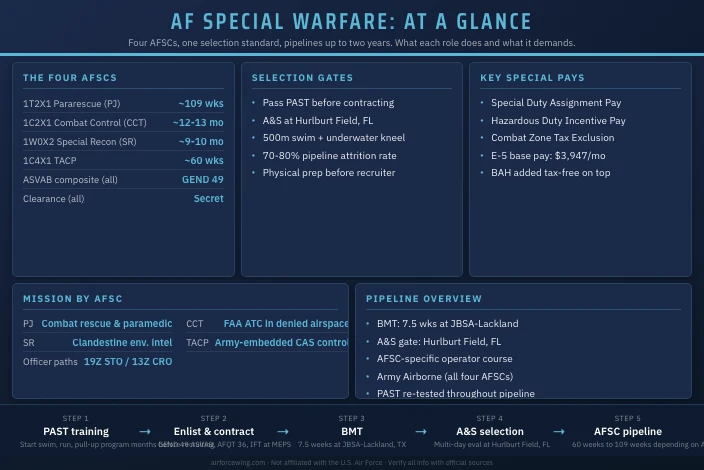
Air Force Special Warfare (AFSPECWAR) is its own career group, not a subset of general operations. Four enlisted AFSCs form the core:
| AFSC | Title | Common Name | Pipeline Length |
|---|---|---|---|
| 1T2X1 | Pararescue | PJ | ~109 weeks |
| 1C2X1 | Combat Control | CCT | ~12-13 months |
| 1W0X2 | Special Reconnaissance | SR / SOWT | ~9-10 months |
| 1C4X1 | Tactical Air Control Party | TACP | ~60 weeks |
All four require the same ASVAB composite (GEND 49), the same minimum AFQT of 36, and the same baseline clearance (Secret). All four are voluntary enlistments, no one is assigned to a special warfare AFSC involuntarily. The shared baseline makes comparison straightforward; what differs is the technical mission and how you’ll spend your career once you’ve earned your beret.
1T2X1 Pararescue (PJ)
Pararescue is the Air Force’s combat search and rescue (CSAR) force. PJs recover isolated, missing, or captured personnel, including downed aircrew, in hostile or denied environments, and provide emergency medical treatment during and after recovery. They freefall, dive, and fight their way to personnel who can’t get out on their own.
The training pipeline is the longest enlisted pipeline in any branch of the U.S. military, running roughly 109 weeks from BMT to beret. That time includes:
- Pararescue Indoctrination Course (PJ Indoc) at JBSA-Lackland, TX
- Army Airborne School (Fort Novosel, AL)
- Combat Divers Qualification Course
- Military Freefall Parachutist Course (HALO/HAHO)
- Air Force Paramedic Course
- Pararescue Recovery Specialist Course
Graduates hold a National Registry EMT-Paramedic (NREMT-P) certification, the highest civilian emergency medicine credential available to someone without a nursing or physician degree. That credential is fully portable after separation and commands strong civilian wages.
Attrition through the PJ pipeline regularly exceeds 75%. Most candidates who fail do so at the early indoctrination phase, not at the later technical schools. Physical preparation before you enlist is not optional if you want a realistic shot at completion.
1C2X1 Combat Control (CCT)
Combat controllers are FAA-certified air traffic controllers who operate in special operations environments where no tower, no radar, and no conventional air traffic control exists. They embed with Army Special Forces, Navy SEALs, and Ranger battalions to direct air assets into denied airspace, calling in airstrikes, coordinating airdrops, and managing austere landing zones during direct action and unconventional warfare missions.
The FAA certification separates CCT from every other combat arms role in the military. You’re simultaneously a credentialed aviation professional and a special operations ground operator. The pipeline runs roughly 12 to 13 months after BMT and includes:
- Combat Control Operator Course (Combat Control School, Pope AAF, NC)
- Army Airborne School
- Air Traffic Control qualification
- Military Freefall and SCUBA courses
CCTs are assigned to Special Tactics Squadrons (STS) alongside PJs. The two AFSCs train together and deploy together, though their missions at the objective are distinct. PJs recover and treat, CCTs control the airspace overhead.
1W0X2 Special Reconnaissance (SR)
The 1W0X2 AFSC was formerly designated Special Operations Weather Technician (SOWT), and many in the community still use that name. SR Airmen collect meteorological, hydrological, oceanographic, and environmental data in denied or hostile territory to support special operations mission planning and execution. Small clandestine teams, high analytical demand, and a skillset that looks more like intelligence collection than combat arms.
The pipeline runs roughly 9 to 10 months post-BMT and includes:
- Special Reconnaissance Operator Course (SROC) at Hurlburt Field, FL
- Army Airborne School
- Weather technical training
- SERE (Survival, Evasion, Resistance, and Escape)
The role draws candidates who are strong at data analysis and technical report writing under pressure. SR Airmen brief special operations commanders on environmental conditions that shape whether a mission proceeds, when it proceeds, and how. That analytical responsibility is the heart of the job. Physical standards match the other three AFSCs, and attrition through selection is similarly high.
1C4X1 Tactical Air Control Party (TACP)
TACP specialists are the Air Force’s link to the Army at the ground level. They embed with Army brigades, battalions, and companies as the terminal controller for close air support (CAS), directing fixed-wing and rotary-wing aircraft onto enemy targets in direct proximity to friendly forces. Of the four special warfare AFSCs, TACP has the most consistent Army integration and the most frequent deployment tempo.
The pipeline runs roughly 60 weeks, the shortest of the four. It includes:
- TACP Apprentice Course at Hurlburt Field, FL
- Army Airborne School
- Joint Terminal Attack Controller (JTAC) qualification
- Army unit integration training
TACP has the shortest training pipeline, but don’t read that as easiest. The same physical standards apply, and the career demands sustained readiness across Army deployment cycles, which move on the Army’s schedule, not the Air Force’s. TACP Airmen spend more time in Army environments than Air Force ones. If that appeals to you, it’s a significant advantage. If you expected Air Force base life, it’s a surprise.
Selection: A&S and the PAST
Every special warfare candidate goes through Assessment and Selection (A&S) before entering their specific pipeline. A&S is a multi-day evaluation of physical fitness, mental resilience, and team cohesion held at Hurlburt Field, FL. It’s a gate, candidates who don’t pass A&S do not proceed to a special warfare pipeline regardless of their ASVAB score or recruiter promises.
Before A&S, candidates must pass the Physical Ability and Stamina Test (PAST). The PAST standards differ by AFSC, but all require:
- 500-meter surface swim (timed)
- Underwater kneel (breath hold)
- Pull-ups (minimum reps, no time limit)
- Sit-ups and push-ups (timed, minimum reps)
- 1.5-mile run (timed)
The PAST is not a one-time event. It’s administered at MEPS, again before shipping, and again during the pipeline. Candidates who pass the first time and then let their fitness slide before shipping have been sent home. Start training for PAST standards before you contact a recruiter, not after.
Attrition rates across all four pipelines run between 70% and 80%. That means most people who start do not finish. The ones who complete the pipeline tend to share two traits: exceptional pre-enlistment physical preparation and strong mental resilience under sustained stress. Neither can be manufactured in a few weeks of prep.
The Culture Inside AFSPECWAR
Special warfare Airmen operate in a culture that is noticeably different from the broader Air Force. The emphasis on physical fitness is constant, not periodic. Rank matters less than competence in small-team environments. Operators are expected to work autonomously, make decisions under fire, and integrate with joint special operations forces who have their own cultures and expectations.
The majority of special warfare assignments are at a handful of installations:
- Hurlburt Field, FL (home of Air Force Special Operations Command, AFSOC)
- Pope AAF, NC (Special Tactics Squadrons)
- Cannon AFB, NM (Special Operations Wing)
- Joint Base Lewis-McChord, WA (Pacific-oriented STS units)
Deployments are frequent and can be extended. The nature of special operations means some units cycle through multiple downrange rotations per year. Family life is feasible but requires planning and stability from the family member who stays home. This is not a 9-to-5 career field, and it’s not a career field where you can predict the schedule three months out.
Officer Special Warfare Paths
Enlisted AFSCs are not the only entry point. The Air Force has two officer designations that lead special warfare units:
- 19Z Special Tactics Officer (STO): Commands Special Tactics units. STOs go through their own selection and pipeline, which includes the same PAST and A&S process as enlisted candidates. The physical standards are identical.
- 13Z Combat Rescue Officer (CRO): Commands combat rescue units and flies as part of CSAR mission packages. CROs attend the same pipeline schools as PJs for the rescue and medical components, then add officer-specific leadership training.
Both paths require a commission through USAFA, AFROTC, or Officer Training School (OTS). The selection pipeline for both is as competitive as the enlisted path. Officer candidates do not get a softer version of PAST or A&S.
Pay and Career Progression
Special warfare Airmen earn standard Air Force basic pay by grade and time in service, plus special pays that reflect the demands of the role. At a Staff Sergeant (E-5) with four years of service, base pay is $3,947/month before allowances. Career progression in special warfare is merit-based but structured, operators typically reach SSgt within four to five years, TSgt within eight to ten.
Special pays available to qualified special warfare Airmen include:
- Special Duty Assignment Pay (SDAP): Monthly supplement for demanding assignments
- Hazardous Duty Incentive Pay: For freefall, SCUBA, and flight duties
- Combat Zone Tax Exclusion: Income earned during deployed months may be tax-free
BAH adds meaningful compensation on top of base pay. At Hurlburt Field in Fort Walton Beach, FL, an E-5 with dependents receives approximately $1,869/month in BAH tax-free. Total cash compensation for a mid-career operator exceeds $7,000/month before factoring in TRICARE coverage, BAS, and other entitlements.
Civilian Transition
The post-service path from special warfare depends heavily on which AFSC you held.
PJs transition with a National Registry EMT-Paramedic credential, extensive trauma experience, and, if they pursued the 4N0X1H shredout path, strong clinical documentation. Flight paramedic, search and rescue specialist, and federal law enforcement medical roles are common landing spots. Some PJs parlay their SCUBA and freefall certifications into specialized government contracting.
CCTs hold FAA air traffic control certification. The civilian ATC market pays well and has consistent demand. Controllers with military special operations experience are competitive for FAA approach control and center positions. Some transition into aviation management or federal DOD contractor roles.
SR Airmen move into intelligence analysis, environmental consulting, federal contractor positions supporting SOCOM, and NOAA or NWS roles that value operational weather experience. The analytical skillset translates broadly.
TACP Airmen hold JTAC qualification, which is a hard credential in the defense contracting world. Contractors who support SOCOM training ranges, combat training centers, and joint training exercises specifically recruit veterans with JTAC cards. Civilian pay for contractor JTACs in active exercise environments is competitive.
Is This Right for You
These careers are not about finding a steady, predictable job. They’re about building a specific kind of capability and using it in the most demanding environments the military operates in.
If you want long pipeline training that produces a real credential, frequent deployments, small-team work, and a post-service resume that stands out, any of these four AFSCs delivers. The question is which mission appeals to you, rescuing people (PJ), controlling airspace (CCT), shaping the intelligence picture (SR), or directing fire from the ground (TACP).
Start physical training today if you’re serious. Not when you talk to a recruiter. Not after you take the ASVAB. Today. The candidates who make it through are the ones who show up to A&S already prepared, not the ones who got prepared by the pipeline.
For full AFSC profiles, pay tables, and training pipeline details, visit Air Force special warfare careers.
The enlistment process guide covers the steps from MEPS through contracting for a special warfare AFSC, including how the PAST fits into the timeline.
You may also find how to become an Air Force Pararescueman, CCT vs TACP vs SOWT, Air Force special warfare vs Army special operations, special warfare ASVAB and fitness requirements, and ASVAB scores for Air Force special warfare jobs helpful as you research each path.