Air Force Space and Satellite Technology Careers
The GPS signal in your phone, the missile warning data feeding the White House Situation Room, and the satellite contact windows that keep military communications online, all of it runs through a small group of Air Force operators at consoles in Colorado and California. These Airmen track satellites, command on-orbit assets, maintain missile warning sensors, and keep launch infrastructure operational 24 hours a day. And when they separate, they walk into one of the fastest-growing hiring markets in the country.
Commercial space is exploding. Lockheed Martin Space, Northrop Grumman, SpaceX, L3Harris, and United Launch Alliance are all competing for engineers, operators, and systems technicians who understand how real space missions work. Military space veterans have exactly that background, cleared, trained, and with operational credibility that no college program produces. This post covers which AFSCs work with space and satellite technology, what the day-to-day work actually looks like, how the Space Force transfer pipeline works, and what the post-service job market pays.
The AFSCs That Work With Space Technology
Four AFSC codes define the military space career field at the enlisted and officer levels. Each covers a distinct part of the mission.
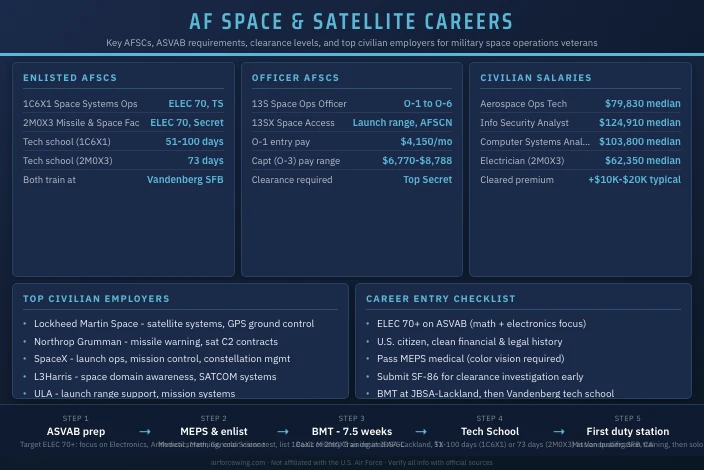
1C6X1 Space Systems Operations is the primary enlisted AFSC for people who want to work directly with satellites and space surveillance. Specialists in this field operate the ground consoles that track satellites, monitor ballistic missile launches, and execute command-and-control sequences for on-orbit assets. The ASVAB requirement is ELEC 70, and the clearance is Top Secret via Single Scope Background Investigation. Tech School runs 51 to 100 days at Vandenberg Space Force Base. Most duty assignments are in Colorado Springs at Peterson, Buckley, or Schriever Space Force Bases.
2M0X3 Missile and Space Facilities covers the physical infrastructure side. These specialists maintain power generation, HVAC, and electrical systems at ICBM launch facilities and space launch sites. The ASVAB requirement is also ELEC 70, with a Secret clearance. Tech School is 73 days at Vandenberg SFB. Duty assignments concentrate at the three Minuteman III missile wings: Malmstrom AFB (MT), Minot AFB (ND), and F.E. Warren AFB (WY), plus Vandenberg for space launch support.
13S Space Operations Officer is the commissioned officer path. These officers plan and lead space operations missions, managing crews that control satellites, operate missile warning systems, and support launch range activities. Entry pay for a new O-1 is $4,150/month, and a Captain (O-3) with four to ten years of service earns $6,770 to $8,788/month. Officer candidates need a bachelor’s degree and a commission through ROTC, Officer Training School, or the Air Force Academy.
13SX Space Access and Sustainment is a shredout within 13S focused on launch range operations and the Air Force Satellite Control Network. These officers manage the ground infrastructure that physically connects commanders to space assets, overseeing the uplink and downlink sites, launch range safety systems, and network configuration across the AFSCN’s distributed global architecture.
What the Day-to-Day Work Looks Like
The environment differs significantly between the two primary enlisted roles.
1C6X1: Operations Center Work
The 1C6X1 job is entirely console-based. You sit in a staffed operations center and manage data feeds from radar and optical sensors tracking satellites and detecting missile launches. Shifts rotate around the clock because the mission never pauses. On any given shift, you might:
- Monitor orbital parameters for a GPS satellite constellation
- Detect and report a ballistic missile launch event to senior controllers
- Execute an uplink command window for a satellite during a contact pass
- Log an anomaly in the system and escalate to a mission controller
- Track orbital debris near a military satellite and coordinate maneuver planning
The mental workload is high even when activity is low. You’re responsible for catching problems before they cascade, which means sustained attention for long stretches of routine data, punctuated by moments that require fast, correct decisions.
2M0X3: Field Maintenance at Launch Sites
The 2M0X3 job is physically demanding and geographically spread out. You convoy to remote missile sites, sometimes 30 to 50 miles from the main base, to perform preventive maintenance on power generators, HVAC systems, and electrical switchgear inside hardened underground facilities. A typical field day involves:
- Driving a convoy to a launch facility complex in weather that can be severe at northern missile wings
- Running scheduled maintenance on power generation equipment
- Troubleshooting equipment malfunctions and repairing them on-site using technical orders
- Inspecting backup power systems and documenting operational status before departing
- Returning to base and coordinating any follow-up work with the next maintenance crew
The work requires freedom from fear of heights and claustrophobia, both tested at MEPS. This is a non-negotiable entry requirement.
The Space Force Transfer Pipeline
The U.S. Space Force stood up in December 2019 as a separate service branch. Since then, the Air Force and Space Force have run an ongoing transfer program for space operations Airmen.
Here’s how that affects career planning:
- Airmen who enlist into 1C6X1 through the Air Force may be eligible to transfer to the Space Force’s enlisted ranks during their career
- Transferred Airmen become Guardians, serving in a separate chain of command with its own rank structure (Specialist 1 through Specialist 4 instead of Airman through Senior Airman, Sergeant instead of Staff Sergeant)
- The operational work at most installations is parallel to what Air Force Airmen do, though Space Force units are organized under Space Operations Command rather than Air Force major commands
- Space Force transfer windows have opened periodically; timing depends on Space Force policy and available billets
- 13S officers have a similar inter-service transfer pathway on the commissioned side
The transfer process requires a formal inter-service transfer request through your unit commander. Approval depends on Space Force manning requirements and your qualifications. Transfer windows are announced through official channels, not on a fixed annual schedule.
Not everyone transfers, and not everyone needs to. Many 1C6X1 Airmen serve full careers under the Air Force and retire from it. The important thing is to understand that the option exists before you enlist or commission, and to talk to a recruiter about current program status.
ASVAB Requirements for Space AFSCs
Both primary enlisted AFSCs in this career group require the same line score. That score is competitive.
| AFSC | ASVAB Composite | Minimum Score | Clearance |
|---|---|---|---|
| 1C6X1 Space Systems Operations | ELEC | 70 | Top Secret (SSBI) |
| 2M0X3 Missile and Space Facilities | ELEC | 70 | Secret (T3) |
The ELEC composite draws from four ASVAB subtests: Electronics Information (EI), Arithmetic Reasoning (AR), Mathematics Knowledge (MK), and General Science (GS). An ELEC score of 70 eliminates a significant share of applicants.
Of the four subtests, Electronics Information trips up the most candidates who haven’t studied electrical theory before. It covers circuit basics, Ohm’s law, resistors, capacitors, and wiring diagrams. The math subtests (AR and MK) are more intuitive for most test-takers but still require solid algebra skills. General Science is the broadest and hardest to cram for, covering physics, chemistry, and biology.
A realistic study timeline is four to eight weeks of focused preparation. Start with the weakest subtest (usually EI), move to math fundamentals, and review general science last. For comparison, ELEC 70 is the same threshold required for cyber and communications AFSCs like 1B4X1 and 3D1X2, so scoring above it opens doors beyond space operations. The ASVAB study guide covers the specific subtest content that drives the ELEC score.
Civilian Career Outcomes
This is where the investment pays off. Military space operations experience is directly translatable to a civilian market that is short on qualified people.
Defense Contractors and Commercial Space
The major employers actively hiring from this population include:
- Lockheed Martin Space (Littleton, CO): satellite systems, GPS ground control, SBIRS operations support
- Northrop Grumman (multiple sites): missile warning systems, satellite command and control contracts
- SpaceX (Hawthorne, CA and Cape Canaveral, FL): launch operations, mission control, satellite constellation management
- L3Harris (Melbourne, FL and Colorado Springs, CO): space domain awareness, satellite communications systems
- United Launch Alliance (Denver, CO): launch range support, mission systems integration
Geographic overlap is significant. Colorado Springs has a dense concentration of defense contractors supporting the Space Force installations there. Vandenberg-area employers support commercial and government launch operations. Veterans separating from Peterson, Schriever, or Buckley rarely need to move far to find relevant civilian work.
Federal Government Positions
The USAJobs federal hiring system posts positions regularly for space operations, systems administration, and facilities management roles at and near military installations. Veterans’ preference and the existing Top Secret clearance make 1C6X1 separatees highly competitive for GS-7 through GS-11 positions without additional education requirements.
Civilian Salary Data
| Civilian Career | Median Annual Salary | BLS Growth Projection |
|---|---|---|
| Aerospace Engineering and Operations Technician | $79,830 | +8% through 2034 |
| Information Security Analyst | $124,910 | +33% through 2033 |
| Computer Systems Analyst | $103,800 | +11% through 2033 |
| Electrician (2M0X3 transition path) | $62,350 | +9% through 2034 |
Median salary figures from the BLS Occupational Outlook Handbook (May 2024 data). The clearance adds a meaningful premium above these medians for roles requiring access, with cleared aerospace technicians frequently earning $10,000 to $20,000 more than uncleared peers in equivalent positions.
Pay During Service
Base pay follows the standard 2026 DFAS tables. Space operations Airmen receive the same compensation as every other AFSC at the same grade and time in service. The difference is what happens on top of base pay.
| Grade | Base Pay | BAS | Estimated Total |
|---|---|---|---|
| E-1 Airman Basic | $2,407/mo | $477/mo | $2,884/mo + BAH |
| E-3 Airman First Class (2 yrs) | $3,015/mo | $477/mo | $3,492/mo + BAH |
| E-4 Senior Airman (4 yrs) | $3,659/mo | $477/mo | $4,136/mo + BAH |
| E-5 Staff Sergeant (6 yrs) | $4,109/mo | $477/mo | $4,586/mo + BAH |
BAH varies by duty station. Colorado Springs and Vandenberg, the two primary space operations locations, carry mid-range BAH rates that add roughly $1,200 to $1,600 per month for single Airmen depending on grade. A single E-4 at Peterson Space Force Base with four years of service draws total monthly compensation above $5,300 before accounting for TRICARE, TSP matching, or leave value.
Space operations AFSCs have seen periodic critical skills bonuses tied to the Space Force’s expansion. The clearance requirement creates a reenlistment incentive: the Air Force and Space Force both pay to retain people who are expensive to replace. Bonus amounts change annually based on retention data, so ask a recruiter for current figures rather than relying on any static source.
Duty Stations and Quality of Life
Where you live is shaped heavily by the mission geography of this career field.
Colorado Springs is the center of the space operations world. Peterson, Schriever, and Buckley Space Force Bases are all within the metro area, and the city has a large, mature military community built around them. School districts near these installations have school liaison officer support. The civilian aerospace and defense job market in the area is one of the strongest in the country for veterans with space backgrounds.
Vandenberg Space Force Base on the California Central Coast is both the tech school location and a duty station for 1C6X1 and 2M0X3 Airmen. Vandenberg is an active launch site for military and commercial missions, which means the training environment is adjacent to real operational infrastructure.
Missile wing installations (Malmstrom, Minot, F.E. Warren) serve the 2M0X3 workforce almost exclusively. These are remote, small-city assignments with harsh winters and low cost of living. Families who adapt well to those environments tend to report strong unit cohesion and appreciate the low deployment tempo. Families accustomed to large metro areas may find the adjustment harder.
Deployment frequency across all space operations AFSCs is lower than most Air Force career fields. The mission is fixed-facility, which means you’re home far more than logistics or security forces Airmen at comparable installations.
Is This Career Field Right for You?
Space operations suits a specific profile. You don’t need to be an aerospace engineer, but you do need to reason well in math and electronics, and you need a background that can sustain a security clearance.
Strong candidates for 1C6X1 or 2M0X3 tend to share these traits:
- Score in the qualifying range on ELEC-weighted ASVAB subtests
- Comfortable with shift work and rotating schedules
- Detail-oriented under sustained attention demands
- Clean financial history and no foreign entanglements (both clearance considerations)
- Interested in space, orbital mechanics, or aerospace technology as a subject area
For 2M0X3 specifically, physical fitness beyond the minimum Fitness Assessment standard makes field work more manageable, and claustrophobia or fear of heights are disqualifying.
The officer path through 13S or 13SX requires a commission, but the day-to-day work at the crew level is directly parallel to what enlisted 1C6X1 Airmen do. Officers own the mission execution decisions; enlisted operators run the consoles.
If the career profile fits, few enlisted AFSCs produce a more direct pipeline to a high-paying civilian career in a sector that is growing fast.
This site is not affiliated with the U.S. Air Force or any government agency. Verify all information with official Air Force sources before making enlistment or career decisions.
For a broader look at which military technical jobs translate best to civilian tech careers, the Air Force STEM jobs guide covers the full picture. You may also find Air Force vs. civilian tech salary helpful for benchmarking what post-service earnings look like compared to going straight to industry.