Air Force Security Forces Qualifications
When you purchase through links on our site, we may receive compensation at no extra cost to you.
Security Forces has one of the lowest ASVAB minimums in the Air Force. That fact misleads a lot of recruits into thinking the bar is easy to clear. The ASVAB score is just the starting point. What filters out more applicants than anything else is the security clearance background investigation, and the combination of criminal history, drug use, and financial problems that make the clearance impossible to grant.
This is the full picture of what 3P0X1 actually requires before you can ship to Basic and start the Defender course.
ASVAB Requirements
The Air Force uses composite scores built from individual ASVAB subtests, not raw ASVAB scores, to determine AFSC qualification. Security Forces draws from one composite:
GEND (General): Word Knowledge + Paragraph Comprehension + Arithmetic Reasoning + Mathematics Knowledge
| AFSC | Title | Composite | Minimum Score |
|---|---|---|---|
| 3P0X1 | Security Forces | GEND | 33 |
| 3P0X1A | Military Working Dog Handler | GEND | 33 |
| 3P0X1B | Combat Arms | GEND | 33 (MECH 35 also required) |
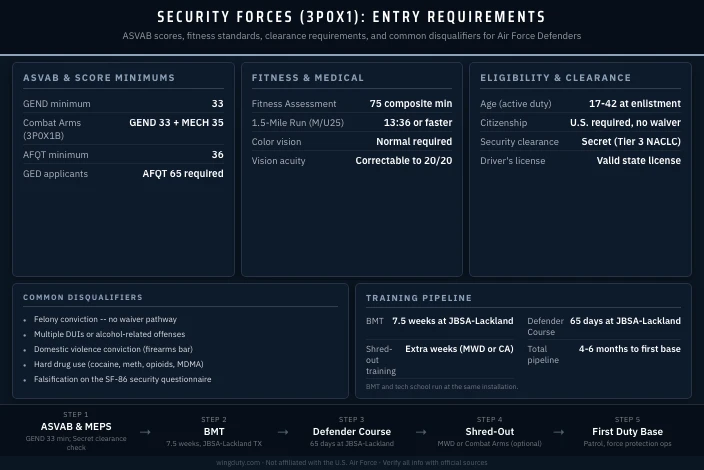
GEND 33 is the minimum for the base designator and both shred-outs. Combat Arms also requires a MECH composite of 35. The minimum AFQT for Air Force enlistment is 36, so most candidates who pass the AFQT gateway will already be close to the GEND threshold.
Scoring above the minimum matters for reasons beyond eligibility. MWD Handler and Combat Arms slots are limited. When slots are competitive, recruiters and assignment officers look at your full profile, and a higher score strengthens that picture.
Physical Fitness Standards
Security Forces does not require a Special Warfare-level physical test at entry. All recruits clear the standard Air Force Fitness Assessment before and during training.
The Air Force Fitness Assessment scores 100 points total, with a minimum passing composite of 75. Each component also carries its own minimum that must be met regardless of the composite total.
| Component | Male (Under 25) Min | Female (Under 25) Min | Max Points |
|---|---|---|---|
| 1.5-Mile Run | 13:36 | 16:22 | 60 |
| Push-Ups (1 min) | 33 reps | 18 reps | 10 |
| Sit-Ups (1 min) | 38 reps | 38 reps | 10 |
| Waist Circumference | 35 inches | 31.5 inches | 20 |
Standards are age- and gender-normed. Security Forces Airmen are expected to score well above the minimums given the physical demands of patrol work, force protection, and deployed operations.
Failing the Fitness Assessment during tech school can delay or end your training pipeline. Start running before you ship to BMT.
Scoring well above the composite minimum also affects competitive duty assignment selection. Deployed billets, Combat Arms instructor (CATM) duty, and Security Forces Leadership and Development (SFLED) courses filter on demonstrated PT performance. A Defender with a 90+ Fitness Assessment composite is more competitive for these assignments than one who clears the minimum 75. Physical readiness is treated as a baseline indicator of overall job performance in the career field.
Medical Requirements
Security Forces carries specific medical requirements beyond the standard MEPS screening. The work involves carrying a firearm daily, making use-of-force decisions under stress, and operating in deployed environments. The medical bar reflects those realities.
Vision: Normal color vision is required. Correctable to 20/20 is the general standard for visual acuity. Color vision deficiencies are disqualifying because Security Forces Airmen must distinguish wire colors, map markings, and tactical indicators accurately.
Hearing: Must meet standard Air Force audiogram requirements at MEPS. Combat Arms instructors (3P0X1B) face annual hearing tests throughout their career due to weapons range exposure.
Weight and Body Composition: Must meet Air Force height/weight standards at MEPS. These are separate from the Fitness Assessment waist circumference standard and apply at accession.
Beyond these, the Air Force looks at medical history for:
- History of drug or alcohol abuse
- Diagnosed mood disorders or anxiety disorders
- Attention Deficit Disorder (ADD) or ADHD
- Sleep disorders
- Fear of heights or confined spaces
- Any condition that would affect firearms carrying or use-of-force judgment
Mental health history is not an automatic disqualifier, but conditions that affect reliability, judgment under stress, or weapons handling are reviewed closely. A waiver is sometimes possible, but the threshold for Security Forces is stricter than most career fields because of the law enforcement authority that comes with the job.
Age and Citizenship Requirements
Age: The standard active-duty enlistment window is 17 to 42 at the time of enlistment. Reserve and Guard components may have slightly different upper limits. Verify your specific component’s cutoff with a recruiter.
Citizenship: U.S. citizenship is required. Security Forces personnel hold a Secret clearance at minimum, and certain assignments require a higher-tier clearance. Federal law prohibits granting national security clearances to non-citizens. There is no waiver pathway for citizenship in this career field.
Education: A high school diploma is the standard requirement. Applicants with a GED instead of a diploma must score AFQT 65 or higher to qualify, per standard Air Force enlistment policy.
Driver’s License: A valid state driver’s license is required. Security Forces Airmen operate patrol vehicles as part of the standard duty cycle, and this credential must be current at enlistment.
Naturalization pathway: Permanent residents with honorable discharge from prior military service may pursue expedited naturalization under federal immigration policy, but the standard 3P0X1 enlistment path requires citizenship at the time of accession. The Guard and Reserve components may have slightly different upper age limits depending on state Adjutant General authority; check the specific component’s policy with a recruiter before assuming the active-duty age window applies.
Security Clearance and Background Investigation
Every 3P0X1 position requires a Secret clearance at minimum. This is a Tier 3 investigation, called a National Agency Check, Local Agency Checks, and Credit Check (NACLC). Specific assignments, particularly those involving nuclear weapons storage, counterintelligence support, or Special Investigations, may require a higher-tier clearance including Top Secret.
The background investigation examines:
- Criminal record: arrests, charges, and convictions at every level
- Drug history: use, possession, or distribution of illegal substances
- Financial responsibility: credit history, debts, bankruptcies, and patterns of financial irresponsibility
- Foreign contacts and travel: close relationships with foreign nationals, extensive foreign travel, dual citizenship
- Employment history: gaps, firings, and disciplinary records
- Personal conduct: honesty, integrity, and any prior falsification on federal forms
An interim Secret clearance may be granted at accession while the full investigation processes. This allows the recruit to start training while the background check works through the system. If the full investigation later produces a denial, the Airman may be removed from the career field.
For a deeper look at how clearances affect career options and pay, see Air Force jobs that require a security clearance.
Common Disqualifiers
Security Forces disqualifiers go beyond the standard Air Force enlistment exclusions. The career field carries federal law enforcement authority, so suitability standards align with federal LEO hiring criteria as well as military requirements.
Criminal history:
- Felony conviction is disqualifying with no waiver pathway
- Multiple DUIs or a pattern of alcohol-related offenses
- Drug charges, even misdemeanor possession in many cases
- Domestic violence convictions (federal law prohibits firearms carrying for anyone convicted of a qualifying domestic violence offense)
- Crimes involving dishonesty, fraud, or misrepresentation
Drug history:
- Recent or extensive marijuana use beyond minor experimental use
- Any hard drug use (cocaine, methamphetamine, opioids, MDMA) is typically disqualifying
- Drug distribution or sale history is disqualifying at any scale
Financial history:
- Recent bankruptcies or patterns of delinquency suggest financial irresponsibility that can disqualify under the clearance adjudicative criteria
- Significant unpaid debt relative to income is a flag, not necessarily a hard bar, but it will be reviewed
Other disqualifiers:
- Gang affiliations or memberships in organizations that advocate violence or discrimination
- History of dishonorable or bad-conduct discharge from prior military service
- Any falsification on federal documents, including the SF-86 security questionnaire
- Prior disqualification from another federal law enforcement position
Minor traffic violations are generally not disqualifying. The pattern and severity of the offense matter more than a single incident. A recruiter can give you a preliminary read on your background before you invest significant time in the enlistment process.
Specialized 3P0X1 Assignments
Every recruit who qualifies for Security Forces enters as a base 3P0X1 Defender. Two shred-out designators are available after completing the Defender course.
3P0X1A: Military Working Dog Handler. MWD Handlers work alongside trained patrol and detection dogs for narcotics and explosives detection, base security, and direct support to combat operations. This shred-out has limited slots and higher demand than the base designator. Temperament screening and aptitude testing at the training level determine selection. Full details at the Military Working Dog Handler career page.
3P0X1B: Combat Arms. Combat Arms Airmen qualify, maintain, and track every weapon system on an installation. They run weapons qualification courses for base personnel and deploy with combat support units. The additional MECH 35 composite requirement exists because the role involves technical weapons knowledge beyond standard patrol work.
7S0X1: Special Investigations. This is a separate AFSC, not a shred-out, assigned to the Air Force Office of Special Investigations (AFOSI). It requires a different enlistment path and a higher clearance from the start. Senior Security Forces personnel with the SEI 321 (Security Forces Investigator) identifier work in a related criminal investigations function, but 7S0X1 agents operate under different authority and training.
Training Pipeline
Security Forces has a distinct training advantage: BMT and tech school both run at the same installation.
Basic Military Training (BMT)
7.5 weeks at Joint Base San Antonio-Lackland, TX. All enlisted Air Force recruits attend BMT here regardless of AFSC.
Defender Apprentice Course (Tech School)
65 days (approximately 13 weeks) at the Security Forces Academy, also at JBSA-Lackland. The course covers criminal law, use-of-force law, patrol tactics, vehicle operations, first aid, defensive driving, and weapons qualification on the M17/M18 pistol and M4 carbine. Graduates earn college credits in criminal justice through the American Council on Education.
Shred-Out Training (3P0X1A or 3P0X1B only)
MWD Handler and Combat Arms training run as separate follow-on courses after the Defender course, adding several additional weeks. Defenders who do not pursue a shred-out proceed directly to their first duty assignment.
The full pipeline from enlistment to first duty station typically runs four to six months for the base Defender track. Shred-out specialties extend that timeline by several weeks.
See the 3P0X1 Security Forces career profile for training phase details, duty station patterns, and deployment expectations.
Full Qualifications Summary
| Requirement | Standard |
|---|---|
| ASVAB Composite | GEND 33 minimum |
| Combat Arms shred (3P0X1B) | MECH 35 also required |
| AFQT Minimum | 36 |
| Citizenship | U.S. citizen |
| Age (active duty) | 17-42 at enlistment |
| Education | High school diploma (GED requires AFQT 65+) |
| Driver’s License | Valid state license |
| Security Clearance | Secret (Tier 3 NACLC) |
| Color Vision | Normal color vision required |
| Fitness Assessment | 75 composite minimum, all components |
| Criminal Background | No felony, no disqualifying misdemeanors |
| Drug History | No recent or extensive use; distribution disqualifying |
The ASVAB score opens the door. The background investigation determines whether you walk through it. Recruits who get this reversed, who study hard for the ASVAB but don’t disclose a prior arrest, routinely get surprised at MEPS or later during the clearance process.
If you have a background item that might be waiverable, start the conversation with a recruiter before investing in the rest of the application. Minor disqualifiers (older isolated incidents, certain financial issues with documented resolution) can sometimes be waived, but the adjudication is handled by the Air Force Personnel Center rather than the recruiter directly. Recruiters can give you a preliminary read; MEPS handles the medical and aptitude gates; AFPC and the federal clearance adjudicator handle the security side. Different stages, different decision authorities.
Explore more about the career at Air Force Security Forces, see training and deployment detail on the 3P0X1 Security Forces career profile, compare ASVAB scores for Security Forces jobs, and use the ASVAB study guide as you build your study plan.