Air Force Security Clearances Explained: Secret, Top Secret, and TS/SCI
When you purchase through links on our site, we may receive compensation at no extra cost to you.
Your ASVAB score gets you into tech school. Your physical gets you through MEPS. But for roughly a third of Air Force career fields, a security clearance is the gate that actually controls access to the job. Without it, you don’t sit in a classified facility. You don’t touch the mission. You wait.
This post breaks down all three clearance levels, what a TS/SCI actually means, how the investigation works, what 13 adjudicative guidelines examine, and what the timeline looks like from MEPS to a granted clearance. If you’re deciding which AFSC to target or just trying to understand what you’re signing up for, this is the process explained in full.
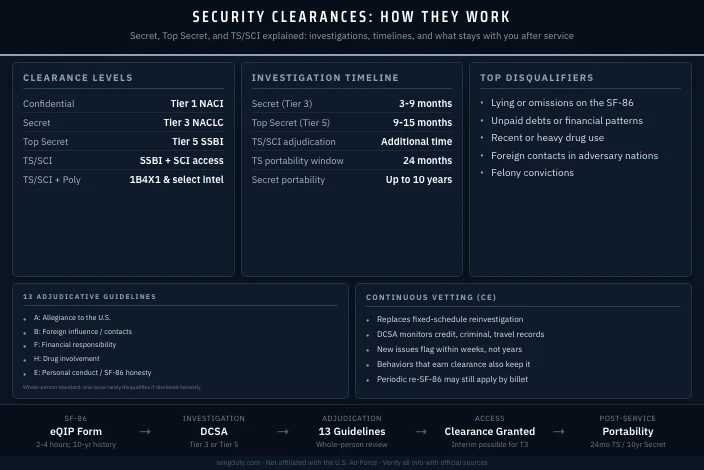
The Three Clearance Levels
The federal government recognizes three standard classification tiers, and the clearance level required for a job tracks directly to what classified information that job accesses.
Confidential is the baseline. It’s the least common entry requirement in the Air Force. Most jobs that need any clearance at all start at Secret or higher.
Secret covers the majority of clearance-required positions across logistics, communications, space operations, and parts of the operations career field. The investigation behind it, called a Tier 3 National Agency Check with Local Agency Checks and Credit Check (NACLC), reviews your criminal record, credit history, foreign contacts, and prior employment going back seven years.
Top Secret requires the most thorough investigation the government runs on enlisted and officer candidates: a Tier 5 Single Scope Background Investigation (SSBI). Investigators don’t just pull records. They interview your neighbors, former coworkers, and personal references in person. Every intelligence AFSC in the 1N series requires a Top Secret at minimum.
| Clearance Level | Investigation Tier | Air Force Career Fields |
|---|---|---|
| Confidential | Tier 1 NACI | Some support roles |
| Secret | Tier 3 NACLC | Logistics, comms, command post, some cyber |
| Top Secret | Tier 5 SSBI | All intelligence, space operations |
| TS/SCI | Tier 5 SSBI + SCI adjudication | 1N series intel, 1B4X1 cyber ops, 14N intel officers |
| TS/SCI + Polygraph | SSBI + CI or full-scope poly | 1B4X1, select 1N4X1 billets |
What TS/SCI Actually Means
Top Secret/Sensitive Compartmented Information is not a fourth clearance level. It’s a Top Secret clearance with an additional access layer granted for specific intelligence programs or compartments.
SCI stands for Sensitive Compartmented Information. Each SCI compartment covers a distinct collection program, technology, or intelligence source. Being granted access to one compartment does not automatically grant access to another. Your access is compartmented, meaning it’s strictly scoped to what your assignment requires.
Access to SCI is granted through a facility called a Sensitive Compartmented Information Facility (SCIF). SCIFs have specific construction standards, access controls, and procedural requirements. Most of your work as an Air Force intelligence specialist will happen inside one.
Some TS/SCI assignments add a counterintelligence (CI) polygraph as a condition. The most sensitive billets, particularly in offensive cyber and certain intelligence compartments, require a full-scope polygraph that covers lifestyle questions beyond counterintelligence scope. The 1B4X1 Cyber Warfare Operations AFSC is the primary Air Force enlisted position carrying both the CI polygraph and, in some assignments, a full-scope requirement.
How the Investigation Works
The process starts with the SF-86, officially the Questionnaire for National Security Positions. You complete it through the eQIP system online. It’s a detailed form, not a quick application. Budget two to four hours if your history is straightforward, longer if you’ve lived in multiple states, had foreign contacts, or have any financial or legal issues to document.
Complete the SF-86 in eQIP
Your recruiter initiates the eQIP request after you sign an intel or cyber contract. Gather your 10-year address history, employment records, W-2s or tax returns, and current contact information for references before you start. Missing information delays the entire process.
Background investigation opens
The Defense Counterintelligence and Security Agency (DCSA) handles federal background investigations. For a Tier 3, investigators run record checks and verify your history through databases. For a Tier 5, they add in-person interviews with people who know you. The depth of verification scales with the clearance level.
Adjudication
A federal adjudicator reviews the completed investigation against the 13 Adjudicative Guidelines. They apply a whole-person standard: your full record, not any single issue in isolation. Mitigating factors matter, and adjudicators are trained to weigh them.
Clearance granted or denied
If granted, you receive clearance eligibility tied to your position. If denied, you have the right to appeal through the Defense Office of Hearings and Appeals (DOHA). Interim Secret clearances are sometimes granted during a Tier 3 investigation, which lets you begin training while the full adjudication continues.
Timelines From MEPS to Granted Clearance
These are realistic ranges, not guarantees. Caseload, complexity, and government workload all affect your individual timeline.
- Secret (Tier 3): 3 to 9 months for most applicants
- Top Secret (Tier 5 SSBI): 9 to 15 months; complex cases can run longer
- TS/SCI adjudication: Additional time on top of the completed Tier 5
If you sign an intelligence contract and your investigation isn’t complete before your tech school class convenes, you may hold at Joint Base San Antonio-Lackland while it processes. This is common and documented in your recruiter’s briefing, so budget for it mentally.
The 13 Adjudicative Guidelines
Every security clearance decision runs through 13 adjudicative guidelines. These are the categories investigators examine and adjudicators weigh. Understanding them tells you exactly what the government is looking for and what will get flagged.
Financial Considerations (Guideline F): Unpaid debts, patterns of not meeting financial obligations, and unexplained wealth all raise concern. A single hardship with documented resolution is usually survivable. A pattern of ignoring financial obligations is not. This is consistently one of the most common reasons clearances are denied.
Foreign Influence (Guideline B): Family members or close contacts who are citizens or residents of a foreign country, foreign financial accounts, or foreign property can create counterintelligence risk. This is especially weighted if those foreign ties involve countries the U.S. intelligence community treats as adversaries.
Drug Involvement (Guideline H): Marijuana use remains a federal disqualifier even in states where it’s legal. The Air Force applies its own drug testing policies on top of the clearance adjudication. Recency and frequency matter: older or isolated use is evaluated differently than ongoing use. Hard drug involvement is more likely to be disqualifying regardless of how old it is.
Criminal Conduct (Guideline J): Felony convictions are essentially automatic disqualifiers. But the guideline covers patterns of disregard for the law, not just convictions. Multiple misdemeanors or charges that were dropped or dismissed can still appear in an adjudication.
Personal Conduct (Guideline E): This guideline specifically covers honesty on the SF-86. Deliberately falsifying, omitting, or misrepresenting information on the form is a federal crime. Lying and getting caught is significantly harder to mitigate than whatever you were trying to hide. Investigators find inconsistencies by comparing your responses to records, interviews, and your prior statements.
Alcohol Consumption (Guideline G): A single incident, such as an alcohol-related citation from years ago, is survivable if disclosed honestly. A pattern suggesting dependency or repeated poor judgment while drinking is a serious concern.
Psychological Conditions (Guideline I): Seeking mental health treatment does not automatically disqualify you. The government has specifically worked to reduce stigma around voluntary treatment-seeking. What the guideline targets is a diagnosed condition that impairs judgment, reliability, or creates risk of coercion. Report treatment honestly; hiding it creates a much larger problem than the treatment itself.
The remaining guidelines cover:
- Allegiance to the U.S. (A): Involvement with groups advocating overthrow of the government
- Foreign Preference (C): Holding or applying for citizenship in a foreign country
- Sexual Behavior (D): Conduct that creates vulnerability to blackmail or exploitation
- Security Violations (K): Prior unauthorized disclosure of classified information
- Outside Activities (L): Business relationships with foreign nationals or governments
- Use of Information Technology (M): Unauthorized access to computer systems
Honesty on the SF-86
This section exists separately from the guideline list because it’s the most preventable reason clearances get denied.
Adjudicators apply a whole-person standard. A person who discloses a prior drug arrest, explains the circumstances, and shows changed behavior has a viable path to clearance. A person who omits the arrest, gets caught in the discrepancy, and then tries to explain it has a much harder case. The deception itself becomes the disqualifying issue.
The most consistently survivable SF-86 disclosures involve: old financial problems with documented resolution, past drug experimentation that stopped, a single criminal incident without a pattern, and mental health treatment sought voluntarily. None of these are guaranteed approvals, but they are routinely adjudicated in favor of candidates who are honest about them.
Continuous Vetting
Periodic reinvestigation, where your background was re-checked on a fixed schedule, has largely been replaced by continuous vetting (sometimes called Continuous Evaluation or CE).
Under continuous vetting, DCSA runs ongoing automated checks against federal databases, financial records, and other sources throughout your time in a cleared position. You don’t submit a new SF-86 every five or ten years. Instead, the government monitors for new issues as they develop.
The automated checks pull from sources that include: credit reporting agencies, criminal justice databases, the Treasury Department’s Financial Crimes Enforcement Network, and foreign travel records. What you report on an initial SF-86 is the baseline. What surfaces in continuous vetting is compared to that baseline for inconsistencies.
For most Airmen, this operates invisibly. What it means in practice is that a financial problem, arrest, or foreign travel issue that emerges mid-career doesn’t wait for a reinvestigation cycle to surface. It may flag within weeks. The practical implication is that the behaviors that matter for getting a clearance also matter for keeping one.
Some positions still require periodic reinvestigations on top of continuous vetting. Your unit security manager will tell you what applies to your assignment. When a periodic review does trigger, you’ll complete an updated SF-86 through eQIP and potentially face a new round of reference checks if your history has changed significantly since the original investigation.
Lifestyle Implications of Holding a Clearance
A clearance isn’t just a credential. It carries ongoing reporting requirements and behavioral expectations that shape daily life, particularly for Airmen in the 1N or 1B series.
Foreign travel: You must report travel to certain countries before you go. After returning, foreign contacts made during travel may need to be reported as well. The specific requirements depend on your clearance level and unit policies, but international travel to adversary nations without prior approval can jeopardize your access.
Foreign contacts: A new significant relationship with a foreign national, particularly one from a country on the counterintelligence watch list, requires reporting to your security officer. This includes romantic relationships. The contact itself isn’t automatically disqualifying, but failing to report it is.
Financial disclosures: Significant new debt, bankruptcy filings, or unexplained financial windfalls that don’t match your reported income can trigger a review. Maintain clean financial records and report anything unusual to your unit security officer before it surfaces in a database check.
Coworker and supervisor reporting: If you observe behavior in a cleared colleague that suggests they may be a security risk, the system expects you to report it through your unit’s security program. This is called insider threat reporting.
What Happens If Your Clearance Is Revoked
Clearance revocation happens when an issue surfaces that the adjudicator determines cannot be mitigated. The most common triggers fall into a short list:
- Financial deterioration that wasn’t reported through your unit security manager, particularly unpaid debts that grow over time
- Unreported foreign contacts or travel to countries on the counterintelligence watch list
- Positive drug tests, including for substances legal in some states but federally controlled
- Security violations involving classified material, whether intentional or due to mishandling
- Falsification or omission on a continuous-vetting re-attestation or a periodic SF-86 update
If your clearance is revoked, you have the right to appeal through the Defense Office of Hearings and Appeals (DOHA). The appeal process involves submitting a written response with mitigating evidence and, in some cases, a hearing before an administrative judge. DOHA appeals typically take several months to a year to resolve, and during that time you may not be able to perform your assigned duties.
For Air Force members, clearance revocation often results in retraining into a non-clearance-required AFSC. The Air Force does not automatically separate you for losing a clearance, but the retraining assignment is not your choice. The Air Force Personnel Center assigns you to a new AFSC from currently available billets, which may not align with your career interests, training, or location preferences. If your current AFSC has no clearance-independent track and no suitable retraining option is available, administrative separation may follow.
Clearance Portability After Service
When you separate from the Air Force, your clearance doesn’t disappear. It enters an inactive status. A new cleared employer can sponsor reactivation without requiring a full reinvestigation, as long as the gap between separation and reactivation doesn’t exceed the applicable reinvestigation period.
For Top Secret and TS/SCI, that window is 24 months. For Secret, it’s up to 10 years. If you find a cleared position within two years of leaving active duty with a TS/SCI, your new employer can sponsor reactivation rather than initiating a new Tier 5 investigation. That distinction saves them a year or more of waiting and gives you an immediate hiring advantage over uncleared candidates.
Clearances are position-specific, not person-specific. You hold clearance eligibility; access is granted only when you’re in a position that requires it and you’ve been read into the relevant programs. After separation, your eligibility is what carries forward, and a new employer sponsors re-access.
A few things cleared veterans commonly misunderstand about portability:
- Your clearance does not transfer to a new employer automatically. The new employer must initiate a sponsorship request through DCSA. This takes weeks, not days. Factor it into your start date negotiations.
- SCI accesses are program-specific. Even if your clearance eligibility reactivates quickly, access to specific compartments requires a separate read-in process that the new employer controls.
- Polygraph results don’t transfer. If you completed a CI or full-scope polygraph on active duty, a new employer at a different agency may require you to sit for a new one. Polygraph requirements are agency-specific, not government-wide.
- The 24-month TS window starts at separation, not at the date your clearance was originally granted.
Keep your financial record clean after you leave. The most common reason separated veterans lose their clearance eligibility during the transition period is financial deterioration, specifically unpaid debt that accumulates between jobs. One clean SF-86 matters less than a clean record when your next employer pulls it up again. The continuous vetting system doesn’t stop when you leave the building; it stops when your clearance formally lapses.
Getting Into Clearance-Eligible AFSCs
The two main Air Force career pipelines that lead to TS/SCI clearances from enlistment are the intelligence career field (1N series) and the cyber career field (1B4X1 and 3D series). Both require competitive ASVAB line scores before you ever reach the clearance investigation step.
The intelligence pipeline values the General composite (GEND), built from Word Knowledge, Paragraph Comprehension, Arithmetic Reasoning, and Mathematics Knowledge. The cyber pipeline, specifically 1B4X1, values the Electronics composite (ELEC), built from General Science, Arithmetic Reasoning, Mathematics Knowledge, and Electronics Information.
For deeper coverage of these career fields and the clearance angle:
- Air Force jobs that require a security clearance, an AFSC-by-AFSC breakdown of who needs what
- How a TS/SCI clearance affects your civilian salary, the post-service pay angle
- Air Force intelligence and cyber AFSC jobs guide, the full pipeline side by side
Qualifying on the ASVAB and qualifying for the clearance are two separate gates. Both must clear before a recruiter can write you a contract for the jobs that matter most. Start with your ASVAB prep and work backward from there.