Air Force Reserves Education Benefits
Reserve service comes with more education money than most recruits realize going in. The challenge is that the programs work differently from active duty, have different caps, and some only activate after you’ve spent time on federal orders. Knowing which benefit applies at which stage of your career is the difference between paying out of pocket and graduating debt-free.
This post covers every education program available to Air Force Reserve members: what each pays, what it doesn’t, how to qualify, and how to stack programs so no benefit gets wasted.
Tuition Assistance for Reservists
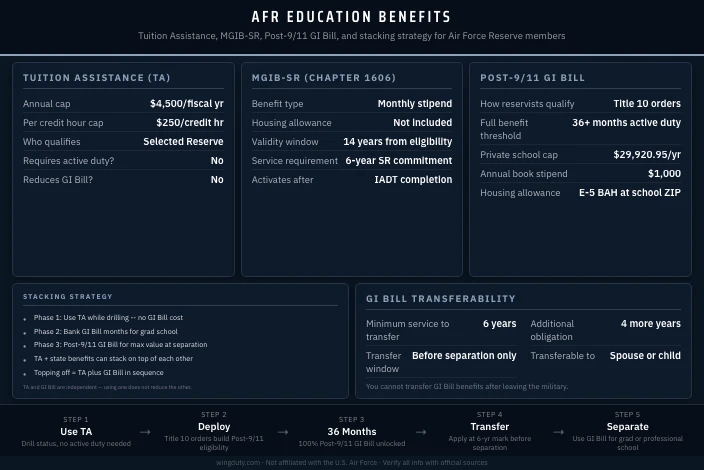
Tuition Assistance is available to Air Force Reserve members in the Selected Reserve who are in good standing with their unit. You don’t need active duty orders. You apply through the AF Virtual Education Center (AFVEC) at your unit or wing education office, and if you’re approved, the Air Force pays the school directly.
The caps for 2026:
- $250 per semester credit hour
- $4,500 per fiscal year (Oct 1 through Sep 30)
Those numbers apply to Reservists and active duty members alike. At most community colleges and regional state schools, $4,500 per year covers a full course load. At private or out-of-state schools, it typically covers three to five courses per year.
TA pays tuition only. Fees, books, lab materials, and parking aren’t covered. If your school charges mandatory fees on top of tuition (a common practice at public universities), those come out of your own pocket.
A few practical points:
- You must enroll in an accredited institution
- Courses must be job-related or part of a degree program
- TA doesn’t reduce your GI Bill entitlement, they’re independent programs
- Approval is not guaranteed; your unit’s education office reviews each request
Montgomery GI Bill - Selected Reserve (MGIB-SR)
The Montgomery GI Bill for the Selected Reserve, also called Chapter 1606, is the baseline GI Bill for Reserve members who haven’t completed qualifying active duty. It pays a flat monthly stipend while you’re enrolled in school.
What it covers and what it doesn’t:
- Monthly stipend: A flat rate per month of full-time enrollment. The rate is set by Congress and adjusts periodically
- No housing allowance: Unlike Post-9/11 GI Bill, there’s no monthly housing payment on top of the stipend
- No tuition-direct payment: The money goes to you, not the school; you pay tuition from it
- 14-year validity window: Benefits are available for 14 years from the date you became eligible (typically your initial enlistment date in the Selected Reserve)
To qualify, you must:
- Be a member of the Selected Reserve (not Individual Ready Reserve)
- Complete initial active duty for training (IADT)
- Have a six-year service commitment in the Selected Reserve
- Hold a high school diploma or GED
The MGIB-SR monthly stipend is lower than what Post-9/11 GI Bill pays. For Reservists who haven’t been mobilized on Title 10 orders, it’s still meaningful tuition money, just not the full active duty education package.
Post-9/11 GI Bill Eligibility for Reservists
The Post-9/11 GI Bill (Chapter 33) is the most valuable education benefit in the military system. Reserve members can qualify, but only through qualifying active duty service under Title 10 orders.
How qualifying service works:
When your Reserve unit is mobilized under Title 10 federal orders, that active duty time counts toward Post-9/11 GI Bill eligibility. The benefit scales with total qualifying service:
| Active Duty Service | Post-9/11 GI Bill Level |
|---|---|
| 90 days to 6 months | 40% |
| 6 to 12 months | 50-60% |
| 12 to 24 months | 60-80% |
| 24 to 36 months | 80-90% |
| 36+ months | 100% (full benefit) |
At 100%, the benefit covers full in-state tuition at public schools with no dollar cap, plus the monthly housing allowance (based on the E-5 with dependents BAH rate at your school’s ZIP code), plus a $1,000 annual book stipend. At private schools, the tuition cap for the 2025-2026 academic year is $29,920.95.
A Reserve member who deploys twice on yearlong mobilizations, for example, crosses the 24-month threshold and qualifies for 80% of the benefit. That still covers most of a public school education.
Key difference from MGIB-SR: Post-9/11 GI Bill pays the school directly for tuition, then pays housing and books directly to you. The monthly housing allowance alone can cover rent at most mid-size cities, which changes the math on attending school full-time after separation.
For a deeper look at how Post-9/11 GI Bill calculations work, including the Yellow Ribbon Program and what “online-only” enrollment means for your housing allowance, see Post-9/11 GI Bill: What It Covers and How to Use It.
TA and GI Bill: How to Use Both Without Losing Money
TA and the GI Bill are separate programs. Using one doesn’t reduce your entitlement in the other. That creates a sequencing advantage Reservists can exploit.
The optimal sequence:
Phase 1: Use TA while in the Selected Reserve
Take courses during drill status and between deployments. $4,500 per fiscal year funds roughly 18 credit hours per year at most public schools. A Reservist serving a full career can complete an associate’s or bachelor’s degree almost entirely on TA.
Phase 2: Bank GI Bill months for high-value programs
GI Bill entitlement is 36 months. If you’ve already earned college credits through TA, you need fewer GI Bill months to finish a degree or pursue a graduate program. That leaves months for a second degree, a professional certification program, or a spouse or child (if you transfer).
Phase 3: Use Post-9/11 GI Bill (if you’ve earned it) for maximum value
Post-9/11 GI Bill at 100% pays tuition plus housing plus books. Using it for a graduate or professional program after separation extracts the highest dollar value per month of entitlement.
The Air Force calls this “topping off”: layering TA and GI Bill in sequence so the total education benefit exceeds what either program provides alone. It’s a legitimate and widely used strategy.
GI Bill Transferability to Dependents
Reserve members can transfer Post-9/11 GI Bill benefits to a spouse or child under the same rules as active duty members:
- Minimum 6 years of qualifying service at the time of the request
- Must agree to 4 additional years of service from the approval date
- Transfer request must be submitted and approved while still in the military
The 4-year additional obligation is non-negotiable. If you’re planning to leave the Reserve in two years, you cannot initiate a transfer and expect it to hold. The request, approval, and obligation agreement all have to happen before you separate or retire.
Once transferred, the dependent uses the benefit under the same terms: same tuition caps, same housing allowance formula, same 36-month limit minus whatever you’ve already used.
AFROTC as a Reserve-Track Entry Path
Air Force Reserve Officer Training Corps (AFROTC) scholarships offer a different angle: education funding before you serve, with a commission on the back end. Two-year and three-year AFROTC scholarships cover tuition and fees, provide a monthly living stipend, and include an annual book allowance.
Students who complete AFROTC and commission as officers can serve in the Reserve component rather than active duty, depending on available positions and needs of the Air Force. This makes AFROTC relevant not just for active duty candidates but for anyone who wants to earn a commission while finishing a degree.
AFROTC scholarship amounts vary by tier and competition. Check current rates through your wing education office or detachment commander for exact figures by academic year.
For the full picture on officer entry paths including AFROTC, see the Reserve enlistment and commissioning guide.
State-Level Education Benefits
Federal programs get most of the attention, but state-level benefits can add significant money on top. Several states have passed legislation offering free or reduced tuition to National Guard and Reserve members attending in-state public schools.
State programs vary widely:
- Some cover full in-state tuition at public universities
- Some cap at community college rates
- Some require the member to live in-state (separate from duty station)
- Most require enrollment in a state-accredited public institution
States with historically strong Reserve and Guard education benefits include Texas, Virginia, Georgia, and Illinois, though programs change and funding levels fluctuate. Check your state’s adjutant general website or your wing education office for current eligibility rules.
State benefits often stack on top of federal TA. A Texas Reservist, for example, might use the Hazlewood Act to cover tuition and fees at a Texas public school, then use MGIB-SR monthly stipend for living expenses, without touching GI Bill entitlement at all.
ANG vs. AFR: The Key Education Difference
Air National Guard (ANG) members and Air Force Reserve (AFR) members access the same federal programs (TA at the same caps, same GI Bill eligibility rules). The difference is in state-level benefits.
| Education Benefit | Air Force Reserve | Air National Guard |
|---|---|---|
| Federal Tuition Assistance | $4,500/yr, $250/credit hour | $4,500/yr, $250/credit hour |
| MGIB-SR | Yes (Chapter 1606) | Yes (Chapter 1606) |
| Post-9/11 GI Bill | Via Title 10 qualifying service | Via Title 10 qualifying service |
| State education benefits | Limited (few states cover AFR) | Broader (most programs designed for ANG) |
The practical gap: state free-tuition programs are almost universally written for the National Guard, which is under state authority. Air Force Reserve units operate under federal authority (Title 10), so state Guard education programs often exclude AFR members by statute. If maximizing state benefits is your goal, ANG typically offers more options at the state level.
Making the Most of Your Education Benefits
The sequence matters as much as the dollar amounts.
Use TA while you’re drilling. It’s available immediately, requires no active duty time, and doesn’t touch your GI Bill clock. If your state offers Guard or Reserve education benefits, layer those on top of TA to cover fees TA doesn’t reach.
Build qualifying active duty time when mobilization opportunities arise. Each deployment or activation adds toward the Post-9/11 GI Bill threshold. Reaching 36 months of qualifying service puts you at 100% eligibility, including the housing allowance that makes full-time school financially viable.
Decide on transferability before your 6-year mark. The obligation adds four years of service, but the window to act closes at separation.
For a full breakdown of all Air Force Reserve benefits (pay, healthcare, retirement, and base access) in one place, start with Air Force Reserve Benefits: What You Actually Get. For the comparison between Reserve, Guard, and active duty compensation, the pillar post Active Duty vs Air Force Reserve vs Air National Guard lays out where each component stands across every benefit category.
The Air Force benefits guide covers active duty pay tables, BAH rates, and TRICARE costs for context on how Reserve benefits compare to the full-time package. Browse Air Force enlisted career fields to see how AFSC selection affects which education programs you can use during drill periods.