Air Force Reserve Benefits: What You Actually Get
Most people understand that Reserve service pays less than active duty. What catches them off guard is the structure: which benefits kick in automatically, which require activation orders, and which are simply not available unless you’re on full-time orders. The gap between active duty and Reserve benefits is real, but it’s not a reason to dismiss Reserve service. It’s a reason to understand exactly what you’re signing up for.
Here’s a complete picture of what Air Force Reserve members actually receive.
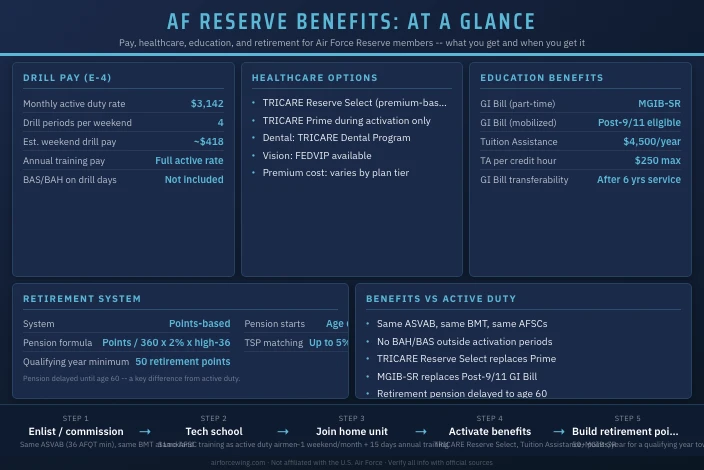
Drill Pay: How Reserve Compensation Works
Reserve airmen don’t receive a monthly paycheck the way active duty airmen do. Pay is tied to service days, and the unit of measurement is the drill period.
A standard drill weekend counts as four drill periods, two per day. Each drill period pays at the daily equivalent of the active duty basic pay rate for your grade and years of service. Using the 2026 military pay tables, an E-4 Senior Airman with less than two years of service earns $3,142 per month on active duty. Divide that by 30 days to get the daily rate, multiply by four periods, and a drill weekend pays approximately $418.
The same basic pay rates apply regardless of branch or component. What changes is how many days per year you’re paid.
| Grade | Monthly Active Duty Pay | Est. Weekend Drill Pay |
|---|---|---|
| E-3 (A1C, under 2 yrs) | $2,837 | ~$379 |
| E-4 (SrA, under 2 yrs) | $3,142 | ~$419 |
| E-5 (SSgt, under 2 yrs) | $3,343 | ~$446 |
| E-6 (TSgt, under 2 yrs) | $3,401 | ~$454 |
| E-7 (MSgt, under 2 yrs) | $3,932 | ~$524 |
During annual training, typically 15 days per year, Reserve airmen receive the full active duty daily pay rate plus the Basic Allowance for Housing (BAH) and Basic Allowance for Subsistence (BAS) for those days. Outside of annual training and activations, BAH and BAS are not paid.
When a unit is mobilized under Title 10 federal orders, members receive full active duty pay and allowances for the duration. The length of mobilizations varies widely, from a few months to over a year.
Healthcare: Reserve Select vs Active Duty Prime
Active duty airmen receive TRICARE Prime at no cost. Reserve members are not automatically enrolled in that program.
The standard healthcare option for Reserve members is TRICARE Reserve Select (TRS), a premium-based plan. TRS covers the member and eligible family members with lower copays than most civilian employer plans, but you pay monthly premiums. Coverage is continuous and doesn’t require activation orders.
When a Reserve member is activated on federal orders for more than 30 consecutive days, they transition to TRICARE Prime for the duration of those orders, with no premium. That full active duty healthcare access ends when orders expire.
Additional coverage options:
- Dental: The TRICARE Dental Program covers Reserve members and their families. Premiums apply.
- Vision: Reserve members can enroll in the Federal Employees Dental and Vision Insurance Program (FEDVIP), which offers competitive group rates.
- Mental health: TRS covers mental health services. Coverage specifics vary by provider network.
TRS premiums and plan details are updated periodically. The TRICARE Reserve Select plan page has current premium rates and enrollment instructions.
Education Benefits
This is where Reserve service compares well to active duty, with one important condition.
Tuition Assistance (TA) is available to Reserve members in good standing. The Air Force covers up to $4,500 per year in tuition costs, capped at $250 per credit hour. TA covers tuition only, not fees, books, or supplies. You apply through the Air Force’s education portal and your unit education office.
The GI Bill situation requires more explanation.
The Montgomery GI Bill - Selected Reserve (MGIB-SR) is the standard GI Bill for Reserve members who haven’t served on active duty. MGIB-SR pays a monthly stipend while enrolled in school, but it’s lower than the Post-9/11 GI Bill benefit that active duty members receive. As of the 2025-2026 academic year, the Post-9/11 GI Bill covers up to $29,920.95 at private schools annually plus a monthly housing allowance. MGIB-SR pays a flat monthly rate with no housing allowance.
Reserve members who complete qualifying active duty service can become eligible for Post-9/11 GI Bill benefits. Members mobilized under Title 10 orders accumulate active duty time toward the 36-month threshold for full Post-9/11 GI Bill eligibility.
GI Bill transferability is the same for Reserve members as for active duty: you need at least six years of qualifying service and must agree to four additional years of service obligation. The transfer must be initiated while still in the military.
| Education Benefit | Reserve (not mobilized) | Reserve (after qualifying active duty) |
|---|---|---|
| Tuition Assistance | $4,500/year | $4,500/year |
| GI Bill program | MGIB-SR (lower stipend) | Post-9/11 GI Bill eligible |
| Housing allowance | None (MGIB-SR) | E-5 with dependents BAH rate |
| Book stipend | Not included | Up to $1,000/year |
Retirement: Points, Not Years
The active duty retirement system and the Reserve retirement system are built on completely different math.
Active duty retirement under the Blended Retirement System (BRS) works on a 20-year service threshold. Hit 20 years, and you’re eligible for a pension that pays 2% of your high-36 average basic pay per year of service. At exactly 20 years, that’s 40% of high-36 pay, paid monthly starting immediately after separation.
Reserve retirement is points-based, and the pension doesn’t start until age 60.
You earn retirement points for each activity:
- 1 point per drill period
- 1 point per day of active duty (training, mobilization, etc.)
- 15 points per year just for being a member (the “membership” credit)
A standard year of Reserve service, with 48 drill periods plus annual training, earns roughly 78 points. To earn a “qualifying year” toward retirement, you need a minimum of 50 retirement points in that year.
After 20 qualifying years, you’re eligible for a pension calculated as:
(Total points / 360) x 2% x high-36 average basic pay = annual pension
A reservist with 20 qualifying years and 1,800 total retirement points would have the equivalent of exactly 20 active duty years (1,800 / 360 = 5.0 x 2% x 20 years = 40% of high-36). But most Reserve retirees have fewer total points than their active duty counterparts at the same calendar age, because Reserve years earn roughly one-quarter of the points an active duty year generates.
The pension delay matters. Even if you complete 20 qualifying years at age 42, the pension doesn’t start paying until you turn 60. There’s an exception: Reserve members who deploy under certain combat-zone orders can reduce that age in six-month increments, potentially down to age 50.
TSP matching under BRS applies to Reserve members at the same rates as active duty: automatic 1% contribution after 60 days, plus government matching up to 5% of basic pay on the days you’re paid. Because you’re paid fewer days per year, the total government TSP contribution is lower in absolute dollars, but the match percentage is identical.
Other Benefits Worth Knowing
Reserve service comes with several benefits that go beyond pay and healthcare.
Base access: Reserve members and their families have access to base exchanges (BX), commissaries, military recreation facilities, and Morale, Welfare, and Recreation (MWR) programs at most installations. These benefits are available year-round, not just on drill days.
Life insurance: Servicemembers Group Life Insurance (SGLI) is available to Reserve members. Coverage can be elected up to $500,000. Premiums are low compared to civilian term life insurance, and coverage is automatic unless you opt down.
Legal assistance: Reserve members can use Judge Advocate (JAG) legal assistance offices at military installations for personal legal matters, including wills, powers of attorney, and tax preparation.
Space-available travel: Reserve members on active duty orders can use military aircraft for space-available travel. Off-orders, the benefit is limited compared to what active duty retirees receive, but it’s available.
Veterans’ hiring preferences: Reserve members and veterans receive federal hiring preferences under the Veterans’ Preference Act. Reserve service counts even if you never serve on active duty.
Activation Changes Everything
The single biggest variable in Reserve benefits is whether you’re on active duty orders.
When activated under Title 10 orders (federal mobilization), Reserve members receive:
- Full active duty basic pay for their grade and years of service
- BAH based on their duty station and dependency status
- BAS ($476.95 per month for enlisted, $328.48 for officers in 2026)
- TRICARE Prime at no cost for the duration of orders
- Full access to on-base services and family support programs
This is the same compensation package that active duty airmen receive. The difference is that it ends when orders expire.
Involuntary activations can last anywhere from a few weeks for training to over a year for operational deployments. Voluntary activations let Reserve members opt into full-time positions when they become available, sometimes through programs like the Active Guard and Reserve (AGR) program, which places Reserve members in full-time Active Guard positions.
AGR status is effectively active duty in all but name. AGR members receive the full active duty benefits package and serve in permanent, full-time Reserve support roles.
Comparing Reserve to Active Duty Benefits
| Benefit | Active Duty | Air Force Reserve |
|---|---|---|
| Basic pay | Continuous monthly | Drill periods + activations |
| BAH | Yes, location-based | Activation periods only |
| BAS | $476.95/month (enlisted) | Activation periods only |
| Healthcare | TRICARE Prime (no cost) | TRICARE Reserve Select (premium) |
| GI Bill | Post-9/11 (full benefit) | MGIB-SR unless mobilized |
| Tuition Assistance | $4,500/year | $4,500/year |
| Retirement | 20-year pension (immediate) | Points-based (starts at 60) |
| TSP matching | Up to 5% on all pay days | Up to 5% on drill pay days |
| Base access | Full, daily | Year-round for member + family |
| SGLI | Up to $500,000 | Up to $500,000 |
The gap closes substantially during mobilization. For Reserve members whose units deploy regularly, the actual benefits received over a career can approach what active duty members receive, especially when activation periods are long.
For a full picture of what active duty service includes, the Air Force benefits guide covers current pay tables, BAH examples, and healthcare costs in detail.
Is Reserve Service Worth It?
That depends entirely on what you’re comparing it to.
If you want to serve but can’t commit to full-time military life, the Reserve offers real benefits: healthcare coverage, retirement earning power, education funding, and base access. The trade-offs are real, too: no guaranteed housing allowance, a pension that arrives 20-plus years after you finish serving, and healthcare that costs money unless you’re activated.
The right question isn’t whether Reserve benefits are as good as active duty benefits. They’re not. The question is whether they fit your actual situation. For someone building a civilian career while serving part-time, Reserve benefits can complement an employer health plan, fund a graduate degree through Tuition Assistance, and build a second retirement stream without requiring a full-time military commitment.
Reserve and Guard service also lets you stay in your community. You join a local unit, train locally, and don’t move every two to three years. That stability has real value that doesn’t show up in a benefits comparison table.
Explore Air Force enlisted career fields to see which AFSCs are commonly available in Reserve units.
You may also find Active Duty vs Air Force Reserve vs Air National Guard and Best Air Force Reserve AFSC Jobs for Civilian Careers helpful as you work through this decision.
This site is not affiliated with the U.S. Air Force or any government agency. Verify all information with official Air Force sources before making enlistment or career decisions.