Air Force PT Test Scoring Chart (2026)
The Air Force overhauled its Physical Fitness Readiness Assessment (PFRA) in 2026. The new scoring chart looks different from what many recruits and servicemembers have studied. The run is still the heaviest component, but the point weights shifted, new exercise options opened up, and body composition now uses a waist-to-height ratio instead of raw inches. If you’re preparing with old tables, you’re preparing for the wrong test.
The new PFRA standards under AFMAN 36-2905 took effect March 1, 2026. Scored testing resumes September 1, 2026, after a six-month diagnostic period. Official scoring charts are available at afpc.af.mil.
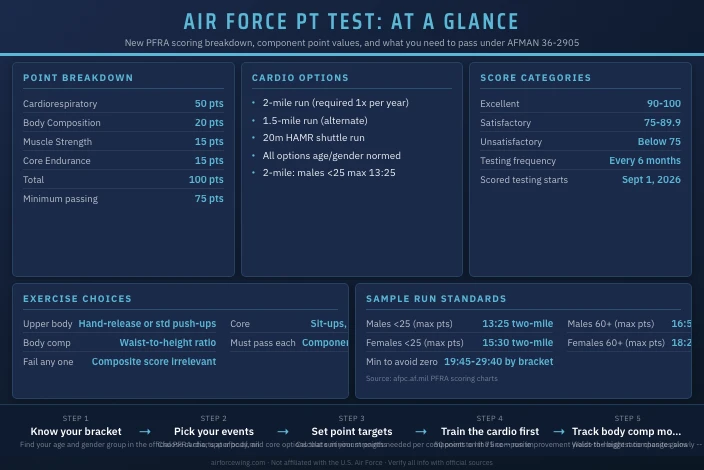
New Point Breakdown
The biggest structural change is how points are distributed. The old system put 60 points on the cardio event. The new one drops that to 50 and splits the remaining 50 across three other components.
| Component | Max Points | Event Options |
|---|---|---|
| Cardiorespiratory | 50 | 2-mile run, 1.5-mile run, or HAMR |
| Body Composition | 20 | Waist-to-height ratio |
| Muscle Strength | 15 | Hand-release push-ups or standard push-ups |
| Core Endurance | 15 | Sit-ups, cross-leg reverse crunches, or forearm plank |
| Total | 100 |
The minimum composite score to pass remains 75 out of 100. But clearing 75 overall is not enough. Each component has its own minimum, and failing any single event makes the composite score irrelevant.
Score categories:
- Excellent: 90 points and above
- Satisfactory: 75-89.9 points
- Unsatisfactory: Below 75 points
One other change: all servicemembers now test every six months regardless of prior score, up from annual for most airmen.
Cardiorespiratory: 50 Points
Cardio is still the biggest single factor in your composite score. Three options exist, though the 2-mile run is required at least once per 365-day period. You cannot replace both tests with HAMR or the 1.5-mile run. One of your two annual tests must be the 2-mile.
The 1.5-mile run and the HAMR (20-meter High Aerobic Multi-shuttle Run) are valid for the other test.
All three options are scored on age- and gender-normed tables. The score range for cardio is 35 to 50 points. There is no zero for this component as long as you finish. Failing to meet the minimum time earns the floor (35 points), but 35 points on a 50-point component still drags your composite down hard.
Sample 2-mile run standards:
| Age Group | Males, Max Score Time | Males, Min Score Time | Females, Max Score Time | Females, Min Score Time |
|---|---|---|---|---|
| Under 25 | 13:25 | 19:45 | 15:30 | 25:23 |
| 60 and over | 16:58 | 24:00 | 18:20 | 29:40 |
The full tables for all age brackets are on the Air Force Personnel Center fitness program page. The gap between max and min score is large. A male under 25 who runs 19:44 earns 35 points while one who runs 13:25 earns 50. That 15-point swing on a single component is the difference between a fail and a Satisfactory pass even if everything else is identical.
Body Composition: 20 Points
Body composition switched from raw waist circumference to waist-to-height ratio (WHtR). The math is simple: divide your waist measurement in inches by your height in inches. The result puts you in one of three risk categories, each carrying a different point value.
- Low risk earns the highest point total
- Moderate risk earns a mid-range score (an example: a 36-inch waist on a 69-inch-tall airman produces a 0.52 ratio, scoring 17 points)
- High risk earns the minimum
The WHtR standard applies to all ages and genders rather than using separate tables. Active-duty members may complete measurements up to five days before their test date. Reserve and Guard members can do it during a drill period prior to the test.
Twenty points on body composition means a high-risk result alone can make a 75 composite nearly unreachable, even with strong cardio and push-up scores.
Muscle Strength: 15 Points
The muscle strength component gives you a choice: hand-release push-ups for two minutes, or standard push-ups for one minute. Hand-release push-ups require a full chest-to-ground lower and a hand lift at the bottom of each rep, which eliminates the partial-rep creep common in standard push-ups.
Sample hand-release push-up standards:
| Group | Minimum Reps (2.5 pts) | Maximum Reps (15 pts) |
|---|---|---|
| Males under 25 | 27 | 52+ |
| Males 60 and over | 11 | 36+ |
| Females under 25 | 17 | 42+ |
| Females 60 and over | 1 | 26+ |
Points scale between minimum and maximum reps. At 15 points maximum, this component can determine whether you pass or fail. An airman sitting at 73 composite needs every available point from strength and core.
Core Endurance: 15 Points
Core gives you three choices: sit-ups for one minute, cross-leg reverse crunches for two minutes, or a timed forearm plank. You pick one option and stick with it for that test.
Sample standards for each option:
Sit-ups (1 minute):
| Group | Minimum Reps | Maximum Reps |
|---|---|---|
| Males under 25 | 33 | 58 |
| Males 60 and over | 17 | 42 |
| Females under 25 | 29 | 58 |
| Females 60 and over | 6 | 31 |
Forearm plank:
| Group | Minimum Hold | Maximum Hold |
|---|---|---|
| Males under 25 | 1:35 | 3:40 |
| Males 60 and over | 0:55 | 3:00 |
| Females under 25 | 1:30 | 3:35 |
| Females 60 and over | 0:50 | 2:55 |
The plank is a timed static hold with no movement required after you set your position, which some airmen find easier to pace than sit-up reps. Try both in training before committing to one.
How to Read Your Score
The charts above show only the endpoints of each scoring table. The actual tables have gradations, and each rep or second of improvement moves you up a fraction of a point. Here is the calculation that matters most:
Your target composite = 75 minimum. Work backward from there.
A practical floor scenario: 35 pts (cardio min) + 17 pts (body comp moderate risk) + 8 pts (strength mid-range) + 8 pts (core mid-range) = 68 points. That’s a fail. You cannot coast on any single component and rely on others to carry you.
A realistic pass scenario: 43 pts (solid run) + 20 pts (low body comp risk) + 10 pts (strength) + 10 pts (core) = 83 points, a Satisfactory pass with room to spare.
Before your next test, calculate your expected composite using the official PFRA scoring charts. Knowing where you stand on each component, not just the run, lets you put training hours where they produce the most points.
What Changed from the Old System
If you’ve tested before or studied older prep materials, here’s where the new PFRA differs from the previous standard:
| Area | Old Standard | New Standard |
|---|---|---|
| Cardio points | 60 | 50 |
| Strength points | 10 | 15 |
| Core points | 10 | 15 |
| Body comp method | Raw waist circumference | Waist-to-height ratio |
| Run requirement | 1.5-mile only | 2-mile required 1x/yr |
| Push-up duration | 1 minute | 2 min (hand-release) or 1 min (standard) |
| Core options | Sit-ups only | Sit-ups, crunches, or plank |
| Test frequency | Annual for most | Every 6 months |
The practical effect: the run matters a bit less than before (50 vs. 60 points), but the floor is higher. You must also clear minimums on strength and core components that now carry 50 percent more point weight each.
Official Tables vs. This Chart
The tables in this post are representative figures drawn from official PFRA scoring documents published by the Air Force Personnel Center. They cover the under-25 and 60-and-over brackets to show the range. The complete tables for every 5-year age bracket between those endpoints are in the official PFRA scoring charts at afpc.af.mil.
Always use the official charts for your actual test prep. The exact run time for each point increment and the precise rep counts at each scoring tier vary by bracket.
You may also find the full breakdown at Air Force Fitness Test: Standards, Scoring, and How to Pass helpful, and if the run is your weak point, How to Train for the 1.5-Mile Run covers a structured training progression.
Explore Air Force enlisted careers if you’re still deciding whether to enlist and want to understand how fitness standards fit into the full picture. The enlistment process guide covers how physical fitness testing fits into the broader timeline from MEPS through BMT.
For a broader look at how scoring connects to training, body composition, and test-day preparation, see our Air Force physical fitness guide.
This site is not affiliated with the U.S. Air Force or any government agency. Verify all information with official Air Force sources before making enlistment or career decisions.