Air Force Pilot vs Navy Pilot: What You're Really Signing Up For
Choosing the Navy does not guarantee carrier flying. Choosing the Air Force does not guarantee a fighter jet. Both services train pilots, but the route into a cockpit and the life around it can differ sharply.
Start with the offer, not the aircraft. A commission, a pilot training slot and an aircraft assignment are separate decisions. Which ones are settled before training, and which are left to later boards and performance? That is the comparison to make before treating one branch as a faster route to a favorite jet.
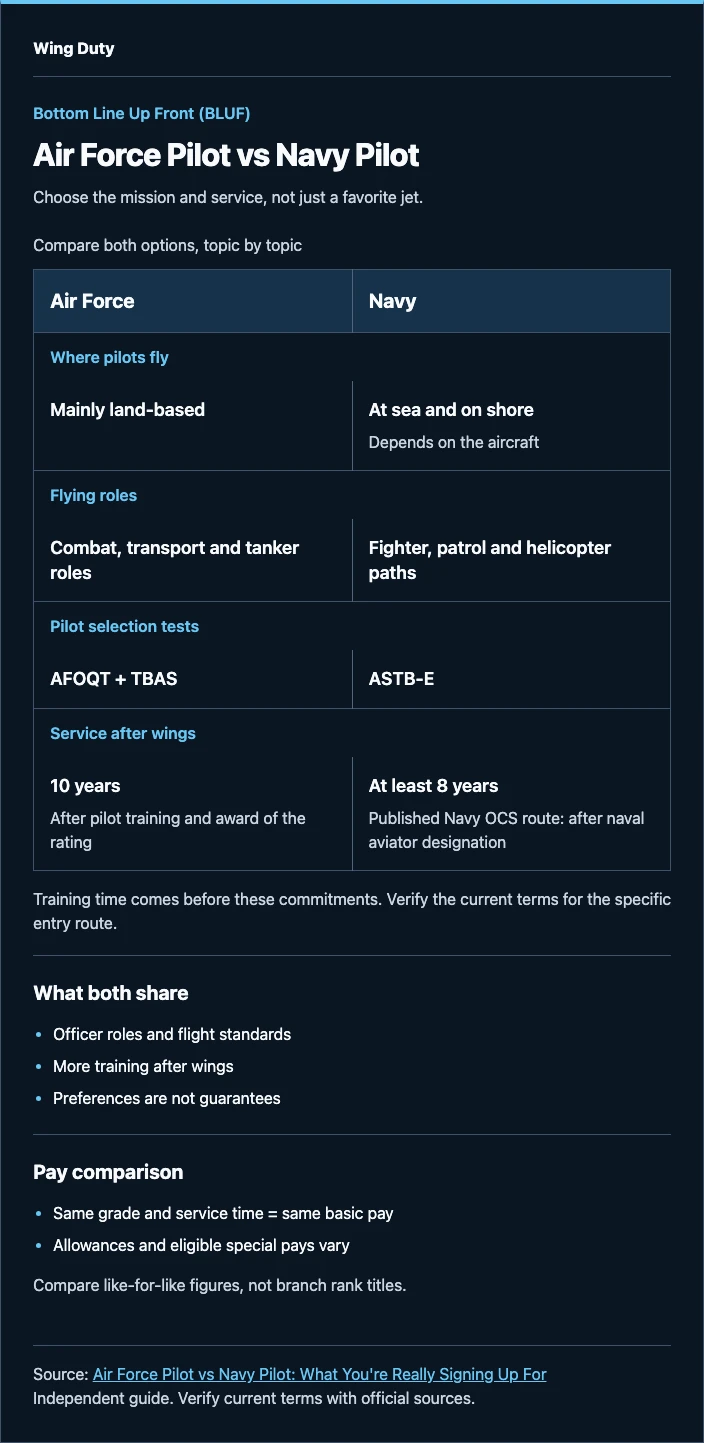
| Air Force | Navy |
|---|---|
| Where pilots fly | |
| Mainly land-based | At sea and on shoreDepends on the aircraft |
| Flying roles | |
| Combat, transport and tanker roles | Fighter, patrol and helicopter paths |
| Pilot selection tests | |
| AFOQT + TBAS | ASTB-E |
| Service after wings | |
| 10 yearsAfter pilot training and award of the rating | At least 8 yearsPublished Navy OCS route: after naval aviator designation |
Training time comes before these commitments. Verify the current terms for the specific entry route.
What both share
- Officer roles and flight standards
- More training after wings
- Preferences are not guarantees
Pay comparison
- Same grade and service time = same basic pay
- Allowances and eligible special pays vary
Compare like-for-like figures, not branch rank titles.
Source: Air Force Pilot vs Navy Pilot: What You're Really Signing Up For
Independent guide. Verify current terms with official sources.
On this page
Wing Duty is supported by purchases through our links, which may earn us a commission.
The main differences at a glance
| Question | Air Force pilot | Navy pilot |
|---|---|---|
| What mission comes first? | Airpower across combat, transport, refueling and other roles | Aviation in support of naval missions, at sea and on shore |
| Where does flying happen? | Mainly from land bases | From land bases and ships, depending on the aircraft |
| Which entry tests matter? | AFOQT and TBAS feed pilot selection | ASTB-E for aviation applicants |
| Is the aircraft guaranteed? | Preferences are one part of assignment | A requested training pipeline is not a promise of a fleet aircraft |
| What commitment is published? | Ten years after pilot training and the award of the rating | At least eight years after designation as a naval aviator under the published OCS authorization |
| Does one branch pay more basic pay? | Same federal pay scale at matching grade and service time | Same federal pay scale at matching grade and service time |
The commitment figures do not include the time spent reaching that point. They also do not replace the terms for a specific entry route. Keep training, time owed after wings and later service choices separate when comparing offers.
Compare the mission before choosing the jet
A tanker pilot and a fighter pilot both serve in the Air Force, but their work is not the same. Aircraft, crew size and mission shape the day. The branch name alone cannot tell you how much time a pilot spends flying, planning, teaching or leading a unit.
The same is true in naval aviation. Navy fighter pilots work at sea and on shore. Its helicopter roles include search and rescue and support to ships. The P-8A serves a different job in long-range maritime patrol. It is not a carrier fighter.
That creates a better question than which branch has the best pilots. Which set of missions would still appeal if the first aircraft choice did not work out?
If long flights with a crew appeal to you, compare those jobs. Look at transport, tanker and patrol work. If you want to fly from a carrier, study the Navy roles that do it. Start with the work you want, then look at the branch. A service can contain jobs with very different ways of life.
Air Force pilots serve in the 11X career field. Navy job codes work in a different way. They use officer designators rather than Air Force Specialty Codes. Use each branch’s own terms when checking a role. A similar flying job does not mean the same entry rules apply.
How the entry routes differ
Both paths start with an officer commission. That is the formal step that makes someone an officer. A degree alone does not secure a pilot place. First comes a place in the service. A pilot training slot is another step. Passing flight school is a further one. Keep those gates apart as you weigh each offer.
The Air Force has three main officer entry routes: the Academy, ROTC and Officer Training School, or OTS. The route shapes when you apply for flying. A student just starting college has different choices from a graduate. Check the route that fits your stage of life.
The Navy also has Academy, ROTC and officer-school paths. Its officer school is called Officer Candidate School, or OCS. The Navy ROTC Navy Option can lead to flying and other officer jobs. A place in ROTC is not a promise that you will be chosen for pilot training.
For each route, find out what the offer actually covers. Does it select someone for pilot training, or does a later board decide? What happens if the flight physical finds a problem? What service may still be owed if training ends early? Ask for the applicable terms before making a plan around a cockpit.
You do not have to enlist first to use those college-to-officer paths. There are routes for people who have already served too. But past service does not promise wings. The Air Force officer entry requirements still apply to a pilot application. Choose a route for what it offers in writing, not what you hope might come later.
The tests are not interchangeable
The tests serve different parts of the process. These names are worth learning before you book a test or buy study material.
| Service | Test or score | What it means |
|---|---|---|
| Air Force | AFOQT | Air Force Officer Qualifying Test |
| Air Force | TBAS | Test of Basic Aviation Skills |
| Air Force | PCSM | Pilot Candidate Selection Method, a combined score |
| Navy | ASTB-E | Aviation Selection Test Battery |
The AFOQT checks skills used to choose officers. The TBAS adds a different set of tasks. The PCSM draws on the pilot part of the AFOQT, the TBAS and flying experience. It is a score built from those inputs, not a third test to book.
A PCSM score is one part of the file. Grades, health and other entry rules still count. No score in this article promises a place. Ask the program staff what the current board will assess.
The Navy uses the ASTB-E for its flying programs. Its test tasks differ from the AFOQT. An AFOQT score cannot stand in for it. Math practice may help build a shared skill. But the tests have different formats and tasks, so a study plan needs to match the right exam.
Build a study plan around the actual application:
- Confirm which test the program requires and check its current testing and retest rules.
- Try official sample questions to find weak areas before choosing paid material.
- Practice those skills under timed conditions, then review why each missed answer was wrong.
- Choose test dates that leave enough time to address those gaps.
For an Air Force application, an AFOQT preparation course is a paid option for a structured study plan. This is an affiliate link. The course is for the written test, not the TBAS, Navy ASTB-E or flight school. Free practice and self-study remain valid choices. A study guide is a secondary format to compare if it suits the budget and study style. Check current prices and contents before buying.

Choose a course only after identifying the gap it is meant to fill. Paid prep does not secure a commission, medical approval or pilot slot.
Flight school leads to more training
Both services teach basic flying skills first. More training then builds skills for the aircraft and its job. Wings mark a major step. They do not mean a new pilot has finished learning. A crew still has to train for the work its unit does.
The Navy starts with primary flight training. Later phases build toward wings. A Fleet Replacement Squadron then teaches the assigned aircraft. The paths include strike, maritime and rotary-wing training. The training system serves more than one branch. Not every aircraft on a joint list is a Navy job.
Air Force training also has more than one route and stage. The Air Force was changing undergraduate pilot training in September 2026. That is a reason to verify the current route, rather than build a life plan around an old claim that flight school always lasts one fixed number of months.
When comparing timelines, ask what the stated time includes. Is it only flying instruction? Does it include time waiting for a class? Does it end at wings or after training on the fleet aircraft? Two estimates can look far apart because they count different parts of the path.
Build a timeline with four parts:
- Commission: when the applicant becomes an officer.
- Flight school: the training that leads toward wings.
- Further training: learning the assigned aircraft and its mission.
- First unit: joining the unit and continuing to train for its work.
Leave room for class dates to change. One past student’s quick path cannot set an end date for yours. Ask which stages the estimate covers before you compare it with another branch’s figure.
A pilot slot is not a fighter guarantee
In the Air Force, results in training help shape the aircraft choice. So do staff views, student preferences and service needs. Doing well helps build a strong record, but an applicant’s preference alone does not determine the assignment.
Navy students also ask for a training path. The process depends on the program and stage. Requesting fighters does not guarantee a fighter seat, a particular squadron or a coast. Check what is being offered and what will be decided later.
This is where an honest backup plan helps. List the missions that would still make the service worth joining. Then list outcomes that would make it a poor fit. If only one aircraft is acceptable, resolve that risk before accepting a broader service commitment.
Do not buy private flight hours as if they buy a fighter seat. Flying experience can be part of a file without promising the result. Ask how the program treats those hours. Check the other rules too. Find out what the expense can and cannot change before you commit the money.
Sea duty is a real lifestyle choice
Carrier flying comes with life aboard a ship. That means fitting into the ship’s work and living routine as well as the flying unit’s schedule. Time away from home is part of the choice. So is shared space. A flight can end while other duties still need to be done.
But Navy does not mean carrier in every case. Its P-8A maritime patrol force has deployed to land bases in the Pacific. That example explains why a branch-wide claim about sleeping aboard a carrier would be wrong. It does not promise a shore-based assignment to a new applicant.
Air Force land basing is not a promise of short trips or a fixed home routine. A base address tells little about how often a particular unit leaves it. Ask about the likely mission, trips, exercises and other duties for the community being discussed. Do not turn one person’s tour into a rate for the entire service.
Talk through these questions with anyone who would share the moves and time apart. How much notice would the household need? What work, school or care duties would be hard to move? What support would be needed during a long absence? The answers may change the choice more than a favorite aircraft does.
Basic pay is the same at the same grade
Basic pay does not rise just because the uniform changes. It follows grade and years of service. Total pay is a different question. Housing and other allowances can change the sum. So can flight pay or a bonus for which the member meets the rules. Keep those parts apart when comparing figures.
The table uses the site’s shared 2026 officer pay data. The labels are Air Force ranks. Navy O-1 is ensign, O-2 is lieutenant junior grade and O-3 is lieutenant. Compare the pay grade and service time, not matching words in the rank title.
| Rank | Pay Grade | Years of Service | Monthly Base Pay | Annual Base Pay |
|---|---|---|---|---|
| Second Lieutenant (2d Lt) | O-1 | 2 or less | $4,150 | $49,802 |
| First Lieutenant (1st Lt) | O-2 | Over 2 | $5,446 | $65,354 |
| Captain (Capt) | O-3 | Over 4 | $7,383 | $88,592 |
Source: DFAS 2026 pay tables. Figures reflect the 2026 pay raise.
These are basic-pay examples, not a promised promotion schedule. An O-3 figure is not what every new pilot receives on the day wings are awarded. Time in training, prior service and career history can change which row applies.
A bonus shown in a headline may be for pilots already in service. Check who can get it and what they must agree to do. Do not add it to a new pilot’s starting pay without that check. The amount on a poster is not a promise to each person who applies.
Ask each recruiter to use the same starting facts. Match the grade, years served, family status and pay year. A move to another base can change the housing allowance even when basic pay stays the same. A total built from different facts is not a fair test of the two branches.
Count the years after wings as well as training
The Air Force publishes a ten-year active-duty commitment after pilot training and the award of the rating. The Navy’s March 2025 OCS aviation authorization states at least eight years after designation as a naval aviator. These start points matter. Neither number includes the time from first application to wings.
Ask for the current written terms for your route. Find out when the clock starts. Check what happens if more time is owed under a later agreement. Do not treat the first end date as fixed for the rest of a career. Make plans from the actual terms, not just the headline number.
The same care applies to plans for civilian flying. Military service should fit as a career in its own right. Do not choose a service solely as a fixed-length route to a later airline job. A future employer, hiring market and personal flight record cannot be guaranteed at entry.
Questions to settle before applying
Ask both services the same questions so the answers can be compared fairly.
- Which route is open for the applicant’s education and current status?
- At what point is pilot training selected, and what does the offer cover?
- Which tests and flight physical are required for that route?
- What happens if the applicant cannot start or finish flight training?
- Which aircraft paths are possible, and how are preferences considered?
- What training stages are included in the quoted timeline?
- When does the pilot service commitment start, and what else may be owed?
- What sea, shore or deployment pattern should the applicant investigate?
Bring the answers back to the original choice. Carrier operations may make the Navy worth pursuing for one person. A wider interest in land-based air missions may point another toward the Air Force. Either choice still needs room for assignments that are not the first preference.
An Air Force pilot application involves an officer entry route, testing and medical screening. Use the comparison to choose which path to explore, then check the current terms for that route.
For the Air Force written entry test, an AFOQT preparation course offers structured study. It does not cover the Navy ASTB-E or flight training. Compare it with free practice and self-study after confirming the test required for the chosen route.