Air Force Pilot vs CSO vs ABM vs RPA
The Air Force has four rated officer positions. Pilot, Combat Systems Officer, Air Battle Manager, and RPA Pilot, and they differ far more than their shared “rated” label suggests. One puts you in a fighter cockpit. Another has you directing an entire air battle from an airborne command platform. A third never leaves the ground, yet flies real combat missions. Choosing between them comes down to what kind of work you actually want to do, how competitive your selection scores are, and what career path matters to you after the Air Force.
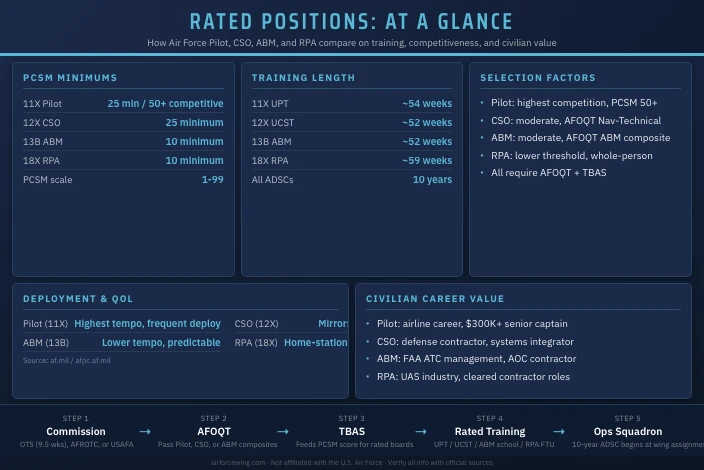
The Four Rated Positions at a Glance
Every rated officer holds a commission, earns aviation incentive pay, and competes through the same selection pipeline. But the daily mission, training length, and career trajectory are different for each designator.
| Position | AFSC | Primary Platform(s) | PCSM Required | Training Length |
|---|---|---|---|---|
| Pilot | 11X | F-35, F-22, C-17, B-52, KC-46, and many others | 25 minimum (50+ competitive) | ~54 weeks (UPT) |
| Combat Systems Officer | 12X | F-15E, B-52, B-1, AC-130 | 25 minimum | ~52 weeks (UCT) |
| Air Battle Manager | 13B | E-3 Sentry AWACS | 10 minimum | ~52 weeks |
| RPA Pilot | 18X | MQ-9 Reaper, RQ-4 Global Hawk | 10 minimum | ~59 weeks |
The Pilot track is the most competitive. CSO and ABM require the same commission and TBAS, but the selection boards are less competitive than Undergraduate Pilot Training boards. RPA boards have the lowest PCSM threshold of any rated track.
All four require a bachelor’s degree, a commission through OTS, AFROTC, or USAFA, and a minimum AFQT of 36 for prior-enlisted applicants going through OTS. Every candidate must also pass the Air Force Officer Qualifying Test (AFOQT) and, for rated selection, the Test of Basic Aviation Skills (TBAS). TBAS scores feed into the Pilot Candidate Selection Method (PCSM) score on a 1 to 99 scale.
This site is not affiliated with the U.S. Air Force or any government agency. Verify all information with official Air Force sources before making enlistment or career decisions.
11X Pilot: Most Competitive, Highest Demand
The 11X designator covers every manned aircraft the Air Force flies. Specific sub-designators (11F fighter, 11M mobility, 11B bomber, 11H helicopter, 11S special operations) are assigned at the end of Undergraduate Pilot Training based on class ranking, instructor evaluations, and Air Force needs. You don’t pick your aircraft, you earn a ranking and the Air Force fills assignments from the top down.
What pilots actually do:
- Plan and fly tactical and strategic missions in fighters, bombers, tankers, and airlift aircraft
- Lead crews and flights; at Captain, most command 15 to 25 Airmen
- Make real-time decisions in contested airspace with incomplete information
- Deploy frequently, fighter and bomber pilots average high operational tempo
UPT runs approximately 54 weeks at Laughlin AFB, Columbus AFB, Vance AFB, or Sheppard AFB (for NATO joint training). Students begin on a primary trainer (T-6A Texan II) before advancing to a jet track (T-38C) or multi-engine track (T-1A Jayhawk). The graduation aircraft track determines what kind of aircraft you’re most likely to fly at your first assignment.
Selection standards:
- PCSM 25 is the minimum to be considered; most UPT board selections come from the 50+ range
- AFOQT Pilot subtest is a weighted input to the PCSM calculation
- Civilian flight hours can add significant points to your PCSM, 200+ hours earns the maximum bonus
- Age limit: under 33 at the start of UPT
The active duty service commitment after UPT is 10 years. That’s the longest commitment in the rated force. Pilots who leave before completing it owe the Air Force money.
12X Combat Systems Officer: The Back-Seat Specialist
Combat Systems Officers (CSOs) fly alongside pilots on multi-crew aircraft. They manage weapons employment, navigation, electronic warfare, and sensor systems. On an F-15E Strike Eagle, the CSO in the back seat runs the targeting pod and employs the weapons while the pilot flies the aircraft. On a B-52, CSOs manage the bomb load and navigation systems for a crew of five. On an AC-130 gunship, the CSO coordinates fire missions against ground targets.
This is a technically demanding job. CSOs are not copilots, they’re systems experts who own the weapons delivery side of the mission.
What CSOs actually do:
- Operate weapons delivery systems, targeting pods, and electronic warfare equipment
- Fly on multi-crew aircraft; specific role depends on platform
- Navigate and manage sensor suites on bombers, fighters, and ISR aircraft
- Deploy at similar tempo to pilots on the same platforms
Undergraduate Combat Systems Officer Training (UCST) runs approximately 52 weeks at Pensacola Naval Air Station (the Air Force trains alongside Navy NFOs). Students complete ground academics, simulator work, and in-flight training on T-6A and T-1A aircraft before earning the CSO badge.
Selection standards:
- PCSM 25 is the minimum; CSO boards are less competitive than pilot boards
- AFOQT Navigator-Technical subtest is the relevant composite for CSO candidates
- TBAS is required and feeds PCSM for the board selection process
- Age limit: under 33 at the start of UCST
The active duty service commitment after UCST is also 10 years.
13B Air Battle Manager: Directing the Air Battle
Air Battle Managers (ABMs) do not pilot aircraft. They fly aboard airborne command and control platforms, primarily the E-3 Sentry AWACS: and direct air battles. An ABM tracks multiple aircraft simultaneously, coordinates fighter employment, manages airspace to prevent collisions and fratricide, and communicates with ground and surface forces.
In a contested environment, the ABM is the person making real-time decisions about where to send the fighters and how to integrate airpower across a joint force. The job requires exceptional situational awareness and the ability to process sensor data across a large area at speed.
What ABMs actually do:
- Control airspace and direct aircraft during joint air operations from E-3 Sentry platforms
- Integrate fighter, tanker, and support aircraft in contested and complex airspace
- Communicate with ground, naval, and allied forces to coordinate airpower employment
- Serve as weapons directors and senior controllers on air operations centers (AOCs)
ABM training runs approximately 52 weeks at Tyndall AFB, Florida. Students complete academic instruction in air battle management procedures, radar systems, and joint air operations before qualifying on the E-3.
Selection standards:
- PCSM 10 is the minimum (significantly lower threshold than pilot or CSO boards)
- AFOQT ABM subtest composite is the relevant score
- TBAS is required; ABM candidates are not PCSM-scored the same way pilot candidates are
- Age limit: under 33
ABMs can progress into command positions within Air Operations Centers and regional air defense commands. The career field has strong overlap with joint operations planning, which creates opportunities for senior ABMs to serve in joint staff roles.
18X RPA Pilot: Operational Without Leaving the Ground
RPA Pilots fly the Air Force’s remotely piloted aircraft, the MQ-9 Reaper and RQ-4 Global Hawk: from ground control stations at bases like Creech AFB in Nevada or Cannon AFB in New Mexico. The designation is 18X. Despite being ground-based, RPA pilots are rated officers with the same commission and aviation incentive pay as manned aircraft pilots.
The MQ-9 Reaper is a strike and ISR platform that can orbit a target for 14 or more hours. That persistence is something no manned aircraft can match. RPA pilots support special operations teams, conduct close air support, and execute precision strikes in real-time combat. The missions are real. The weapons are live. The decisions carry the same weight as any other rated position.
What RPA pilots actually do:
- Fly MQ-9 and RQ-4 missions from ground control stations, often in continuous combat support
- Employ weapons, coordinate with ground forces, and conduct long-endurance surveillance
- Work in crew teams (pilot and sensor operator) managing time-sensitive targets
- Deploy less frequently than manned aircraft pilots but maintain high operational tempo from home station
RPA Initial Flight Training and formal training units run approximately 59 weeks in total. Students complete academic instruction, simulator qualification, and then mission qualification training at the operational wing level.
Selection standards:
- PCSM 10 is the minimum: the lowest required of any rated track
- AFOQT Pilot subtest is still the relevant composite
- TBAS is required; scores feed PCSM
- Age limit: under 33
The active duty service commitment after RPA training is 10 years, matching the manned pilot commitment. Assignment locations are more concentrated than for manned aviation, the bulk of RPA operations run through Creech AFB in Nevada, with additional units at Cannon AFB, New Mexico.
Head-to-Head: Training Pipeline
The training timelines differ, but all four paths include OTS or another commissioning source, plus rated training that takes roughly a year.
| Phase | Pilot (11X) | CSO (12X) | ABM (13B) | RPA (18X) |
|---|---|---|---|---|
| Commissioning (OTS) | 9.5 weeks | 9.5 weeks | 9.5 weeks | 9.5 weeks |
| Primary training | T-6A Texan II | T-6A / T-1A | Academic / radar | Ground school |
| Advanced training | T-38C or T-1A | T-1A / B-52/F-15 | E-3 qualification | MQ-9 / RQ-4 |
| Total rated training | ~54 weeks | ~52 weeks | ~52 weeks | ~59 weeks |
| ADSC after wings | 10 years | 10 years | 10 years | 10 years |
All four training pipelines run longer than any enlisted technical school. The 10-year active duty service commitment is the same across the board.
Head-to-Head: Deployment and Quality of Life
This is where the positions diverge most sharply in day-to-day experience.
Pilots (11X) face the highest operational tempo in the rated force, especially in fighter and bomber communities. Six-month deployments are common. Some aircraft types, particularly fighters, have deployed continuously since the 1990s. Mobility pilots on tankers and airlifters deploy frequently but often rotate through shorter tours. Family separation is a real factor in this career field.
CSOs (12X) deploy with the aircraft they’re assigned to, so tempo mirrors the platform. F-15E CSOs deploy at fighter pilot tempo. B-52 CSOs deploy with bomber units. The deployment picture is tied entirely to the airframe, not the designator itself.
ABMs (13B) typically deploy in support of air expeditionary rotations aboard E-3 aircraft. Deployment tempo is generally lower than fighter or bomber communities. Home station time is more predictable, and the operational footprint is smaller since AWACS units are fewer in number than fighter wings.
RPA Pilots (18X) operate mostly from home station. The persistent nature of RPA operations means crews work rotating shifts, including overnight and weekend missions, from bases in the continental United States. The trade-off is significantly less family separation from overseas deployments. But shift work, including nights and holidays, is a normal part of the job rather than an exception.
Head-to-Head: Competitiveness
| Track | Board Competition | Key Selection Factor |
|---|---|---|
| 11X Pilot | Highest | PCSM 50+ recommended; flying hours help |
| 12X CSO | Moderate | PCSM 25+; AFOQT Navigator-Technical |
| 13B ABM | Moderate | PCSM 10+; AFOQT ABM composite; leadership record |
| 18X RPA | Lower | PCSM 10+; AFOQT Pilot; whole-person factors |
The pilot track is the most competitive rated position. Selection boards compare PCSM scores head-to-head, and applicants without scores in the competitive range face long odds regardless of how strong the rest of their package looks. For candidates who want a rated career but score below 50 on the PCSM, CSO is often the realistic path to an operational flying career. ABM and RPA offer rated status with lower selection thresholds, though each carries a genuine operational mission.
Head-to-Head: Civilian Career Value
Post-service career potential differs significantly across the four tracks.
Pilot (11X) produces the strongest civilian aviation outcome. Major airlines hire military pilots directly and count military flight hours toward ATP certificate requirements. Senior captains at legacy carriers earn well over $300,000 per year. Fighter and mobility pilots with several hundred hours of flight time are preferred applicants. Defense contractors also hire former pilots for test pilot, flight operations, and program management roles.
CSO (12X) transfers to defense contractor work and systems integration roles. CSOs with experience on F-15E or B-52 electronic warfare systems can transition to contractor jobs supporting those same programs. The civilian salary ceiling is lower than airline piloting, but the specialized technical knowledge has real market value.
ABM (13B) has direct overlap with Federal Aviation Administration (FAA) air traffic control management. Former ABMs with current clearances are competitive applicants for FAA en route center and terminal positions, as well as air operations center contractor roles at defense companies supporting combatant commands.
RPA Pilot (18X) translates well to the commercial drone industry and to defense contractors running government RPA programs. The civilian unmanned systems market has grown substantially, and former 18X pilots with operational clearances are competitive for both government and private sector UAS positions. Entry-level civilian UAS jobs pay less than airline careers, but senior contractor roles supporting active RPA programs can pay well.
Which Rated Position Fits You
The right choice depends on three things: your selection scores, the kind of daily work you want, and your post-service career priorities.
Go for 11X Pilot if you have a PCSM above 50, civilian flying hours or the ability to build them, and are willing to commit to the highest operational tempo in the rated force. The career ceiling, airline captain, test pilot, airline management, is higher than any other rated track.
Go for 12X CSO if your PCSM is competitive but below pilot board averages, or if technical systems work appeals to you more than stick-and-rudder flying. The operational missions are real and the aircraft are impressive.
Go for 13B ABM if you want a rated career oriented around large-scale mission coordination rather than individual aircraft operations. The PCSM threshold is low, and the career has strong overlap with joint operations and command staff assignments.
Go for 18X RPA if you want a rated position with the best quality-of-life balance, minimal overseas deployment against high operational impact. The civilian UAS market is growing, and the clearances RPA pilots carry open contractor doors that other resumes can’t.
For complete career details on each position, the Air Force Operations officer career field covers all four rated tracks with AFOQT minimums, PCSM cutoffs, and full training pipelines. For TBAS preparation and PCSM score strategy, the Air Force TBAS test guide covers what the test measures and what a competitive score actually looks like on a selection board.
You may also find Air Force aviation jobs and Air Force officer selection tests helpful for understanding the full selection pipeline.