Air Force Physical Fitness: Standards, Scoring, and How to Prepare
Physical fitness is not optional in the Air Force. It affects whether you graduate Basic Military Training, whether you get promoted, and in some cases whether you stay in at all. Every active-duty airman takes a scored fitness assessment at least twice a year. Every recruit faces a fitness evaluation before graduating BMT. And for special warfare candidates, an entirely separate and far more demanding test stands between them and a contract. This guide covers all of it: what each test requires, how scores are calculated, what the consequences of failing look like, and how to build a training plan that addresses the right priorities.
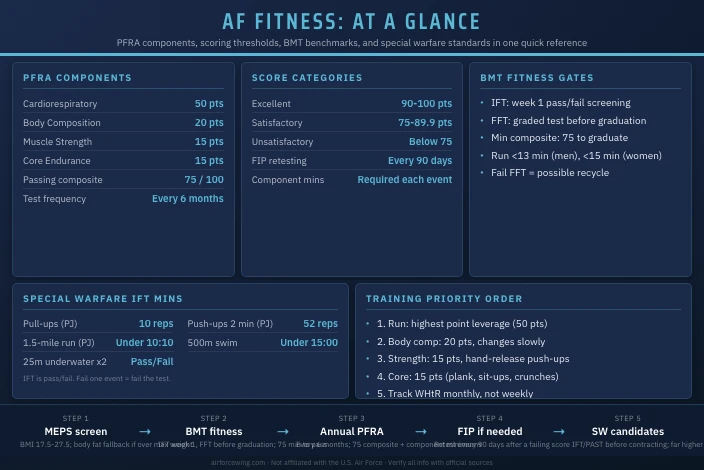
Why Fitness Standards Exist
The Air Force is an operational force. Even desk-based career fields deploy. Medical personnel work in field conditions. Maintainers work long shifts in physical environments that demand endurance and physical resilience. Fitness standards exist because airmen across every specialty need a baseline level of physical capability to function in those environments.
The standards also serve an administrative function. Poor fitness scores follow you. They show up in performance reports, affect promotion eligibility, and can restrict you from certain assignments. One failing assessment triggers mandatory remediation. Repeated failures can lead to separation.
The message the Air Force sends is consistent: physical readiness is part of the job, not a separate hobby.
The Air Force Fitness Assessment
The primary fitness standard for active-duty airmen is the Air Force Physical Fitness Readiness Assessment (PFRA), updated under AFMAN 36-2905 and effective March 1, 2026. It replaced the older four-event Fitness Assessment format with a structure that gives airmen more options while maintaining a rigorous composite standard.
Testing frequency increased to twice per year for all active-duty members, up from the previous annual cycle for most airmen.
The Four Components
| Component | Max Points | Options |
|---|---|---|
| Cardiorespiratory | 50 | 2-mile run, 1.5-mile run, or HAMR |
| Body Composition | 20 | Waist-to-height ratio |
| Muscle Strength | 15 | Hand-release push-ups (2 min) or standard push-ups (1 min) |
| Core Endurance | 15 | Sit-ups, cross-leg reverse crunches, or forearm plank |
| Total | 100 |
The minimum composite score to pass is 75 out of 100. But meeting 75 composite is not the only requirement. Each component has its own floor. Fail any single event and the overall result is a fail, regardless of your composite.
The 2-mile run is required at least once per 365-day period. You cannot use the 1.5-mile run or HAMR for both annual tests. One of the two must be the 2-mile.
The Cardiorespiratory Component
Cardio carries 50 of the 100 available points, making it the heaviest single factor. Run times are scored on age- and gender-normed tables, with the scoring range running from 35 to 50 points. A minimum effort still earns 35 points, but 35 points on a 50-point component will drag down your composite significantly.
For men under 25, the maximum-score 2-mile time is around 13:25. The minimum passing time runs near 19:45. That’s a 6-minute gap where every second of improvement adds points. Older age brackets have more generous standards, but the same math applies within each group.
For complete run time standards broken out by every 5-year age bracket, the Air Force PT Test Scoring Chart has current PFRA tables with both endpoints and score-increment detail.
Body Composition
The body composition component is worth 20 points and uses waist-to-height ratio (WHtR). The standard is a WHtR of 0.55 or less. The calculation is straightforward: divide waist measurement in inches by height in inches. A 5'10" airman (70 inches) needs a waist under 38.5 inches to meet the threshold.
This replaced the older raw waist circumference measurement. The WHtR applies uniformly across all ages and genders, which eliminates the separate tables the old system required.
A result above 0.55 doesn’t automatically disqualify you from the assessment, but it drops your body composition score and makes reaching 75 composite significantly harder. At 20 points, a high-risk body composition result can make a passing composite almost unreachable on its own.
The Air Force Height and Weight Standards covers both the enlistment-stage BMI and body fat limits and the active-duty WHtR standard in detail.
Muscle Strength and Core
These two components each carry 15 points, a notable increase from the 10 points each held under the old system. Together they represent 30% of your total possible score.
For muscle strength, you choose between hand-release push-ups for two minutes or standard push-ups for one minute. Hand-release push-ups require a full chest-to-floor lower and a hand lift at the bottom of each rep, which eliminates partial-rep momentum.
For core endurance, you choose between sit-ups for one minute, cross-leg reverse crunches for two minutes, or a timed forearm plank. The plank is a static hold with no movement required, which some airmen find easier to gauge than timed reps.
Try both options for each component in training before your test. You pick one and commit for that session.
Score Categories and Consequences
| Composite Score | Category |
|---|---|
| 90-100 | Excellent |
| 75-89.9 | Satisfactory |
| Below 75 | Unsatisfactory (Fail) |
An Excellent score reflects positively in promotion packages. Satisfactory meets the standard for deployments and most career actions. Unsatisfactory triggers mandatory enrollment in a Fitness Improvement Program (FIP) and requires retesting, typically every 90 days until scores recover.
Consequences escalate with repeated failures:
- Referral performance reports (EPR or OPR)
- Ineligibility for deployment
- Loss of promotion eligibility for certain cycles
- Administrative discharge proceedings in cases of sustained failure
One failing score is recoverable. A pattern of fails is a career-ending track.
BMT Fitness Standards
Fitness begins before the official annual assessment. At Basic Military Training (BMT) at Joint Base San Antonio-Lackland, every recruit goes through an organized physical training program across 7.5 weeks. PT starts on Day 1.
Two formal fitness events happen at BMT:
- Initial Fitness Test (IFT): Administered in week one. Pass/fail screening. Recruits who fail may be held back or placed in a remedial program before continuing.
- Final Fitness Test (FFT): Administered near graduation. This is the graded test that determines whether you graduate.
The FFT mirrors the Fitness Assessment format. A minimum composite of 75 is required. Failing the FFT can result in being recycled into a later BMT class or placed in a Physical Training Leaders (PTL) remediation program. Repeated failures can result in separation before completing training.
Arriving prepared makes the difference between building fitness at BMT and merely surviving it. BMT’s PT program is designed to improve recruits who arrive at a minimum fitness level. It’s not designed to build fitness from scratch in 7.5 weeks.
Practical benchmarks for arriving at BMT:
- Run 1.5 miles in under 13 minutes (men) or 15 minutes (women)
- Complete 30+ push-ups with good form
- Run consistently 3-4 days per week for at least 8 weeks before shipping
What daily PT looks like week by week, and how fitness intensity builds across the full BMT schedule, is covered in Air Force BMT Physical Training: What to Expect.
Body Composition Before Enlistment
Body composition standards apply before you ever reach BMT. At MEPS (Military Entrance Processing Station), applicants are screened with a BMI range of 17.5 to 27.5. Exceeding the maximum BMI triggers a secondary body fat assessment.
Maximum body fat at accession by group:
| Group | Maximum Body Fat |
|---|---|
| Males under 30 | 20% |
| Males 30 and older | 24% |
| Females under 30 | 28% |
| Females 30 and older | 32% |
Body fat is measured using tape circumference methods at MEPS. If you exceed both the BMI ceiling and the body fat limit for your group, you cannot ship until you comply. The Air Force doesn’t run a weight-loss program for applicants. You reduce and return.
This is a separate system from the active-duty WHtR standard. Enlistment uses BMI plus body fat fallback. Once in, the Fitness Assessment uses waist-to-height ratio.
Training Priorities
The scoring math makes the cardio component the highest-return training target. A 30-second improvement in your run time produces more composite points than maxing out both push-ups and sit-ups combined in most age brackets.
That said, the 2026 scoring update raised the weight of strength and core to 15 points each. An airman sitting at 73 composite cannot afford to coast on those events. Meeting minimums is not optional on any component.
A general training framework:
The Air Force PT Test Scoring Chart shows the exact run times and rep counts needed for each point tier in your age bracket, which lets you set specific weekly targets rather than training blind. For a full 10-week run training plan with pacing guidance, interval progressions, and a taper week, see How to Train for the 1.5-Mile Run.
The Standard Annual Fitness Assessment
The PFRA is an ongoing career obligation, not a one-time hurdle. Most active-duty airmen now test every six months. Those on a FIP following a failing score retest every 90 days until scores recover to Satisfactory or above.
The cycle creates a predictable rhythm: test, identify weak points, train to those points, test again. Airmen who treat it this way rarely fail twice. Those who train to the minimum, pass, and stop training until the next test cycle often watch their scores trend in the wrong direction.
Age brackets adjust the standards every five years. A 24-year-old holding the same fitness level at 29 will face slightly more generous scoring thresholds. But the floor, 75 composite and minimums on every component, does not change.
Special Warfare: An Entirely Different Bar
Most Air Force career fields require passing the PFRA. Special warfare careers require passing the Initial Fitness Test (IFT), previously called the Physical Ability and Stamina Test (PAST), just to get a contract. The IFT is not scored on a composite. It’s pass/fail, and all six events must be cleared in a single session.
IFT events by career field:
| Event | PJ (1T2X1) | CCT / TACP / SR |
|---|---|---|
| Pull-ups | 10 | 8 |
| Push-ups (2 min) | 52 | 40 |
| Sit-ups (2 min) | 54 | 50 |
| 1.5-Mile Run | Under 10:10 | Under 10:20 |
| 500m Surface Swim | Under 15:00 | Under 15:00 |
| 25m Underwater Swim x2 | Pass/Fail | Pass/Fail |
The IFT minimum is a contracting floor. Candidates who test at exactly the minimum rarely survive Assessment and Selection (A&S), which eliminates roughly 50% of IFT passers. The practical preparation targets are significantly higher: 20 pull-ups, 80+ push-ups in two minutes, a sub-9:00 run, and 500m swim under 10 minutes.
The underwater swim is the most common failure point. It requires breath-hold confidence that no amount of running fitness compensates for. Training for special warfare means training in the water first, not last.
Special Warfare Fitness Requirements: PAST Standards covers the full IFT breakdown by AFSC, the 16-week preparation block, and what to expect at Assessment and Selection. The Air Force Special Warfare career section profiles the specific AFSCs and training pipelines.
Putting It All Together
Fitness in the Air Force isn’t a single test you prepare for once. It’s a recurring standard with real career consequences that spans every stage from MEPS through your final year of service.
For recruits: MEPS body composition screening and the BMT Final Fitness Test are the immediate gates. For active-duty airmen: the PFRA every six months, with scoring tables that reward consistent training over crash preparation. For special warfare candidates: an entirely separate test that demands months of dedicated preparation before you ever sit across from a recruiter.
The details on specific scoring tables, depth on BMT progression, and structured run training plans each live in their own dedicated guides. This overview gives you the map. The support posts give you the instructions for each leg of the journey.
Air Force Fitness Test: Standards, Scoring, and How to Pass is the natural next read for anyone who wants the full PFRA breakdown. The enlistment process guide covers how physical fitness standards fit into the broader timeline from recruiter contact through BMT graduation.
You may also find Air Force enlisted careers useful if you’re still deciding which AFSC to pursue, since career field selection affects training pipeline length and duty station, both of which shape your fitness environment.
This site is not affiliated with the U.S. Air Force or any government agency. Verify all information with official Air Force sources before making enlistment or career decisions.