Complete Guide to Air Force Pay and Benefits
Most people see the enlistment ad and think about the salary. The reality is that basic pay is only one part of what the Air Force puts in your pocket. Add in housing allowance, free healthcare, paid leave, and a matching retirement account from day one, and the full picture looks very different from a civilian compensation package.
This guide breaks down every major piece of Air Force compensation so you can calculate your actual take-home and make an informed decision before you sign.
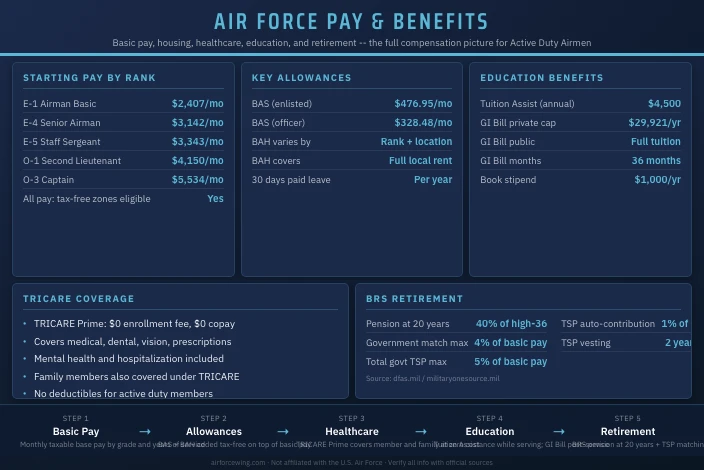
Basic Pay: What You Actually Earn
Basic pay is the foundation. It’s set by Congress each year and applies across all military branches by grade (rank) and years of service. The 2026 pay table reflects a 3.8% across-the-board raise effective January 1, 2026.
| Rank | Pay Grade | Years of Service: 2 | Years of Service: 4 | Years of Service: 6 | Years of Service: 8 |
|---|---|---|---|---|---|
| Airman (Amn) | E-2 | $2,698 | $2,698 | $2,698 | - |
| Senior Airman (SrA) | E-4 | $3,303 | $3,659 | $3,816 | $3,816 |
| Staff Sergeant (SSgt) | E-5 | $3,599 | $3,947 | $4,109 | $4,299 |
| Technical Sergeant (TSgt) | E-6 | $3,743 | $4,069 | $4,236 | $4,613 |
Source: DFAS 2026 pay tables. Figures reflect the 2026 pay raise.
A few things worth knowing about the table:
- E-1 Airman Basic (AB) starts at $2,407/month after the first four months of service.
- Pay steps up automatically with years of service, not performance reviews.
- O-6 Colonel (Col) basic pay is capped at $15,408/month regardless of years served.
Basic pay is taxable, but service in a designated combat zone makes it tax-exempt for the months you’re deployed there. That alone can shift your net take-home substantially during a deployment year.
For context on how rank and pay interact with career choice, the enlisted career pages show pay ranges by AFSC alongside qualification requirements.
Allowances: The Tax-Free Layer
Allowances sit on top of basic pay and are not taxed. They cover two basic needs: food and housing.
Basic Allowance for Subsistence (BAS)
BAS is a flat monthly payment toward food costs. It doesn’t vary by location or family size. Every enlisted Airman gets the same amount.
$477BAS is not a meal card or a dining facility credit. It’s cash deposited with your paycheck. If you eat in the dining facility, you pay for it separately out of BAS.
Basic Allowance for Housing (BAH)
BAH replaces the need for military housing when you live off-base. The amount varies by three factors: your pay grade, your duty station ZIP code, and whether you have dependents.
The Air Force sets BAH to cover median local rent at each installation. That means an E-5 Staff Sergeant (SSgt) stationed at Joint Base San Antonio earns different BAH than the same rank stationed at Edwards AFB in California.
| Example: JBSA-Lackland, TX | Without Dependents | With Dependents |
|---|---|---|
| E-4 Senior Airman (SrA) | $1,359/mo | $1,728/mo |
| E-5 Staff Sergeant (SSgt) | $1,500/mo | $1,869/mo |
| O-1 Second Lieutenant (2d Lt) | $1,584/mo | $1,905/mo |
These are representative figures for one installation. Your actual BAH depends on your assigned duty location. The DoD BAH Rate Lookup gives exact figures by ZIP code and grade.
BAH does not count as taxable income. For most Airmen with dependents, BAH alone covers rent at a typical installation city.
Leave
The Air Force gives 30 days of paid leave per year, accruing at 2.5 days per month. You can carry up to 60 days over into the next year. There are also 11 federal holidays. Unused leave at separation can be paid out (up to the 60-day cap).
Healthcare: TRICARE Prime
Active duty Airmen and their families are covered under TRICARE Prime at no cost. There’s no enrollment fee, no annual deductible, and no copays for active duty members.
Coverage includes:
- Medical and surgical care
- Dental (active duty only; family members use a separate dental plan)
- Vision
- Mental health and behavioral health
- Prescription drugs (through military pharmacies at no cost)
- Hospitalization
Family members covered under TRICARE Prime may have small copays for some services, but routine care at a military treatment facility is typically free for them as well.
The dollar value of this benefit is significant. A comparable civilian family health plan often runs $500-$1,000/month in premiums alone, before deductibles and copays. For more on how TRICARE works in practice, the Air Force TRICARE guide walks through plan options, referrals, and what changes when you separate.
Education Benefits
The Air Force has two main education programs, and they serve different points in your career.
Tuition Assistance (While Serving)
Tuition Assistance (TA) covers tuition costs while you’re on active duty. The Air Force pays up to $250 per semester credit hour and caps the benefit at $4,500 per fiscal year. That covers most or all of the tuition at community colleges and many four-year programs.
TA applies to tuition only. Books, fees, and living costs come from your own pocket (or BAS).
Post-9/11 GI Bill (After Serving)
The Post-9/11 GI Bill kicks in after you separate and covers up to 36 months of education costs. At public schools, it pays full in-state tuition and mandatory fees with no dollar cap. At private schools, it pays up to the annual cap:
$29,920.95On top of tuition, the GI Bill provides a monthly housing allowance (based on the E-5 with dependents BAH rate at your school’s ZIP code) and a $1,000 annual book stipend. Online-only students receive $1,169/month for housing instead of the BAH-based rate.
You can transfer unused GI Bill benefits to a spouse or dependent children after 6 years of service, if you commit to 4 additional years. That transfer must be requested while you’re still on active duty.
For the full breakdown on maximizing this benefit, see Post-9/11 GI Bill: What It Covers and How to Use It.
Housing Allowance Deep Dive
BAH deserves more attention because it’s often the biggest single-number difference between what people expect and what they actually receive.
A few mechanics that are easy to miss:
You keep BAH even if your rent is lower. If you find housing cheaper than the BAH rate, you pocket the difference. Many Airmen in lower cost-of-living cities do exactly this.
BAH is calculated at your installation, not where you grew up. Assignments to high-cost areas like the Bay Area or Washington, D.C. come with proportionally higher BAH.
The rate is locked when you PCS. When you move to a new base, your BAH updates to the new location’s rates. If rates drop at your current base in a subsequent year, your BAH is protected at the rate you were receiving (this is called “rate protection”).
For a full explanation of how BAH is calculated, updated, and protected, the Air Force BAH guide covers all the edge cases including what happens during deployments and remote assignments.
Retirement: The Blended Retirement System
Every Airman who enlists after January 1, 2018 enters the Blended Retirement System (BRS). The BRS has two components working in parallel from the start.
Pension
If you serve 20 or more years and receive an honorable discharge, you qualify for a monthly pension for life. The formula:
2% x years of service x average of your highest 36 months of basic pay
At exactly 20 years, that’s 40% of your high-36 average basic pay, paid monthly for the rest of your life. At 24 years it’s 48%, at 30 years it’s 60%.
Thrift Savings Plan (TSP)
The TSP works like a 401(k). The government automatically contributes 1% of your basic pay starting after 60 days of service. You don’t have to do anything to receive this.
If you contribute your own money, the government matches up to an additional 4%:
| Your Contribution | Government Match |
|---|---|
| 0% | 1% (auto only) |
| 1% | 2% |
| 2% | 3% |
| 3% | 4% |
| 4% | 4.5% |
| 5% | 5% (maximum) |
The 1% auto-contribution vests at 2 years of service. The matching contributions vest at 2 years as well. So if you separate before the 2-year mark, you forfeit the government contributions but keep everything you contributed yourself.
The TSP offers traditional (pre-tax) and Roth (post-tax) accounts. Investment options include low-cost index funds and lifecycle funds that auto-adjust as you approach a target retirement date.
For a detailed look at contribution strategies and fund selection, see Thrift Savings Plan (TSP) for Air Force Members.
Continuation Pay
BRS includes one more piece: Continuation Pay, a one-time lump sum paid to members who reach 12 years of service and agree to serve at least 3 more. The amount varies by year and career field. It’s separate from enlistment bonuses and re-enlistment bonuses.
For a full analysis of the BRS pension formula, break-even timelines, and how it compares to the legacy retirement system, see Air Force Retirement: BRS Pension Calculator and Timeline.
The Full Compensation Picture
Basic pay gets quoted in job ads. The real number includes everything. Here’s how a mid-career enlisted Airman’s compensation actually stacks up:
| Component | Monthly Value | Notes |
|---|---|---|
| Basic Pay (E-5, 4 yrs) | $3,947 | Taxable |
| BAS | $477 | Tax-free |
| BAH (JBSA, with dependents) | $1,869 | Tax-free |
| TRICARE (family) | ~$600 | Estimated market value |
| TSP 5% match | $197 | Non-taxable contribution |
| Total estimated monthly | ~$7,090 |
That $7,090 figure doesn’t include education benefits, paid leave value, or any special pays (flight pay, hazardous duty pay, assignment incentive pay). An E-5 with dependents on an overseas assignment or in a combat zone earns considerably more after those additions.
For a direct comparison of what enlisted and officer packages look like at the same experience level, the Air Force officer vs: enlisted pay comparison runs the numbers side by side.
Special Pays and Incentives
Basic pay plus allowances covers the base case. Several additional pays layer on top for specific roles or circumstances.
Aviation career incentive pay supplements basic pay for rated officers (pilots, combat systems officers, air battle managers). Amounts vary by years of aviation service.
Special duty assignment pay applies to certain demanding or critical assignments where the Air Force needs to retain qualified people.
Hazardous duty incentive pay covers activities like parachuting, EOD work, flight deck duty, and others with elevated physical risk.
Hostile fire/imminent danger pay activates during deployments to designated threat areas. It’s paid as a flat monthly amount regardless of how many days in the zone.
These pays are role-specific and change with Air Force manning needs. Your recruiter or assignment officer can confirm which special pays apply to a given AFSC or assignment.
Benefits: Everything Else
A few additional benefits round out the package:
Commissary and Exchange access. On-base grocery stores (commissaries) are priced at cost, often 20-30% below civilian grocery prices. The Base Exchange sells electronics, clothing, and household goods tax-free.
Legal assistance. Military legal assistance offices provide free wills, powers of attorney, notary services, and limited civil legal advice.
Life insurance. Servicemembers’ Group Life Insurance (SGLI) provides up to $500,000 of coverage for about $30/month, far below comparable civilian policies.
Recreation and fitness. Fitness centers, pools, golf courses, outdoor recreation programs, and Space-A travel are available at most installations.
None of these have a direct cash value, but they reduce expenses meaningfully over a career.
What to Verify Before You Sign
Pay and benefits change with each fiscal year, and specific amounts depend on your grade, duty station, and personal circumstances. The figures in this guide reflect current official data, but always confirm the following with your recruiter or finance office before signing your enlistment or officer accession contract:
- Current bonus availability for your AFSC
- BAH rate for your likely first assignment
- Any special pays tied to your career field
- Exact GI Bill transferability eligibility if you plan to transfer benefits to dependents
The Air Force benefits hub on this site compiles current figures and links to official calculators.
This site is not affiliated with the U.S. Air Force or any government agency. Verify all information with official Air Force sources before making enlistment or career decisions.
You may also find Air Force BAH Rates: How Housing Allowance Works and Post-9/11 GI Bill: What It Covers and How to Use It helpful.