Air Force Operations AFSC vs Maintenance AFSC
Two of the most distinct enlisted career tracks in the Air Force are often described side by side, but they feel almost nothing alike once you’re in them. Operations AFSCs are the brain, the controllers, forecasters, and command post operators who direct flights, brief pilots, and manage communications. Maintenance AFSCs are the hands, the crew chiefs, propulsion specialists, and avionics technicians who keep aircraft flyable. Both are essential to every mission. Neither is interchangeable with the other.
If you’re trying to decide which path fits you, the differences run deeper than job title. Work environment, shift tempo, ASVAB requirements, physical demands, and what happens after you separate all diverge significantly between these two groups.
This site is not affiliated with the U.S. Air Force or any government agency. Verify all information with official Air Force sources before making enlistment or career decisions.
What Operations Airmen Actually Do
The 1C career group controls, coordinates, and monitors every aspect of flight operations on a military airfield. These aren’t pilots, they’re the infrastructure that makes flying safe and coordinated.
Air Traffic Controllers (1C1X1) work tower cabs and radar approach control facilities, directing aircraft through the most demanding phases of flight: takeoff, approach, and landing. A busy military airfield runs multiple aircraft types simultaneously, and controllers manage all of it in real time. The job demands fast decisions, precise communication, and constant mental presence.
Weather Airmen (1W0X1) analyze atmospheric data and brief flight crews on conditions that could affect safety or mission success. When icing threatens a training route or a fast-moving storm threatens a forward base, the weather flight delivers the call that planners act on. Assignments can include space weather support, which adds a Top Secret clearance requirement.
The other three operations AFSCs round out the picture:
- 1C3X1 Command Post: the wing’s 24/7 communications and command center, handling emergency action messages and linking the wing commander to subordinate units
- 1C5X1 Airfield Management: processes flight plans, manages airfield data, conducts inspections, and keeps the documentation compliant
- 1C8X3 Radar, Airfield and Weather Systems: the outlier in the group; these Airmen maintain and repair the radar, navigation aids, and meteorological systems that the other four AFSCs depend on
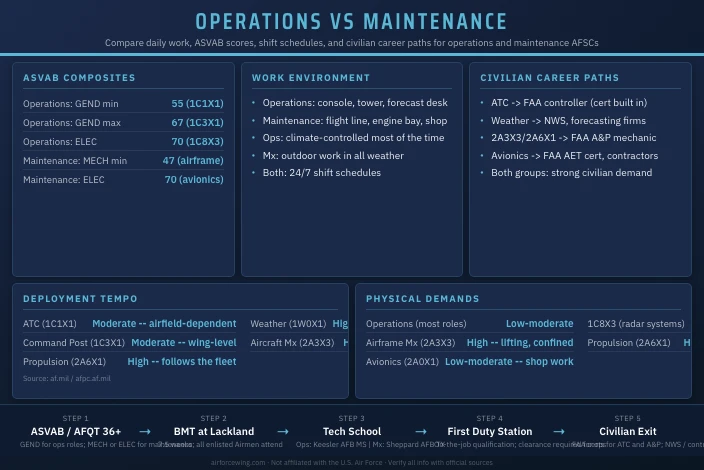
Operations Airmen typically work in climate-controlled environments: tower cabs, control rooms, weather flights, and command posts. The physical environment is relatively stable compared to outdoor flight-line work.
What Maintenance Airmen Actually Do
The 2A career group owns the aircraft. Every flight that takes off depends on a maintainer certifying that jet as safe to fly.
Aircraft maintainers (2A3X3, 2A3X7, 2A5X1) run pre- and post-flight inspections, troubleshoot discrepancies reported by pilots, and sign off on aircraft as mission-ready. The 2A3X3 and 2A3X7 codes focus on tactical fighters. The 2A5X1 covers mobility and tanker aircraft. Regardless of airframe, the work is physical, time-sensitive, and happens in all weather conditions.
Propulsion specialists (2A6X1) focus exclusively on jet engines: removal, installation, troubleshooting, and test cell runs where engines are run at full power in a controlled bay. It’s deep specialization, and it maps cleanly to FAA Powerplant certification after service.
Structural maintainers (2A7X3) handle the aircraft’s physical structure, sheet metal repair, welding, corrosion control, and component fabrication. The work has direct airworthiness implications; a structural repair that fails can down an aircraft.
Avionics technicians (2A0X1, 2A2X1) work the electronics side: radar, weapons systems, navigation, and flight controls. The 2A2X1 is platform-specific to the F-15, so technicians develop deep expertise on one airframe’s complete avionics suite. Both avionics codes require a Secret clearance on top of the higher ASVAB threshold.
The flight line is an outdoor environment. Maintainers work in the cold, the heat, and in confined spaces inside aircraft structures. Physical strength and stamina matter here in ways they don’t for most operations roles.
ASVAB Requirements: Operations vs Maintenance
This is the most concrete difference between the two groups, and it determines whether certain jobs are even available to you before you enlist.
| AFSC | Title | Composite | Minimum |
|---|---|---|---|
| 1C1X1 | Air Traffic Control | GEND | 55 |
| 1C5X1 | Airfield Management | GEND | 55 |
| 1W0X1 | Weather | GEND + ELEC | 66 + 50 |
| 1C3X1 | Command Post | ADMI + GEND | 55 + 67 |
| 1C8X3 | Radar, Airfield and Weather Systems | ELEC | 70 |
| 2A3X3 | Tactical Aircraft Maintenance | MECH | 47 |
| 2A5X1 | Aerospace Maintenance | MECH | 47 |
| 2A6X1 | Aerospace Propulsion | MECH | 47 |
| 2A7X3 | Aircraft Structural Maintenance | MECH | 47 |
| 2A0X1 | Avionics Test Station and Component | ELEC | 70 |
| 2A2X1 | F-15 Avionics | ELEC | 70 |
The GEND composite (Word Knowledge + Paragraph Comprehension + Arithmetic Reasoning + Mathematics Knowledge) drives most operations qualifications. It rewards verbal aptitude and general math.
The MECH composite (General Science + Auto & Shop Information + Mathematics Knowledge + Mechanical Comprehension) opens the airframe and propulsion maintenance jobs. It measures mechanical reasoning and technical knowledge.
The ELEC composite (General Science + Arithmetic Reasoning + Mathematics Knowledge + Electronics Information) is the high-bar score for avionics maintenance and radar systems work. Both groups have a role requiring ELEC 70, the 1C8X3 in operations and the 2A0X1 and 2A2X1 in maintenance.
If you’re undecided between the two paths, checking your practice test scores on GEND vs MECH subtests gives you a fast signal about where your natural aptitude points.
Shift Schedules and Deployment Tempo
Both groups run 24/7 operations, so shift work is a given regardless of which path you take. The texture of that shift work differs.
Operations jobs are tied to airfield activity. When aircraft are flying, the tower, command post, and weather flight are staffed. During stand-downs and low-activity periods, the pace drops significantly. ATC and command post roles involve long stretches of monitoring punctuated by periods of intense activity. The work is mental rather than physical, which can make sustained alertness over a shift its own challenge.
Maintenance jobs follow the aircraft. When jets are deployed, maintainers deploy with them. The 2A career group generally sees higher deployment tempo than the operations group because the aircraft go downrange and need qualified maintainers on-site to keep flying. During high-tempo exercises and deployments, maintainers can work extended shifts and back-to-back days with minimal rest.
Both groups deploy. Weather Airmen often deploy to forward operating locations where they’re the only atmospheric support asset. Command post operators deploy to contingency bases that need communications and battle staff capability. But the maintenance career group consistently experiences more deployment exposure tied directly to aircraft movements.
Physical Demands
The gap here is significant and worth being honest about.
Operations roles are low-to-moderate physical demand for most AFSCs. Controllers, forecasters, and command post operators spend their shifts at consoles, workstations, and briefing desks. The 1C8X3 radar systems AFSC is the exception, field installation and maintenance of outdoor systems can require climbing antenna structures and carrying heavy equipment in austere locations.
Maintenance is a physically demanding career group. Crew chiefs and propulsion specialists regularly lift engine components, work in confined spaces inside aircraft, crouch under aircraft for inspections, and spend hours on concrete ramps in full summer heat or winter cold. The work requires stamina and the ability to operate in awkward positions. Back injuries are a known occupational risk across the 2A career group.
The Air Force Fitness Assessment applies equally to both groups: a 1.5-mile run, push-ups, sit-ups, and waist measurement, all age- and gender-normed with a minimum passing composite of 75. That baseline is the same. The physical demands of the job itself are not.
Civilian Career Paths
Both groups produce veterans with credentials that civilian employers value. The quality and directness of those career paths vary by specific AFSC.
Operations exits:
- 1C1X1 ATC has the clearest civilian path of any AFSC in either group. FAA certification is built into military training. Separating controllers can apply directly to FAA facilities; military training is recognized as qualifying experience.
- 1W0X1 Weather translates to meteorological technician roles at the National Weather Service, private forecasting companies, and federal agencies. Top Secret-cleared veterans have access to classified weather support contracts.
- 1C8X3 Radar systems experience positions veterans for FCC-licensed electronics technician work, FAA avionics contractor roles, and defense contractor positions supporting air traffic infrastructure.
Maintenance exits:
- 2A6X1 Aerospace Propulsion experience counts toward the FAA Powerplant certificate. Most Airmen finish a first enlistment with enough documented hours to test immediately after separation.
- Airframe maintainers (2A3X3, 2A5X1, 2A7X3) can pursue the FAA Airframe certificate through the same hours-based process. A combined A&P certificate opens commercial airline and MRO shop hiring.
- Avionics technicians (2A0X1, 2A2X1) with active Secret clearances move into defense contractor roles at a premium over standard aviation-electronics jobs.
The BLS consistently flags aircraft mechanic and avionics technician positions as in shortage. Both maintenance paths have real labor market tailwinds.
Which Path Fits You
Neither group is objectively better. The right choice comes down to what kind of work you want to do every day.
Choose operations if:
- You prefer mental work over physical work
- You want to qualify for FAA certification as part of your military training
- You’re strongest on verbal and general reasoning ASVAB subtests
- You want to work in a climate-controlled environment for most of your career
- A structured, procedural environment with high-stakes decision-making appeals to you
Choose maintenance if:
- You prefer hands-on, physical work with tangible results
- You want to specialize on aircraft and be on the flight line
- Your ASVAB aptitude leans toward mechanical and technical reasoning
- You’re comfortable with outdoor work in variable conditions
- You want a direct path to FAA A&P or avionics certification after service
Both paths require a minimum AFQT of 36 for active duty enlistment. Beyond that floor, the specific composite that matters to you depends on which AFSC you’re targeting. The ASVAB study guide at our test prep section breaks down each composite by subtest so you can study the sections that actually move your target score.
The full AFSC rosters for each group are at the Air Force enlisted careers hub, where you can compare every available job in both career groups side by side with training lengths and clearance requirements listed.
You may also find Air Force Operations Jobs: ATC, Airfield Management, Weather helpful as a deeper look at the 1C career group.