Air Force Operations Jobs: ATC, Airfield Management, Weather
Every Air Force flight starts and ends with someone in a tower, a weather flight, or a command post making a decision. The 1C career group, the enlisted operations career field, is the human infrastructure behind every sortie. These five AFSCs are responsible for clearing aircraft to land, briefing pilots on storm systems, managing airfield data, routing emergency calls, and keeping the radar systems alive that tie it all together.
The work is high-stakes and mission-direct. A missed weather call can cancel a combat sortie. A controller error can put two aircraft in the same airspace. And a command post operator who can’t reach the wing commander during an emergency action message event creates a real problem. That’s the environment these jobs operate in every day.
This site is not affiliated with the U.S. Air Force or any government agency. Verify all information with official Air Force sources before making enlistment or career decisions.
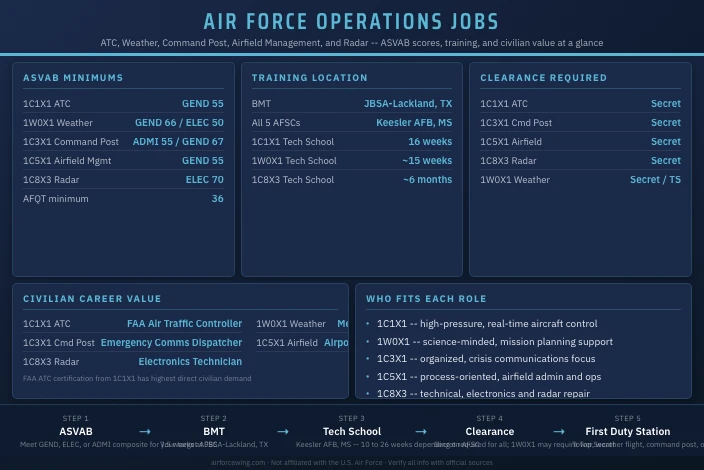
The Five Operations AFSCs
The 1C enlisted career group has five AFSCs. They share a training base (Keesler AFB, Mississippi) and a minimum security clearance requirement, but the day-to-day work and ASVAB requirements are different across all five.
| AFSC | Title | ASVAB Composite | Clearance |
|---|---|---|---|
| 1C1X1 | Air Traffic Control | GEND 55 | Secret |
| 1C3X1 | Command Post | ADMI 55 and GEND 67 | Secret |
| 1C5X1 | Airfield Management | GEND 55 | Secret |
| 1C8X3 | Radar, Airfield and Weather Systems | ELEC 70 | Secret |
| 1W0X1 | Weather | GEND 66 and ELEC 50 | Secret/TS |
All five require at minimum a Secret clearance, U.S. citizenship, a high school diploma, and a minimum AFQT score of 36 for active duty enlistment. Every Airman completes 7.5 weeks of Basic Military Training at Joint Base San Antonio-Lackland, TX, then moves to technical school.
1C1X1 Air Traffic Control
1C1X1 Air Traffic Control is one of the most recognizable jobs in the Air Force, and one of the most demanding. Controllers direct aircraft from tower cabs and radar approach control facilities on military airfields worldwide. The job requires constant situational awareness, fast decisions, and clear communication under pressure.
The minimum composite is GEND 55. Controllers must also earn FAA certification to work a live position, which happens during technical school at Keesler AFB. Tech school runs approximately 16 weeks. After graduation, controllers complete on-the-job qualification at their first duty station before working unsupervised positions.
A few things make this AFSC stand out in the group:
- FAA certification is built into military training, not earned separately
- The civilian job market for FAA controllers is consistently strong
- The physical demands are low compared to other high-ASVAB Air Force jobs
- Rotational shift work and constant currency requirements come with the territory
The civilian exit from 1C1X1 is as direct as any in the enlisted Air Force. FAA air traffic controllers earn median annual wages that rank among the highest for any federally licensed occupation. Military experience and FAA certification give veterans a credible application from day one.
1W0X1 Weather
1W0X1 Weather Airmen are atmospheric science technicians who brief flight crews and mission planners before every sortie. They observe, analyze, and forecast weather conditions at their assigned base and downrange locations. When a storm threatens a training mission or combat operations are affected by icing conditions, the weather flight is the unit that briefs the decision-makers.
The ASVAB requirement is dual composite: GEND 66 and ELEC 50. That combination reflects both the communication and science demands of the role. Tech school runs approximately 15 weeks at Keesler AFB. Some 1W0X1 assignments support space weather operations, and those positions can require a Top Secret clearance.
What the job involves day to day:
- Upper air soundings and surface observation
- Pilot weather briefings before and after missions
- Severe weather watches and warnings for the installation
- Downrange deployments to forward operating locations
The BLS classifies atmospheric science technicians separately from meteorologists. Military weather training is rigorous and translates well to the National Weather Service, private-sector forecasting firms, and federal agencies that hire atmospheric scientists. Veterans with Top Secret clearance experience have an edge when applying to agencies that run classified weather support programs.
1C3X1 Command Post
The 1C3X1 Command Post AFSC carries the highest combined ASVAB requirement in the group: ADMI 55 and GEND 67. Command post operators run the wing’s 24-hour command and control center. They track aircraft, handle emergency action messages, manage crisis communications, and serve as the direct link between the wing commander and subordinate units during contingency operations.
Tech school is at Keesler AFB and runs approximately 11 weeks. The job is less physically demanding than most, but the cognitive and procedural load is significant. Operators must master classified communications systems, battle staff procedures, and a high volume of administrative and operational protocols.
The civilian parallel is closest to emergency communications and public safety dispatch, though the military version involves far more classified material and command-level tasking. Veterans from this career field often move into operations center roles, emergency management, or government contractor positions that support command and control systems.
1C5X1 Airfield Management
1C5X1 Airfield Management Airmen keep the administrative and operational infrastructure of the airfield running. They process flight plans, maintain airfield data, coordinate with air traffic control and operations units, conduct airfield inspections, and manage the documentation that keeps a flying operation legally and operationally compliant.
The minimum composite is GEND 55: the same floor as ATC, but the work is procedural and coordination-heavy rather than real-time and high-pressure. Tech school runs approximately 10 weeks at Keesler AFB. This AFSC is the best fit for someone who wants to work on the flight line side of operations without the shift-intensive pace of tower or radar work.
Airfield management experience translates to airport operations specialist positions at civilian airports. The FAA’s airport operations certification process recognizes military training, and veterans with 1C5X1 backgrounds regularly transition into FBO management, airport authority roles, and aviation safety compliance positions.
1C8X3 Radar, Airfield and Weather Systems
1C8X3 is the maintenance AFSC of the operations group. Where the other four AFSCs operate systems, 1C8X3 Airmen install, align, troubleshoot, and repair them. The systems in scope include precision approach radar, instrument landing systems, airfield lighting controls, and meteorological equipment.
The ASVAB floor is the highest in the group: ELEC 70. Tech school at Keesler AFB runs approximately six months: longer than any other AFSC in this group, reflecting the depth of electronics training required. The job is primarily shop and field maintenance work rather than a console or operational role.
Strong electronics scores and six months of hands-on systems training translate directly to civilian electronics technician work. FAA-certified avionics technicians and radar system contractors frequently recruit from this career field. The electronics knowledge base also positions veterans well for roles in telecommunications infrastructure, industrial control systems, and federal contractor positions supporting air traffic systems.
Training Pipeline
All five AFSCs follow the same entry path before diverging at tech school.
One factor worth planning around: tech school housing at Keesler AFB can involve dormitory assignments shared with trainees from multiple career fields. Processing times for security clearances vary, and delays can push your tech school start date. Ask your recruiter about typical clearance timelines for your target AFSC.
ASVAB Scores and How to Read Them
The Air Force uses composite line scores, not the raw AFQT, to qualify applicants for specific AFSCs. Each composite is built from a combination of ASVAB subtests.
The composites that matter most for operations jobs:
- GEND (General): Word Knowledge + Paragraph Comprehension + Arithmetic Reasoning + Mathematics Knowledge
- ELEC (Electronics): General Science + Arithmetic Reasoning + Mathematics Knowledge + Electronics Information
- ADMI (Administrative): General Science + Paragraph Comprehension + Word Knowledge + Arithmetic Reasoning
If your target is 1C1X1 or 1C5X1, focus your prep on the verbal and math subtests that drive the GEND composite. If 1W0X1 is your goal, you need both GEND and ELEC, so Electronics Information and General Science need attention too. The 1C8X3 ELEC 70 floor is the hardest single-composite threshold in the group, the Electronics Information and General Science subtests are where most applicants fall short.
Your scores determine which doors are open before you walk into the recruiter’s office. Air Force ASVAB test prep covers the subtests that feed every composite in this group.
Civilian Career Value by AFSC
Some Air Force jobs translate well to civilian careers. Others require significant retraining. The operations group sits toward the favorable end of that spectrum, with one clear standout.
| AFSC | Civilian Role | Licensing/Cert Path |
|---|---|---|
| 1C1X1 | FAA Air Traffic Controller | FAA certification earned during military training |
| 1W0X1 | Meteorological Technician | NWS, private forecasting firms, federal agencies |
| 1C3X1 | Emergency Comms Dispatcher | Public safety, government contractor ops centers |
| 1C5X1 | Airport Operations Specialist | FAA Part 139, FBO management |
| 1C8X3 | Electronics Technician | FAA avionics, radar contractors, telecom |
1C1X1 has the clearest civilian career path in the group. The FAA certification earned during military service is directly recognized in the civilian hiring process. Veterans who separate before the mandatory FAA retirement age for controllers (56) can work a full second career as a civilian controller.
1W0X1 and 1C8X3 both translate well but require more active credentialing work on separation. Weather veterans benefit from the American Meteorological Society’s professional certifications. Radar and systems technicians often pursue FCC licensing or FAA airframe and powerplant training depending on which sector they target.
Is Operations the Right Career Group?
The 1C career group is a strong fit for Airmen who want to work close to the flight line without being a pilot, crew chief, or maintainer. The work is mission-direct, the training is structured, and most of the five AFSCs produce credentials or experience that civilian employers value.
The tradeoffs are real. Shift work is common across all five AFSCs. Controllers and command post operators work 24-hour rotations that affect family life and sleep schedules throughout a career. Deployments happen across the group, including to forward locations where the weather flight or command post may operate under austere conditions.
The Air Force operations career group covers all five AFSCs in depth, including specific duty station patterns, deployment tempo, and career progression for each role.
You may also find 1C1X1 Air Traffic Control: What It’s Really Like and Air Force Operations vs Maintenance AFSC helpful.