Air Force Officer vs Enlisted Pay Comparison
The gap between officer and enlisted pay is real, but it doesn’t tell the whole story. A new Second Lieutenant earns nearly $1,750 more per month in base pay than a new Airman Basic, but that officer also entered with a four-year degree, spent 9.5 weeks at Officer Training School, and carries management responsibility from day one. At the 10-year mark, the gap widens considerably. At 20 years, the retirement math changes everything. Here’s what the numbers actually look like at each stage.
Starting Pay: Entry-Level Officer vs Enlisted
New Air Force members enter at the bottom of their respective pay ladders. The 2026 pay table reflects a 3.8% across-the-board raise effective January 1, 2026.
| Rank | Grade | Monthly Base Pay (under 2 yrs) |
|---|---|---|
| Airman Basic (AB) | E-1 | $2,407 |
| Airman (Amn) | E-2 | $2,698 |
| Airman First Class (A1C) | E-3 | $2,837 |
| Senior Airman (SrA) | E-4 | $3,142 |
| Second Lieutenant (2d Lt) | O-1 | $4,150 |
| First Lieutenant (1st Lt) | O-2 | $4,782 |
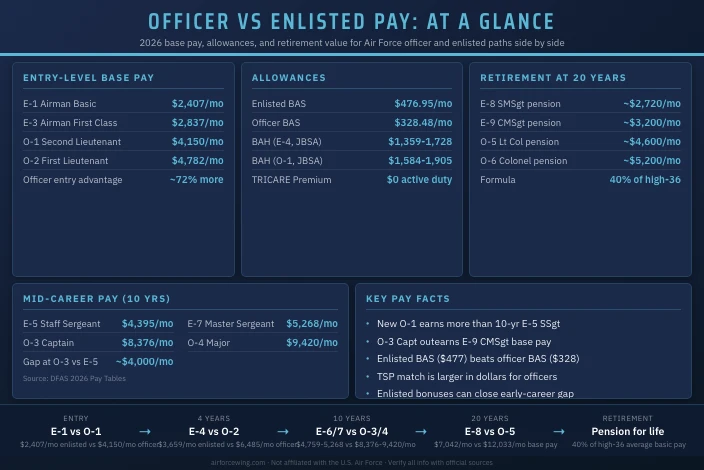
A new officer earns roughly 72% more in base pay than a new enlisted airman. But both come with allowances that change the real comparison.
Basic Allowance for Subsistence (BAS) flips the script slightly. Enlisted members receive $476.95/month, while officers receive $328.48/month. The higher enlisted BAS reflects the original intent of the allowance, covering food costs for physically demanding work. It doesn’t close the overall pay gap, but it narrows it by about $148/month at the entry level.
Basic Allowance for Housing (BAH) depends on duty station, pay grade, and dependent status. At Joint Base San Antonio, a new O-1 without dependents receives $1,584/month in BAH, while an E-4 receives $1,359/month. The officer BAH advantage at entry level is real but modest compared to the base pay gap.
Mid-Career Pay: Where the Gap Grows
The pay difference between officer and enlisted paths compounds over time. Enlisted pay grows steadily with years of service and promotion. Officer pay follows the same structure but from a much higher starting point.
At the 10-year mark, a realistic comparison looks like this:
| Rank | Grade | Monthly Base Pay (10 yrs) |
|---|---|---|
| Staff Sergeant (SSgt) | E-5 | $4,395 |
| Technical Sergeant (TSgt) | E-6 | $4,759 |
| Master Sergeant (MSgt) | E-7 | $5,268 |
| Captain (Capt) | O-3 | $8,376 |
| Major (Maj) | O-4 | $9,420 |
A Captain at 10 years earns roughly $4,000 more per month in base pay than a Staff Sergeant at the same point. A Major, which some officers reach by year 10 to 12, earns over $5,000 more than a typical mid-career NCO.
The key word is “typical.” Not every officer promotes to Major. Not every enlisted member makes Master Sergeant. Actual pay depends heavily on promotion selection, and both officer and enlisted career fields have competitive boards above certain grades.
The Full Pay Package at Mid-Career
Base pay is just one column. A complete comparison has to include BAS and BAH, since those vary by path.
| Component | E-5 (10 yrs, JBSA, with dependents) | O-3 (10 yrs, JBSA, with dependents) |
|---|---|---|
| Base Pay | $4,395 | $8,376 |
| BAS | $477 | $328 |
| BAH (JBSA est.) | $1,869 | ~$2,100+ |
| Estimated Monthly Total | ~$6,741 | ~$10,804+ |
The officer total compensation advantage at this stage is roughly $4,000 to $4,500 per month. Over a year, that’s $48,000 to $54,000 in additional compensation, before special pays or bonuses.
BAH for O-3 at JBSA is estimated above because exact figures vary by dependent status and ZIP code. The DoD BAH Rate Lookup gives precise figures for your specific assignment location.
Senior Pay: 20-Year Comparison
The pay advantage for officers is most visible at the 20-year mark, where both paths converge on the retirement decision point.
| Rank | Grade | Monthly Base Pay (20 yrs) |
|---|---|---|
| Senior Master Sergeant (SMSgt) | E-8 | $7,042 |
| Chief Master Sergeant (CMSgt) | E-9 | $8,248 |
| Lieutenant Colonel (Lt Col) | O-5 | $12,033 |
| Colonel (Col) | O-6 | $13,751 |
An E-9 Chief Master Sergeant, the highest enlisted rank, reached by very few, earns $8,248/month at 20 years. An O-5 Lieutenant Colonel at 20 years earns $12,033/month. The gap at senior levels isn’t just monthly income. It drives the retirement pension calculation.
The Retirement Math
Both paths use the Blended Retirement System (BRS) for members who entered service after January 1, 2018. The pension formula is straightforward:
2% x years of service x high-36 average basic pay
At 20 years, that equals 40% of your average basic pay over your highest 36 months. The officer advantage here is significant because the pension percentage applies to a much larger number.
| Rank at Retirement | High-36 Base Pay Estimate | Monthly Pension (40%) |
|---|---|---|
| E-8 Senior Master Sergeant | ~$6,800 | ~$2,720 |
| E-9 Chief Master Sergeant | ~$8,000 | ~$3,200 |
| O-5 Lieutenant Colonel | ~$11,500 | ~$4,600 |
| O-6 Colonel | ~$13,000 | ~$5,200 |
These are lifetime monthly payments. Over a 30-year post-military life, the cumulative pension difference between an E-9 retirement and an O-6 retirement is roughly $700,000 to $900,000 in nominal terms. No single pay comparison captures that number.
The BRS also includes a Thrift Savings Plan (TSP) component. The government automatically contributes 1% of basic pay and matches up to an additional 4% if you contribute from your paycheck. The dollar value of the TSP match is larger for officers because it’s a percentage of a higher base.
Pay That Doesn’t Show Up in the Table
Several forms of compensation apply differently by path or career field.
Flight pay goes to rated officers (pilots, combat systems officers, air battle managers). Aviation career incentive pay varies by years of aviation service and can add hundreds of dollars per month on top of base pay.
Special duty assignment pay and hazardous duty incentive pay apply to specific enlisted and officer roles. EOD technicians, pararescuemen, and certain intelligence positions. These pays can be substantial but are role-specific and change with Air Force manning needs.
Enlistment and reenlistment bonuses are available for enlisted members in high-demand AFSCs. Amounts vary significantly by career field and the Air Force’s current manning priorities. Officers have their own continuation pay and selective retention bonuses, particularly for rated aviators who are in high demand by airlines.
Both paths are also eligible for hostile fire/imminent danger pay during qualifying deployments, paid as a flat monthly amount.
TRICARE and Non-Pay Benefits
Both officers and enlisted members on active duty receive TRICARE Prime at no cost. No enrollment fee, no deductible, no copays for the service member. Family members under TRICARE Prime may have small copays for some services.
The market value of this benefit is real. A comparable civilian family health plan typically runs $600 to $1,000 per month in premiums before deductibles. Across a 20-year career, that’s $144,000 to $240,000 in avoided healthcare costs, the same for an E-3 and an O-3.
TRICARE doesn’t create a pay gap between paths, but it matters for the full compensation picture. The Air Force benefits guide covers all the components of military compensation in detail.
Enlisted-to-Officer: Crossing Over
The pay gap between paths isn’t permanent if you’re willing to change lanes. Several programs let enlisted airmen earn a commission.
- Enlisted Commissioning Program (ECP): Active-duty enlisted members apply while serving, attend college full-time with continued pay and benefits, then commission at OTS upon graduating.
- OTS application: Prior-enlisted members who complete a bachelor’s degree on their own can apply directly to OTS as civilians.
- Direct Commission: Selected specialists, nurses, chaplains, lawyers, can receive commissions without attending OTS if they hold the required professional credentials.
The tradeoff is time. An airman who enlists at 18, completes a four-year degree while serving using Tuition Assistance, and commissions at 24 or 25 has lost 6 or 7 years of officer pay, but also has 6 or 7 years of enlisted service credit and a much clearer sense of whether military leadership is the right fit.
Side-by-Side: 20-Year Financial Comparison
| Career Stage | Enlisted (E-7, typical NCO) | Officer (O-5, typical career) |
|---|---|---|
| Entry base pay | $2,407/mo (E-1) | $4,150/mo (O-1) |
| Mid-career base pay | $5,268/mo (E-7, 10 yrs) | $8,376/mo (O-3, 10 yrs) |
| Senior base pay | $7,042/mo (E-8, 20 yrs) | $12,033/mo (O-5, 20 yrs) |
| Pension at 20 yrs | ~$2,800/mo | ~$4,800/mo |
| Pension over 30 yrs | ~$1,000,000 | ~$1,700,000 |
| BAS | $477/mo (higher) | $328/mo (lower) |
| BAH | Grade-dependent | Grade-dependent (higher) |
These figures represent realistic median career paths, not top performers on both ends. An E-9 CMSgt retirement outpaces a typical O-4 Major in some scenarios. An O-6 Colonel’s pension dwarfs everything else in the enlisted column.
What the Numbers Mean for Your Decision
Pay matters, but it doesn’t make the decision for you.
Officers earn more at every stage and retire with larger pensions. That’s simply true. But officers also enter with a four-year degree requirement, take on management and leadership responsibilities from their first assignment, and face a more demanding and competitive promotion environment above O-4.
Enlisted members earn less in base pay but build genuine technical expertise, qualify for enlistment bonuses in high-demand fields, and can transition to civilian careers with certifiable skills. The enlisted path also leads to officer commissioning for motivated airmen who want the pay jump later.
The Air Force officer vs enlisted guide covers the full comparison beyond pay, entry requirements, training pipelines, career roles, and daily work culture. For a complete breakdown of all Air Force pay components including special pays, education benefits, and retirement calculations, the Air Force pay and benefits guide runs every number in detail.
Browse enlisted career profiles and officer career profiles to see pay ranges and qualification requirements for specific career fields.
This site is not affiliated with the U.S. Air Force or any government agency. Verify all information with official Air Force sources before making enlistment or career decisions.