Air Force Officer vs Enlisted: Which Path Is Right for You
Two people walk into a recruiting office with the same goal: serve in the Air Force. One leaves heading to Officer Training School. The other ships to Basic Military Training three months later. The difference between those two paths isn’t just rank. It’s education, daily responsibilities, pay structure, and what the next 20 years look like. This guide covers everything you need to honestly compare both tracks before you commit.
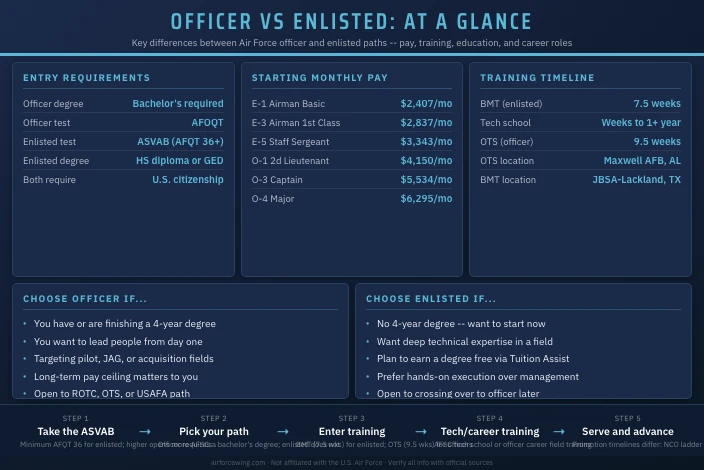
The Core Difference
Officers lead. Enlisted members execute.
That’s an oversimplification, but it’s the right starting point. Officers commission as Second Lieutenants (O-1) and are responsible for managing people, equipment, budgets, and missions from their first assignment. Enlisted airmen enter as Airman Basic (E-1) and spend the first years of their career mastering a specific technical specialty.
Both paths contribute to the same mission. Neither is superior. They attract different people for different reasons, and the entry requirements alone separate them sharply.
Officer entry requirements:
- Four-year college degree (bachelor’s minimum)
- Pass the AFOQT (Air Force Officer Qualifying Test)
- Meet age requirements (typically 18-39 for OTS)
- U.S. citizenship
Enlisted entry requirements:
- High school diploma or GED
- AFQT score of 36 or higher on the ASVAB
- Meet age requirements (17-39 for active duty)
- U.S. citizenship or permanent resident (select exceptions apply)
The degree requirement is the biggest wall. If you have a four-year degree, both doors are open. If you don’t, enlisted is your only path to active duty service.
Pay: Officer vs Enlisted by Grade
Pay follows rank, and rank is tied to your entry path. A new officer earns roughly 70% more per month than a new enlisted airman doing a comparable job.
| Rank | Grade | Monthly Base Pay (under 2 years) |
|---|---|---|
| Airman Basic | E-1 | $2,407 |
| Airman First Class | E-3 | $2,837 |
| Staff Sergeant | E-5 | $3,343 |
| Technical Sergeant | E-6 | $3,401 |
| Second Lieutenant | O-1 | $4,150 |
| First Lieutenant | O-2 | $4,782 |
| Captain | O-3 | $5,534 |
| Major | O-4 | $6,295 |
Base pay is only part of the picture. Both officers and enlisted members receive Basic Allowance for Housing (BAH), which varies by duty station and dependency status, and Basic Allowance for Subsistence (BAS). The enlisted BAS rate is $476.95/month; the officer BAS rate is $328.48/month. Enlisted members receive higher BAS because food allowances were originally tied to the physical demands of the work.
Over a 20-year career, the gap compounds. An enlisted Senior Master Sergeant (E-8) at 20 years earns $7,042/month in base pay. An O-5 Lieutenant Colonel at the same point earns $12,033/month. Both qualify for retirement at 40% of high-36 average basic pay under the Blended Retirement System, but 40% of a higher base means significantly more per month for life.
A detailed breakdown of what each rank takes home, including BAH examples by installation, is in the Air Force officer vs enlisted pay comparison.
Training: How Each Path Starts
Both paths begin with entry-level training, but the structure, length, and purpose are different.
Enlisted Training Pipeline
Every enlisted airman goes through Basic Military Training (BMT) at Joint Base San Antonio-Lackland, Texas. BMT runs 7.5 weeks and covers Air Force customs and courtesies, physical fitness, weapons qualification, and foundational military skills. After BMT, airmen move to Technical Training School for their specific AFSC (Air Force Specialty Code). Tech school length ranges from a few weeks to over a year depending on the career field.
The ASVAB line score you earn before shipping determines which AFSCs you’re eligible to pursue. Higher scores open more specialized, and often higher-paying, jobs. Cyber and intelligence roles typically require scores in the upper composites, while some logistics and administrative roles have more accessible thresholds. If you’re still preparing for the test, the Air Force ASVAB test prep guide maps out a study plan by line score target.
Officer Training Pipeline
Officers without a service academy or ROTC background attend Officer Training School (OTS) at Maxwell AFB, Alabama. OTS runs 9.5 weeks and focuses on leadership, Air Force doctrine, and officer professional development. Graduates commission as Second Lieutenants.
From there, officers complete Initial Flight Training (for rated positions) or their specific career field training. A pilot candidate, for example, completes OTS and then enters Undergraduate Pilot Training, a process that takes well over a year before they’re fully qualified in a specific airframe. Non-rated officers move into assignments faster, but still complete formal career field education before assuming their duties.
Officers pursuing a commission after college should read how to prepare for Air Force OTS selection for what boards actually weigh beyond test scores.
Career Roles: What the Job Actually Looks Like
The distinction between officer and enlisted roles runs deeper than rank insignia.
Enlisted roles are technical. An enlisted airman in cyber operations (1B4X1) spends their days running network analysis tools, monitoring traffic, and executing specific defensive or offensive tasks. An aircraft maintainer works hands-on with aircraft systems. An intelligence analyst (1N0X1) processes imagery and signals data. The work is skilled, specialized, and often certifiable for direct civilian application.
Officer roles are managerial and strategic. A cyber operations officer (17S) oversees cyberspace operations and makes mission-level decisions. A logistics officer manages supply chains and readiness across an entire wing. A squadron commander is responsible for the performance, welfare, and discipline of dozens or hundreds of airmen. Officers don’t typically work at the technical level day-to-day, they lead the people who do.
This creates a recurring question for college graduates: “I have a degree in computer science. Should I commission as a cyber officer or enlist in cyber?” The honest answer depends entirely on whether you want to do the technical work yourself or lead others who do it.
Career field options by path:
| Path | Example Career Fields |
|---|---|
| Enlisted | Cyber (1B4X1), Aerospace Medical (4N0X1), Air Traffic Control (1C1X1), EOD (3E8X1), Intelligence (1N0X1) |
| Officer | Pilot (11X), Intelligence (14N), Cyber Operations (17S), Acquisition (63A), Judge Advocate (51J) |
Some career fields exist only on one side. You cannot be an Air Force pilot as an enlisted member. You cannot be an enlisted-equivalent of a JAG officer. Other fields, intelligence, cyber, medical, exist on both sides with different responsibilities. The enlisted career directory and officer career directory have full profile pages for each specialty.
Promotion Timelines
Enlisted promotion moves through the NCO ranks over a 20-year career, with time-in-service requirements and performance evaluations driving advancement.
Typical enlisted promotion milestones:
- E-2 (Airman): 6 months after BMT graduation
- E-3 (Airman First Class): 16 months total service
- E-4 (Senior Airman): 36 months total service
- E-5 (Staff Sergeant): Competitive; typically 5-8 years
- E-6 (Technical Sergeant): Competitive; typically 10-13 years
- E-7 through E-9: Highly competitive; most careers plateau at E-7
Officer promotion follows a different clock. The Air Force promotes through O-3 (Captain) almost automatically for officers performing at standard, it’s more of an administrative milestone than a competitive selection. Above O-4 (Major), selection becomes competitive and attrition increases meaningfully.
Typical officer promotion milestones:
- O-2 (First Lieutenant): 18 months after commissioning
- O-3 (Captain): 48 months after commissioning
- O-4 (Major): Competitive board; typically 11-13 years
- O-5 (Lieutenant Colonel): Increasingly selective
- O-6 (Colonel): Selected from a small fraction of O-5s
The pay gap matters for long-range planning. An enlisted Master Sergeant (E-7) after 12 years earns roughly $5,268/month in base pay. An O-4 Major at 12 years earns approximately $10,214/month. When both individuals retire at 20 years, that base pay difference determines their pension for the rest of their lives.
Day-to-Day Life and Work Culture
The daily experience of an officer and an enlisted airman, even on the same base, in the same career field, is meaningfully different.
Enlisted airmen typically work within a defined shift or duty schedule tied to their AFSC. A medical technician works their clinic hours. A crew chief works aircraft maintenance cycles. The work is predictable in structure, even when the content is demanding. Most enlisted airmen operate within a clear chain of command and know exactly who they answer to at any given moment.
Officers carry broader accountability at all times. A flight commander doesn’t clock out when the shift ends, if one of their airmen has a problem at 2 a.m., they’re the one who gets the call. Staff officer positions involve significant administrative and planning work that doesn’t fit a clean shift model. The further up you go, the more your time belongs to the mission rather than to yourself.
This isn’t a critique of either path. Some people thrive in structured, technical environments. Others want the broader responsibility. Honest self-assessment matters here more than anything else in this article.
Education Benefits: Flip Sides of the Same Coin
Officers enter with a degree already in hand. Enlisted airmen often pursue one during or after service.
Tuition Assistance (TA) pays up to $4,500 per year toward college courses taken while on active duty, capped at $250 per semester hour. TA doesn’t require any additional service commitment. It’s one of the more underused enlisted benefits, a focused airman can complete a bachelor’s degree before their first enlistment ends.
The Post-9/11 GI Bill provides up to 36 months of education benefits for veterans. Public school tuition is fully covered. Private school coverage is capped at $29,920.95 per academic year for the 2025-2026 school year. The monthly housing allowance is calculated at the E-5 with dependents BAH rate for the school’s ZIP code.
For enlisted airmen who want to cross over to the officer side, the Enlisted Commissioning Program offers a path to OTS without leaving service. Direct commission programs offer another route for specialists, lawyers, physicians, and chaplains, who enter the Air Force with professional credentials already in hand.
Post-Service Careers: How Each Path Translates
The civilian labor market values both paths, but for different reasons.
Enlisted veterans leave with documented, verifiable technical certifications. An airman who spent six years in cyber operations has hands-on experience with network monitoring, intrusion detection, and threat analysis. That experience maps directly to a cybersecurity analyst role paying $80,000 to $110,000 depending on clearance and location. A medical technician (4N0X1) qualifies for emergency medical technician certifications during service. An intelligence analyst (1N0X1) often has TS/SCI clearance, which federal contractors pay premiums to access.
Officers transition with leadership credentials. A captain with five years in logistics has managed multi-million dollar supply chains. A former squadron commander has personnel management experience that many MBA graduates lack. Post-service officer careers often land in management consulting, defense contracting program management, and government senior executive service roles.
Clearance matters for both paths. A TS/SCI clearance can add $15,000 to $30,000 per year to a civilian salary compared to uncleared roles. Both officers and enlisted members in intelligence, cyber, and special operations routinely hold these clearances. Whether you’re an officer or enlisted, if your AFSC touches classified work, protect that clearance carefully, it follows you out the door.
Security Clearance and Background Requirements
Many Air Force jobs, both officer and enlisted, require a security clearance. The tier required varies by career field, but the investigation process is the same regardless of your path.
| Clearance Level | Common Fields |
|---|---|
| Secret | Most intel, cyber support, logistics, maintenance roles |
| Top Secret | Intelligence, cyber operations, special operations |
| TS/SCI | 1N series intelligence AFSCs, 17S cyber officers, select acquisition roles |
The clearance investigation looks at finances, foreign contacts, drug history, and overall reliability. Having a clearance requirement on your AFSC doesn’t mean you’ll be denied, but it means the investigation is part of your path from day one. A prior drug conviction or significant debt can complicate the process for both officer and enlisted candidates. For a full breakdown of which jobs carry which clearance requirements, the Air Force jobs that require security clearance post covers it by career field.
The Reserve Option
Neither path requires a full active-duty commitment. Both the Air Force Reserve and Air National Guard have officer and enlisted positions, and the decision between active duty and reserve service is entirely separate from the officer vs enlisted question.
Reserve and Guard service allows airmen and officers to maintain civilian careers while serving part-time. The tradeoff involves lower base pay, different benefits structures, and less predictable deployment timelines. Some Guard and Reserve members serve for 20+ years without ever mobilizing to a major contingency. Others deploy more frequently than some active-duty units.
For ROTC graduates weighing their options, should I go active duty or reserve after ROTC walks through the financial, career, and lifestyle tradeoffs in detail.
Who Should Go Officer
The officer path makes sense if:
- You have (or are completing) a four-year degree
- You want to lead and manage people from early in your career
- You’re targeting career fields that exist only as officer designators (pilot, JAG, chaplain, acquisition)
- The long-term pay ceiling matters to you. O-6 base pay reaches over $15,000/month at senior time-in-service brackets
- You want the credential of a commission on a post-service resume
- You’re willing to stay in long enough to make major, since the return on the officer investment grows sharply after O-4
Who Should Go Enlisted
The enlisted path makes sense if:
- You don’t have a four-year degree and want to start serving now
- You want deep technical expertise in a specific specialty
- You’re drawn to hands-on, execution-focused work over management
- You want to earn a college degree debt-free using Tuition Assistance while serving
- You’re open to the enlisted-to-officer crossover path after a few years
- You prefer a more predictable daily work structure in the early years
A college graduate considering both paths should read should I go officer or enlisted after college before committing. It works through the financial math, timeline pressure, and career-field-specific tradeoffs for people who have the credentials for both options.
Paths to a Commission
If you’re leaning toward officer and don’t know how to get there, three main commissioning sources exist:
Each path has different eligibility windows, application timelines, and commitment structures. The paths to serve guide covers all three in full, including how the Enlisted Commissioning Program works for airmen already in uniform.
ASVAB scores for every Air Force AFSC is a useful reference if you’re still mapping which enlisted career fields your line scores can unlock.
This site is not affiliated with the U.S. Air Force or any government agency. Verify all information with official Air Force sources before making enlistment or career decisions.
You may also find Air Force officer vs enlisted pay comparison and Air Force ASVAB test prep helpful.