Air Force Officer Selection Tests: ASVAB for OTS and TBAS
Becoming an Air Force officer involves more tests than most candidates expect. The ASVAB is just one piece. Depending on your career field, you may also face the AFOQT, the TBAS, and a PCSM score calculation before a board ever reviews your package. Each test measures something different, and each one plays a distinct role in selection. This guide maps all of them in one place.
Prepare for Officer Selection Tests
When you purchase through links on our site, we may receive compensation at no extra cost to you.
- ASVAB study guide with full practice tests, covers all nine subtests with answer explanations
- ASVAB online course with video lessons, self-paced instruction for every subtest
Officer Tests at a Glance
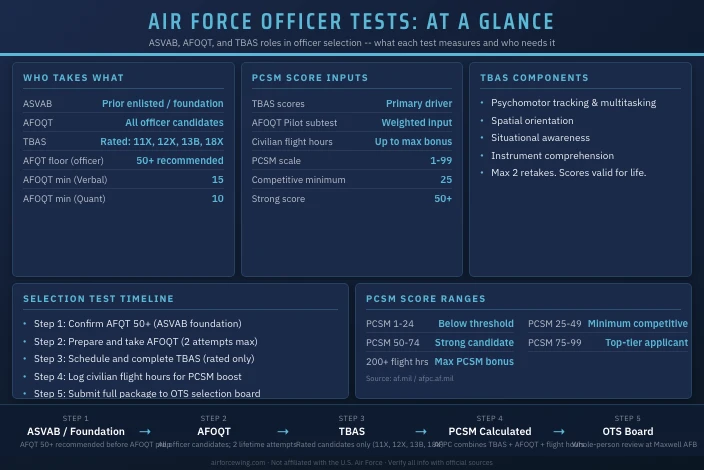
The path to a commission runs through multiple assessments, not a single exam. Here’s how they fit together before you reach Officer Training School at Maxwell AFB, Alabama.
| Test | Who Takes It | Purpose |
|---|---|---|
| ASVAB | All enlistees; officer candidates with prior service or early screening | Confirms basic academic eligibility; feeds AFQT percentile |
| AFOQT | All officer candidates (OTS, ROTC, USAFA) | Primary selection test; produces 6 composites including Pilot, CSO, and ABM |
| TBAS | Pilot (11X), CSO (12X), ABM (13B), and RPA (18X) candidates | Feeds PCSM score for rated aviation board selection |
The ASVAB and AFOQT are not interchangeable. The ASVAB screens enlisted applicants for career field eligibility. The AFOQT is the officer selection exam. Most officer candidates only deal with the ASVAB in one specific context: confirming that their academic baseline is high enough before they invest time in an AFOQT study plan.
Understanding where each test sits in the timeline keeps you from preparing for the wrong thing at the wrong time.
ASVAB and Officer Candidates
The ASVAB is not an officer selection test. It’s an enlisted qualification tool. But it still touches the officer path in two situations.
Prior enlisted applicants. If you’re currently serving and applying to OTS through the Enlisted Commissioning Program, your original ASVAB scores are in your service record. The selection board doesn’t evaluate them, but a recruiter may reference them during early screening. You’ll still take the AFOQT regardless of how you scored on the ASVAB.
Direct civilian applicants. Some recruiters use an AFQT score as an informal readiness check before advising a candidate to invest in formal preparation. The AFQT minimum for Air Force enlistment is 36, but that number has nothing to do with officer candidacy. Officer candidates should aim for AFQT 50 or higher as a practical floor. That’s not an official threshold, it’s a signal that your math and verbal foundations are strong enough to support serious AFOQT preparation.
Why AFQT 50 Matters for Officers
The AFQT pulls from four ASVAB subtests: Arithmetic Reasoning, Mathematics Knowledge, Paragraph Comprehension, and Word Knowledge. These four subtests are the same foundation that drives the AFOQT’s Verbal and Quantitative composites. A candidate who scored 45 on the AFQT is likely to struggle with the AFOQT’s math sections without additional work. Getting your AFQT above 50 means you’ve built the base.
ASVAB scores are not retested for officer candidates. If you took the ASVAB during enlisted processing and scored below 50 on the AFQT, that score doesn’t follow your OTS application. But it should prompt you to spend extra time on math and verbal prep before your AFOQT.
Build Your Math and Verbal Foundation
- ASVAB study guide, full review of all subtests including Arithmetic Reasoning and Math Knowledge
- ASVAB online course, structured lessons organized by subtest
AFOQT: The Primary Officer Selection Test
The Air Force Officer Qualifying Test is the exam that officer candidates prepare for most intensively. It consists of 12 subtests and produces 6 composite scores.
| Composite | Used For |
|---|---|
| Pilot | Pilot training selection |
| CSO | Combat Systems Officer selection |
| ABM | Air Battle Manager selection |
| Academic Aptitude | General officer eligibility |
| Verbal | All officer program eligibility |
| Quantitative | All officer program eligibility |
The minimum scores for commissioning eligibility are Verbal 15 and Quantitative 10. These are floors. Successful OTS applicants typically score in the 70s and 80s across the rated composites. Non-rated candidates (intelligence, logistics, finance) are evaluated more heavily on Academic Aptitude, Verbal, and Quantitative.
The AFOQT has two lifetime attempts. If you take it twice, the Air Force uses your second score regardless of whether it’s higher or lower than your first. That rule makes first-attempt preparation non-negotiable.
What the AFOQT Tests Beyond the ASVAB
The 12 AFOQT subtests include several sections with no ASVAB equivalent:
- Instrument Comprehension
- Block Counting
- Table Reading
- Aviation Information
- Rotated Blocks
- Hidden Figures
These subtests test spatial reasoning and aviation knowledge that no ASVAB study guide covers. Strong ASVAB prep builds the math and verbal foundation. AFOQT-specific preparation handles the rest. Candidates pursuing rated positions need both.
TBAS: The Rated Aviation Test
The Test of Basic Aviation Skills is required for candidates pursuing rated officer positions. These are the flying and aviation operations career fields:
- 11X. Pilot
- 12X. Combat Systems Officer (CSO)
- 13B. Air Battle Manager (ABM)
- 18X. Remotely Piloted Aircraft (RPA) Pilot
Non-rated officer candidates, intelligence, logistics, finance, public affairs, legal, civil engineering, do not take the TBAS. Their board selection relies on AFOQT composites, GPA, and leadership record.
What the TBAS Measures
The TBAS is not a knowledge test. It measures cognitive and psychomotor skills that predict performance in aviation training.
Psychomotor tracking and multitasking. You use a joystick to keep a crosshair centered on a moving target while responding to additional stimuli on screen. This is the most heavily weighted component. It directly simulates the divided-attention demands of cockpit operations.
Spatial orientation. Tests your ability to mentally rotate objects and interpret your position relative to a reference frame. Aircraft attitude problems, reading whether a plane is banking left or right from a horizon indicator, are common formats.
Situational awareness. Measures how quickly you process multiple changing data streams and identify what needs immediate attention. It’s pattern recognition under time pressure.
Instrument comprehension. Presents cockpit instrument displays and asks you to identify aircraft attitude from them. Candidates who have spent time with basic flight instruments have a real advantage here.
TBAS Retake Limits
The TBAS allows a maximum of two retakes: three total attempts. Scores are valid for life. A poor TBAS score from five years ago still counts today; there’s no expiration date that gives you a clean slate. Don’t schedule a retake without meaningful preparation between attempts.
AFOQT Preparation Resources
- AFOQT study guide with practice tests, covers all 12 subtests and 6 composites with strategies and practice material
- AFOQT online preparation course, video instruction and practice for every section of the officer qualifying test
The PCSM Score
TBAS results don’t stand alone. They feed into the Pilot Candidate Selection Method (PCSM) score, a composite from 1 to 99 that rated selection boards use to rank candidates.
| Input | Role |
|---|---|
| TBAS scores | Primary driver |
| AFOQT Pilot subtest | Weighted input |
| Civilian flying hours | Up to a substantial bonus |
The Air Force Personnel Center calculates your PCSM after you complete the TBAS. You don’t receive it on test day.
What PCSM Score Is Competitive
| PCSM Range | What It Means |
|---|---|
| 1-24 | Below the threshold for most boards |
| 25-49 | Minimum competitive range; every other factor must be strong |
| 50-74 | Strong candidate range |
| 75-99 | Top-tier applicant |
The minimum competitive PCSM is 25. That gets your package reviewed, not selected. Most Undergraduate Pilot Training (UPT) board selections come from candidates in the 50+ range. CSO boards are typically less competitive than pilot boards, but a strong PCSM still distinguishes a package.
Flying Hours and PCSM
Civilian flight time is the one PCSM input you can improve after the test. Documented hours receive measurable credit in the formula.
| Flight Hours | PCSM Effect |
|---|---|
| 0 hours | No bonus |
| 1-20 hours | Small improvement |
| 21-100 hours | Meaningful gain |
| 101-200 hours | Substantial improvement |
| 200+ hours | Maximum bonus applied |
A private pilot certificate requires roughly 40 hours of flight time. The cost runs $8,000 to $15,000 depending on location and training pace. Even 20 to 30 hours short of a full certificate still moves your PCSM. If a local flying club or university flight program offers reduced rates, it’s worth investigating before your application window closes.
How the Three Tests Connect
The tests don’t operate in isolation. Here’s the sequence that a rated officer candidate typically follows:
Non-rated candidates skip Steps 3 and 4 entirely. Their application relies on AFOQT composites, GPA, and whole-person factors.
The AFOQT and ASVAB: What They Share
Both tests include math and verbal sections that draw from the same foundational skills. The overlap is most direct between the ASVAB’s AFQT subtests and the AFOQT’s Verbal and Quantitative composites.
Candidates who prepare for the ASVAB’s Arithmetic Reasoning, Mathematics Knowledge, Paragraph Comprehension, and Word Knowledge subtests are building the same skills the AFOQT’s Academic, Verbal, and Quantitative composites test. ASVAB prep materials can serve dual purpose for early-stage officer candidates who need to reinforce their academic foundation.
The divergence comes with the AFOQT’s aviation-specific content: Instrument Comprehension, Block Counting, Rotated Blocks, and Aviation Information. Those sections require AFOQT-specific preparation that no ASVAB study guide covers.
OTS Selection: What Boards Actually Weigh
Officer Training School runs 9.5 weeks and commissions graduates as Second Lieutenants. The selection board uses a whole-person evaluation, not a single test score.
Factors that carry weight in the review:
- AFOQT scores: especially Verbal, Quantitative, and the relevant rated composites
- College GPA: STEM degrees are preferred but not required
- Physical fitness: candidates are expected to meet Air Force Fitness Assessment standards from day one
- Leadership record: work history, community involvement, and EPRs for prior-enlisted applicants
- Commander recommendation: required for current and prior enlisted members
Test scores determine eligibility and signal academic preparation. Leadership record and GPA determine selection. A candidate with AFOQT scores in the 80s and a thin leadership record still faces a competitive board.
Preparing for All Three Tests
The preparation strategies differ because the tests measure different things.
For the ASVAB (foundation work): Fix your weakest subtest first. Take a diagnostic practice test before studying anything. If Arithmetic Reasoning is your floor, two weeks of focused math work before touching anything else is the fastest path to AFQT improvement.
For the AFOQT: The math and verbal sections respond to the same strategies as the ASVAB. The aviation-specific subtests require separate preparation: spatial reasoning puzzles, instrument comprehension practice, and block-counting drills. Allow at least six to eight weeks of dedicated prep.
For the TBAS: You’re training cognitive patterns and fine motor skills, not memorizing content. Flight simulation software builds psychomotor tracking habits. Spatial reasoning apps and mental rotation practice address the orientation sections. Instrument comprehension improves with study of the six basic flight instruments. Budget four to eight weeks of active preparation, not passive review.
The complete Air Force test prep hub covers resources for all three tests with study schedules and section-by-section game plans.
This site is not affiliated with the U.S. Air Force or any government agency. Verify all information with official Air Force sources before making enlistment or career decisions.
You may also find these posts helpful for planning your preparation:
- ASVAB Scores for Every Air Force AFSC, full line score chart for enlisted and officer careers
- TBAS vs ASVAB: What Air Force Officers Need, side-by-side comparison of the two tests
- PiCAT vs ASVAB at MEPS: Which Should You Take, how the PiCAT verification test works
- How to Prepare for Air Force OTS Selection, what boards weigh beyond test scores
- Air Force ASVAB Retesting Rules and Timeline, wait times and score policies
Browse Air Force officer careers to see which rated and non-rated fields align with your test scores and career goals.