Air Force Officer Bonuses and Incentive Pay
Base pay is only part of what Air Force officers take home. Pilots can earn up to $50,000 per year in aviation bonuses on top of their salary. Surgeons can stack multiple specialty pay tiers that push their annual compensation well above what base pay alone would show. If you’re weighing an officer career or already serving, understanding these programs changes the math significantly.
Officer incentive pay isn’t automatic. It targets specific career fields where the Air Force is short on people or needs to keep experienced talent from leaving for civilian jobs. That context shapes who gets bonuses, how much, and for how long.
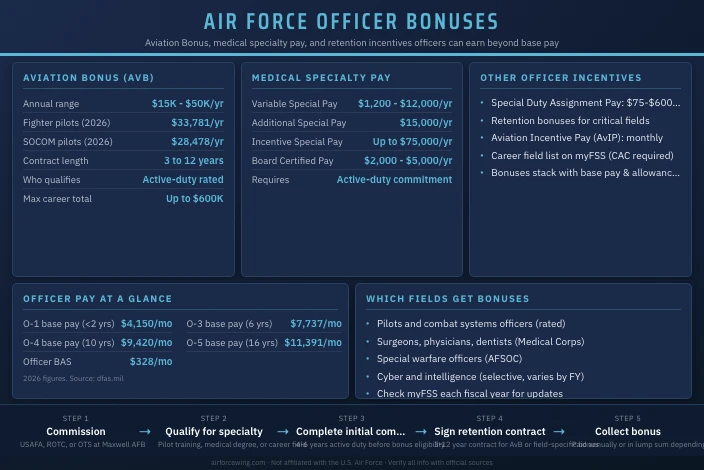
Aviation Bonus (AvB)
The Aviation Bonus is the largest and most publicized officer incentive program. It targets rated officers, primarily pilots, who are at the point where they could leave for a commercial airline career.
Eligible pilots can sign contracts ranging from 3 to 12 years in exchange for annual bonus payments. The annual amounts vary by aircraft type and contract length:
| Aircraft Category | Annual Bonus (2026) |
|---|---|
| Fighter pilots | $33,781 |
| Special operations pilots | $28,478 |
| Other manned aircraft | $15,000 - $35,000 |
The Air Force projects that roughly 10,300 pilots will receive an aviator bonus in fiscal year 2026. That’s about 15 percent more than the previous year, reflecting how aggressively the service is competing with commercial aviation for experienced crews.
Contracts are typically back-loaded, meaning the longer the commitment, the higher the annual rate. A 12-year contract can push total bonus value toward $600,000 over the life of the agreement. Combat systems officers (CSOs) and air battle managers in certain assignments are also eligible, though at lower rates than pilots.
Thinking about a rated officer career? The AFOQT and TBAS are the gates you clear first. An AFOQT study guide covers all 12 subtests of the officer qualifying test, including the Pilot and CSO composites that rated boards evaluate. An AFOQT prep course gives you structured practice for every section.
When you purchase through links on our site, we may receive compensation at no extra cost to you.
Aviation Incentive Pay (AvIP)
Separate from the bonus, rated officers also receive Aviation Incentive Pay (AvIP), a monthly stipend paid for active flying duty. AvIP is not a retention bonus; it’s continuous pay for performing aviation duties. The two programs stack, so a pilot on a bonus contract receives both.
Medical Specialty Pay
Air Force Medical Corps officers have access to one of the most layered incentive structures in the military. Four separate pay types can apply at the same time, each with its own eligibility rules.
Variable Special Pay (VSP) is the baseline. Any Medical Corps officer on active duty for at least one year receives between $1,200 and $12,000 annually, scaled by pay grade and years of service. It’s paid monthly and requires no separate contract.
Additional Special Pay (ASP) adds $15,000 per year for officers who sign a one-year commitment and hold a current, unrestricted medical license. Residents in initial training are excluded during that period.
Board Certified Pay (BCP) rewards officers certified by an American Medical or Osteopathic Specialty Board. The annual amounts step up with experience:
| Years of Service | Board Certified Pay |
|---|---|
| Less than 10 years | $2,000 |
| 10 through 12 years | $2,500 |
| 12 through 14 years | $3,000 |
| 14 through 17 years | $4,000 |
| 18 or more years | $5,000 |
Incentive Special Pay (ISP) is the big one. High-demand specialties can qualify for up to $75,000 per year with a signed active-duty commitment. Surgeons and specialists in shortage areas typically qualify for the higher end of that range.
All four pay types can stack. A board-certified surgeon with 15 years of service, a current license, and an ISP agreement could see their specialty pay alone exceed $90,000 annually before base pay or allowances.
Special Duty Assignment Pay (SDAP)
Officers assigned to positions that are unusually demanding, hard to fill, or carry exceptional responsibility may receive Special Duty Assignment Pay. SDAP rates currently range from $75 to $600+ per month, depending on the position.
SDAP is not field-specific in the same way as aviation or medical pay. It applies to individual billets. Officers in certain instructor, recruiting, joint staff, or special operations support roles have received SDAP historically.
The Air Force does not publish a public SDAP list for officers. Current billets and rates are available on myFSS with a CAC login.
Critical Skills Retention Bonuses
Some officer career fields receive targeted retention bonuses when the Air Force identifies a shortage. These are separate from the AvB program and typically require a multi-year commitment in exchange for a lump sum or annual payment.
Special warfare officers in Air Force Special Operations Command have been among the more consistent recipients. Cyber and intelligence officers have been eligible in select fiscal years.
The list changes annually. What qualifies in one fiscal year may not in the next, and the Air Force has moved away from publishing these lists publicly. Your FSS and career manager are the best sources for current eligibility.
How Officer Bonuses Differ from Enlisted Bonuses
Enlisted bonuses are largely front-loaded, paid at enlistment or reenlistment. Officer incentive pay works differently. Most officer bonuses are annual payments tied to a multi-year contract, not a one-time check.
A few key distinctions:
- Timing: Officers typically don’t become bonus-eligible until they’ve completed an initial active-duty service obligation, which runs 4 to 6 years depending on how they commissioned and what training they received.
- Targeting: Enlisted bonuses cover a wider range of career fields. Officer bonuses are concentrated in aviation, medical, and select high-demand technical fields.
- Contract structure: Officer retention contracts are longer. A 3-year minimum is common; 12-year aviation contracts exist. Enlisted reenlistment bonuses often cover shorter terms.
- Stacking: Officer pay has more stackable components. Base pay, housing allowance, BAS, AvIP, and a bonus contract can all run simultaneously for a rated officer.
Base Pay as the Foundation
All incentive pay stacks on top of base pay, not instead of it. Officer base pay ranges from $4,150 per month for a new O-1 to over $15,000 per month for an O-6 with 30 years of service.
A pilot at O-4 with 10 years of service draws $9,420 per month in base pay before bonuses, BAH, or BAS. Add a mid-range aviation bonus ($25,000 annually) and allowances, and total annual compensation clears $150,000 in many duty locations.
Officers also receive BAH based on their duty station and dependency status, and officer BAS of $328 per month. Neither allowance is taxable.
What to Verify Before You Count On It
Bonus programs change year to year. Congress authorizes funding levels, and the Air Force sets specific rates and eligible fields each fiscal year. A bonus that existed last year may not exist this year at the same rate.
The following deserve a direct conversation with your recruiter, ROTC detachment, or career manager:
- Current AvB rates for your aircraft type and years of service
- Whether your specialty qualifies for ISP and at what tier
- The current year’s critical skills retention bonus list
- Any additional commitment you’d incur by accepting a bonus
This site is not affiliated with the U.S. Air Force or any government agency. Verify all information with official Air Force sources before making enlistment or career decisions.
You may also find the Air Force enlistment bonuses overview and AFSC jobs with the biggest signing bonuses helpful for comparing what enlisted and officer compensation paths look like side by side. If the officer path interests you, Air Force officer careers covers every field from operations to medical. The OTS guide explains the commissioning process and how bonus eligibility connects to your service commitment timeline.