Air Force Medical Officer vs Enlisted Medic
Two people can work in the same Air Force clinic, treat the same patients, and leave after four years with careers that look nothing alike. One might go on to medical school with a scholarship. The other might transition straight into a civilian nursing or radiology job. The difference comes down to which path they chose at the start: enlisted medic or medical officer.
This comparison breaks down both tracks side by side so you can decide which one fits where you are right now.
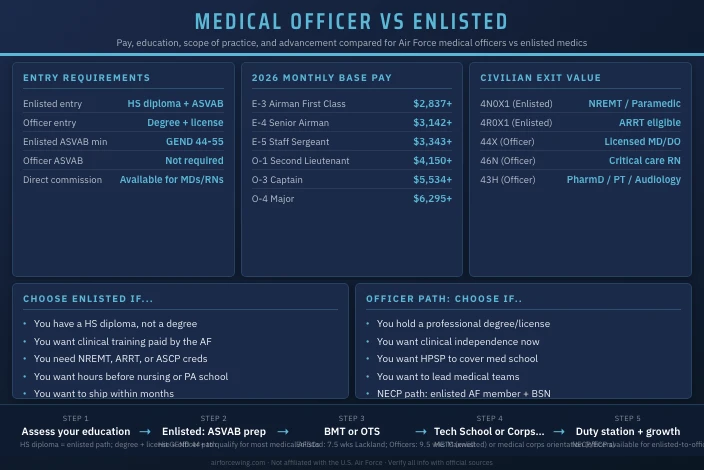
The Fundamental Difference
The split between enlisted and officer medical careers starts with education, not ambition.
Enlisted medical Airmen (AFSCs like 4N0X1, 4T0X1, 4R0X1) enter with a high school diploma. The Air Force provides all clinical training at the Medical Education and Training Campus (METC) at Fort Sam Houston. You graduate with hands-on skills, nationally recognized credentials, and real patient care experience, but you work under supervision. You don’t diagnose independently. You support the clinical mission.
Medical officers (designators 44X for physicians, 46N for nurses, 43H for biomedical sciences corps) enter with a professional degree already in hand. A 44X Medical Officer must hold an MD or DO and a state license before commissioning. A 46N Flight Nurse needs a BSN and an active RN license. A 43H officer may be a licensed pharmacist, physical therapist, or audiologist. The Air Force isn’t training you to be a clinician. You already are one.
That single difference downstream affects pay, scope of practice, authority, and advancement speed.
Education and Entry Requirements
The entry bars could not be more different.
| Requirement | Enlisted Medic | Medical Officer |
|---|---|---|
| Education | High school diploma | Professional degree (MD, BSN, PharmD, etc.) |
| License | None required at entry | Active state license required |
| ASVAB | GEND composite 44-55 depending on AFSC | Not required (officer applicants do not take ASVAB) |
| Commissioning source | Enlistment | Direct commission, ROTC, or OTS |
| Age at entry | Typically 17-39 | Typically up to 48 for physicians |
| Service commitment | 4-6 years standard | Varies by program; HPSP physicians owe 1 year per year funded |
Enlisted entry is faster. You can ship to Basic Military Training at Joint Base San Antonio-Lackland within months of signing. The officer track requires completing a full degree program first, or using the Air Force’s scholarship programs to fund one you’ve already started.
Pay Comparison
Base pay is published by DFAS and applies uniformly across all branches. These are 2026 monthly figures.
| Grade | Rank | Monthly Base Pay |
|---|---|---|
| E-3 | Airman First Class | $2,837 - $3,198 |
| E-4 | Senior Airman | $3,142 - $3,816 |
| E-5 | Staff Sergeant | $3,343 - $4,422 |
| O-1 | Second Lieutenant | $4,150 - $5,222 |
| O-3 | Captain | $5,534 - $9,004 |
| O-4 | Major | $6,295 - $10,510 |
A new enlisted Airman starts at E-3 after Basic Military Training graduation. Most reach E-4 Senior Airman within two years. A new medical officer commissions at O-1, but physician officers typically enter at O-3 or higher based on years of graduate training. A 44X physician with a residency behind them may enter at O-3 or O-4 directly.
Base pay is only part of the picture. Both enlisted Airmen and officers receive Basic Allowance for Housing (BAH, which varies by duty station and dependency status) and the Basic Allowance for Subsistence. Enlisted BAS is $476.95/month. Officers receive $328.48/month. Healthcare under TRICARE Prime is free for all active-duty members with no enrollment fee or copays.
Officers also carry student loan exposure that enlisted Airmen don’t. A physician entering the Air Force after medical school may arrive with $200,000-$300,000 in debt unless they used the Health Professions Scholarship Program (HPSP), which covers tuition, fees, books, and provides a monthly stipend in exchange for an active-duty service commitment.
Scope of Practice
This is where the two tracks diverge most visibly in daily work.
An enlisted 4N0X1 Aerospace Medical Technician performs patient assessments, administers medications and immunizations, manages wound care, and supports aeromedical evacuation. At the 5-skill level, the Independent Duty Medical Technician (IDMT) shredout allows solo care at remote sites, a significant expansion of authority. But the standard 4N0X1 works under physician or PA supervision.
A 44X Medical Officer holds a medical license and operates within that license’s full scope. They diagnose, prescribe, order imaging, manage complex cases, and supervise the enlisted medics around them. A flight surgeon, for example, makes the final call on whether a pilot is medically fit to fly.
46N Flight Nurses provide in-flight critical care during aeromedical evacuations. The stakes are high and the environment is austere. You’re managing ventilated patients in the air, sometimes from deployed locations with limited backup.
43H officers practice within their specific discipline. A 43H pharmacist manages formulary operations and medication therapy. A 43H physical therapist runs rehabilitation programs and makes clinical decisions independently within their scope.
The authority gap is real. Officers lead. Enlisted Airmen support. That distinction matters if you want clinical independence from day one.
Training Path
Both tracks start differently, but they can converge for the right person.
Enlisted training pipeline:
- BMT at JBSA-Lackland (7.5 weeks)
- Tech School at METC, Fort Sam Houston (varies by AFSC: roughly 14 weeks for 4N0X1, 12 months for 4T0X1 and 4R0X1)
- First duty station assignment
Officer training pipeline:
- Complete professional degree and licensure (independent of Air Force)
- Apply for direct commission or HPSP
- Officer Training School at Maxwell AFB, AL (9.5 weeks, if required; many medical officers receive direct commission and do a shorter orientation)
- Medical-specific orientation training for the corps
- First duty station assignment
There is a third path worth knowing: the Nurse Enlisted Commissioning Program (NECP). An enlisted Airman with clinical experience can apply for NECP, which funds a BSN program and commissions the graduate as a 46N officer. It’s competitive, but it’s designed exactly for the person who started enlisted and wants to become an officer.
Advancement Speed
Enlisted Airmen advance through the E-1 through E-9 structure. The first two promotions (E-2 and E-3) are time-based. From E-4 upward, promotion requires testing, performance reports, and board review. A typical enlisted medical Airman reaches E-5 Staff Sergeant around years four to six.
Officers advance through O-1 to O-6 on a longer but more structured timeline. Promotion from O-1 to O-3 happens mostly on time-in-grade. The board becomes competitive at O-4 and above. Physician officers who enter at O-3 move to O-4 faster than their peers who started at O-1.
Neither track is slow, and both offer meaningful promotions within a four-year contract. But officers start higher and have higher earnings ceilings. The tradeoff is the years spent getting the degree before you can commission.
Civilian Equivalency After Service
Both tracks produce civilian-ready credentials.
| Path | Military Role | Civilian Outcome |
|---|---|---|
| 4N0X1 | Aerospace Medical Technician | EMT-Basic or Paramedic (NREMT) |
| 4R0X1 | Diagnostic Imaging | Radiologic Technologist (ARRT eligible) |
| 4T0X1 | Medical Lab | Medical Laboratory Technician (ASCP eligible) |
| 44X | Medical Officer (Physician) | Licensed MD/DO in any state |
| 46N | Flight Nurse | RN with critical care and flight nursing experience |
| 43H | Biomedical Sciences Corps | Licensed pharmacist, PT, audiologist, etc. |
Enlisted Airmen in 4R0X1 or 4T0X1 effectively replace a two-year associate’s degree program while drawing a salary and benefits. That’s a compelling trade for someone who’s 18 and doesn’t want to take on college debt.
Officers transition with their pre-existing professional license. A 44X physician separating after 10 years enters the civilian market with deep experience, no school debt (if HPSP-funded), and usually some leadership positions in their record. Civilian healthcare employers have consistently strong demand for both groups.
Direct Commission: The Fast Track for Licensed Professionals
If you already hold a healthcare license, you don’t need ROTC or OTS to become an Air Force officer. The direct commission pathway lets physicians, nurses, and allied health professionals apply to commission without going through the standard accession pipeline.
The Health Professions Scholarship Program is worth a separate mention. HPSP pays full tuition, fees, and books for medical or dental school, plus a monthly living stipend. In exchange, you owe one year of active duty for each year funded. For a four-year medical program, that’s a four-year service commitment. Given that medical school averages over $200,000 in total cost, HPSP is one of the better financial deals available to aspiring physicians.
The full detail on commissioning paths for medical professionals, including HPSP eligibility and application steps, is at Air Force medical officer careers.
Which Path Fits You
There’s no objectively better answer. There’s only the right fit for where you are.
Start enlisted if:
- You have a high school diploma and want clinical training now
- You want the Air Force to fund your education or give you clinical hours before nursing school or PA school
- You’re drawn to hands-on patient work and want to move fast
- You want to earn credentials like NREMT, ARRT, or ASCP with no tuition debt
Commission as a medical officer if:
- You already hold a professional degree and license
- You want clinical independence and the authority to make diagnostic decisions
- You’re a medical or dental student who wants HPSP to cover tuition costs
- You want to lead medical teams rather than support them
The enlisted-to-officer path via NECP or the Enlisted Commissioning Program is a real option too. Plenty of 4N0X1 Airmen have left tech school, spent four years in the clinic, and returned to civilian school with military healthcare experience that strengthens their nursing school application.
For the full breakdown of all Air Force medical AFSC options and how the enlisted career field works, see the Air Force medical AFSC jobs guide. Preparing your ASVAB scores for the enlisted path starts at the Air Force ASVAB test prep guide.
This site is not affiliated with the U.S. Air Force or any government agency. Verify all information with official Air Force sources before making enlistment or career decisions.