Medical Disqualifications for Air Force Enlistment
A medical condition doesn’t automatically close the door to Air Force service. But it can slow the process, limit your AFSC options, or in some cases end your application before it starts. Understanding what gets flagged at MEPS, and what happens after, keeps you from being blindsided.
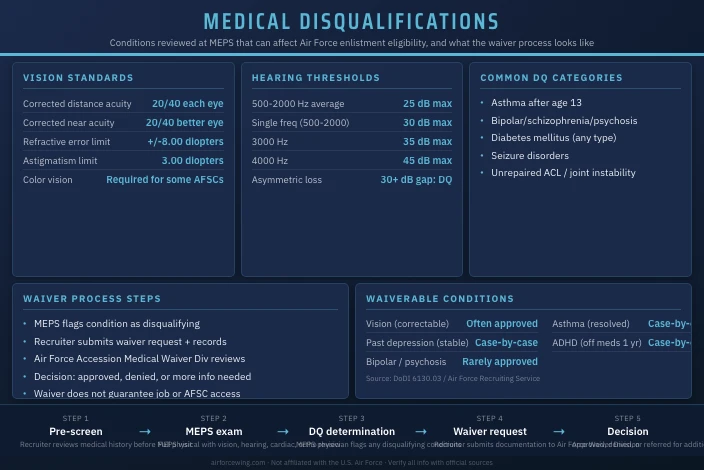
What Happens at MEPS
The Military Entrance Processing Station (MEPS) is where every enlisted applicant gets a full medical examination before shipping to Basic Military Training. This is not a general wellness checkup. MEPS physicians are evaluating you against the standards in DoD Instruction 6130.03, which governs medical fitness for military service across all branches.
The exam covers every major body system: vision, hearing, cardiac function, musculoskeletal integrity, neurological history, mental health, substance use, and more. MEPS also reviews your medical history forms and may request records from your civilian providers if anything on your forms raises a question.
A few things worth knowing before you go:
- Disclose everything. Concealing a medical condition is considered fraudulent enlistment, a serious legal offense. It is always safer to disclose and pursue a waiver than to hide something and have it surface later.
- Temporary vs. permanent conditions. Some conditions are disqualifying only because they require treatment or haven’t fully resolved. A healed ACL repair looks very different to a MEPS physician than an active tear.
- AFSC-specific standards apply separately. Even if you pass general MEPS standards, certain Air Force Specialty Codes have stricter requirements for vision, color perception, hearing, or physical fitness that apply on top of the baseline.
Vision
Vision is the most common reason applicants are flagged at MEPS. The baseline standards under DoDI 6130.03 require:
| Standard | Threshold |
|---|---|
| Distance acuity (corrected) | 20/40 in each eye |
| Near acuity (corrected) | 20/40 in the better eye |
| Refractive error | No more than +/-8.00 diopters |
| Astigmatism | No more than 3.00 diopters |
These are the general enlistment thresholds. Rated officer positions (pilot, combat systems officer) carry significantly tighter standards, and some enlisted AFSCs, particularly in intelligence and special operations, require normal color vision.
Laser vision correction surgery (LASIK, PRK) does not automatically disqualify you. The Air Force evaluates surgery outcomes on a case-by-case basis, and successful procedures that produce stable corrected acuity are often acceptable. Complications or instability post-surgery are a different matter.
Hearing
Hearing loss is evaluated through audiometric testing at MEPS. The specific thresholds that trigger a disqualification are:
- Average loss greater than 25 dB across 500-2000 Hz
- Loss exceeding 30 dB at any single frequency between 500-2000 Hz
- Loss exceeding 35 dB at 3000 Hz
- Loss exceeding 45 dB at 4000 Hz
- Asymmetric loss of 30 dB or more between ears at any frequency
- Any history of hearing aid use
Jobs requiring clear radio communication, target acquisition, or air traffic coordination have additional hearing requirements beyond these baseline figures.
Cardiac and Pulmonary Conditions
Several heart conditions are disqualifying without a waiver:
- Implanted pacemakers or defibrillators
- Arrhythmias that require ongoing treatment or medication
- History of myocardial infarction, myocarditis, or cardiomyopathy
- Moderate-to-severe valve disease (stenosis or regurgitation)
- Uncontrolled hypertension or a resting heart rate above 100 BPM
- Most congenital heart defects, though some minor ones are evaluated individually
On the pulmonary side, asthma is a well-known disqualifier. The standard under DoDI 6130.03 is specific: any history of airway hyperresponsiveness, including asthma, reactive airway disease, or exercise-induced bronchospasm, after the 13th birthday is disqualifying. Using inhaled or oral corticosteroids, leukotriene inhibitors, or beta-agonists for airway conditions after age 13 is also disqualifying, even if the medication was discontinued.
Waivers for asthma exist. They are granted when credible evidence shows the diagnosis was incorrect or the condition has fully and verifiably resolved, not just that you haven’t had symptoms recently.
Musculoskeletal Conditions
This category covers a wide range: spine, joints, ligaments, and bones. Common disqualifying conditions include:
- Anterior cruciate ligament tears that are unrepaired or have resulted in joint instability
- Meniscal injuries with functional limitations
- Scoliosis or other spinal deformities causing functional impairment
- Herniated discs with ongoing symptoms
- Fractures that healed with malunion or non-union
- Joint instability requiring multiple surgeries
A fully repaired ACL with documented recovery, normal range of motion, and no functional limitations is a very different case from an unrepaired tear. MEPS physicians and waiver reviewers look at current functional status, not just whether a surgery occurred.
Mental Health
Mental health history is evaluated carefully at MEPS. The conditions most likely to result in disqualification include:
| Condition | Standard |
|---|---|
| Schizophrenia / psychotic disorders | Disqualifying |
| Bipolar disorder | Disqualifying |
| Depressive disorder requiring outpatient care | Disqualifying if care exceeded 12 cumulative months |
| Autism spectrum disorder | Disqualifying |
| Suicidal ideation or self-harm history | Disqualifying |
| Psychiatric hospitalization | Disqualifying if within recent history |
| ADHD | Disqualifying if still medicated or recent history |
Waivers for mental health history are possible but depend on stability, time since treatment, and whether the condition is likely to recur under the stress of military service. A brief episode of depression treated years ago, with no recurrence, is viewed differently than chronic treatment for a major mood disorder.
ADHD is a common question. The Air Force typically requires applicants with an ADHD history to have been off medication for at least one year and to demonstrate academic and behavioral performance that shows they can function without it.
Neurological and Metabolic Conditions
Seizure disorders are disqualifying in most cases. Applicants who have been completely seizure-free for at least 60 months may be eligible for waiver consideration depending on the type and cause.
Diabetes mellitus of any type is disqualifying for general enlistment. There is currently no established waiver path for insulin-dependent diabetes for active-duty enlisted service.
Sleep apnea without effective treatment is disqualifying. If you have a diagnosis and are successfully managing it with a CPAP device and have documentation of compliance, the case becomes more complex but is not automatically closed.
Other conditions that frequently come up:
- Moderate-to-severe traumatic brain injury
- Multiple sclerosis or progressive neurological disease
- Hepatitis B or C (unless fully cured with documented lab results)
- Lupus, rheumatoid arthritis, or other autoimmune conditions requiring treatment
- Active or inadequately treated tuberculosis
Substance Use History
Drug and alcohol history is part of the MEPS evaluation. A positive drug screen on test day is disqualifying. A documented history of drug or alcohol dependence, not just experimentation, is disqualifying, as is a DUI or DWI conviction on your record.
Marijuana deserves specific mention. Even in states where recreational use is legal, a positive THC drug test at MEPS disqualifies you. Recruiters generally advise stopping use well in advance of your exam date.
The Waiver Process
Being flagged at MEPS as medically disqualified is not a final answer. The Air Force has a formal waiver process, and many conditions that trigger an initial disqualification are waiverable depending on the specifics.
The conditions most commonly approved with a waiver are correctable vision issues, resolved asthma with strong documentation, stabilized mental health history, and orthopedic conditions with complete surgical repair and documented recovery. Conditions like bipolar disorder, insulin-dependent diabetes, and active psychotic disorders are rarely if ever waived for general enlistment.
Conditions That Vary by AFSC
General medical qualification gets you through the door. AFSC selection adds another layer.
Special Warfare AFSCs. Combat Controller, Pararescue, TACP, Special Reconnaissance, require passing the Physical Ability and Stamina Test and have stricter medical standards than general enlistment. Color vision deficiency that is waiverable for most jobs may still close certain operations or intelligence roles. Pilot candidates face the strictest vision and cardiac standards in the Air Force, governed by aviation medicine standards that go well beyond the general enlistment baseline.
Ask your recruiter which AFSC you’re targeting and whether your medical history creates additional hurdles for that specific job, not just for enlistment in general.
Before Your MEPS Appointment
A few practical steps that make the process go smoother:
- Get your records in order. Collect treatment summaries, operative reports, and discharge paperwork for any condition you plan to disclose. Showing up without records slows everything down.
- Be honest on the pre-screen forms. Your recruiter reviews these before MEPS. Surprises at MEPS are worse than disclosures up front.
- Don’t rely on your recruiter’s informal opinion. Recruiters are not physicians. An informal “you’ll be fine” is not a waiver. The MEPS physician makes the call.
The path from MEPS to BMT involves the fitness test, ASVAB scores, and job selection, all of which matter alongside your medical status. A full picture of how enlistment works is at Air Force enlisted careers, and ASVAB test prep covers how to maximize your line scores once medical is cleared.
You may also find the Air Force Fitness Test guide and Air Force BMT Physical Training: What to Expect useful as you prepare for what comes after MEPS.
This site is not affiliated with the U.S. Air Force or any government agency. Verify all information with official Air Force sources before making enlistment or career decisions.