Air Force Medical Direct Commission Guide
A licensed physician, nurse, dentist, or psychologist doesn’t have to spend months at Officer Training School to earn a commission. The Air Force has a separate door for healthcare professionals: direct commission. You come in as an officer, skip the standard OTS pipeline, and attend a shorter orientation course instead. The tradeoff is a service commitment, but the package, pay, benefits, loan forgiveness potential, and clinical variety, is worth understanding before you rule it out.
What Direct Commission Actually Means
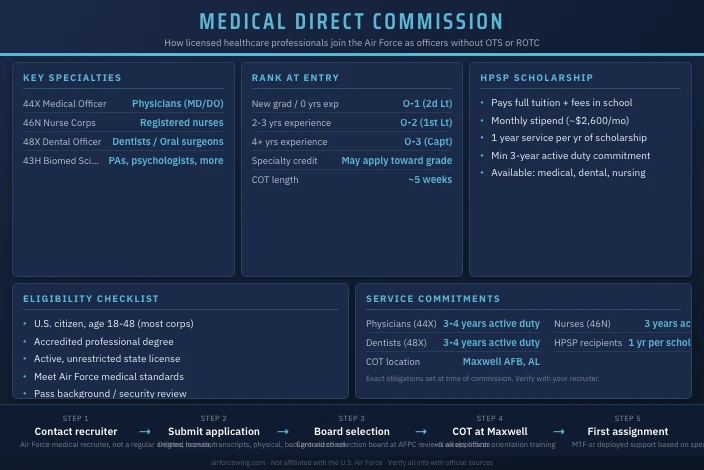
Most Air Force officers commission through ROTC, the Air Force Academy, or OTS. Direct commission is different. The Air Force selects practicing healthcare professionals and grants them a commission based on their credentials rather than a multi-year school program.
You won’t attend OTS. Instead, direct commissionees complete Commissioned Officer Training (COT) at Maxwell AFB, Alabama: roughly five weeks of officer orientation. COT covers Air Force customs, leadership basics, and service-specific policies. It’s designed for professionals who are already experts in their field.
The idea is straightforward: the Air Force needs working clinicians, not students learning to be clinicians.
Who Qualifies
Every medical specialty has its own eligibility criteria, but the baseline requirements apply across the board:
- U.S. citizenship
- Accredited professional degree (MD, DO, DDS, DMD, CRNA, PA, PhD, DNP, MSN depending on the corps)
- Active, unrestricted state license in your specialty
- Meet Air Force medical and physical standards
- Age limits: generally 18-48 depending on the corps; some specialties have different ceilings
- Background investigation clearance
No prior military service is required. Licensed professionals who have never worn a uniform can apply.
The application goes through the Air Force medical recruiting office, a separate channel from the standard enlisted or officer recruiter. Your packet typically includes transcripts, proof of licensure, a physical examination, letters of recommendation, and a background check. A centralized selection board at Air Force Personnel Command reviews all applicants.
Officer Medical Specialties
The Air Force organizes medical officers into four corps. Each covers a different clinical domain.
| AFSC Designator | Corps | Who Applies |
|---|---|---|
| 44X | Medical Corps | Physicians (MD/DO), including flight surgeons |
| 46N | Nurse Corps | Registered nurses (BSN minimum; MSN or DNP for some roles) |
| 48X | Dental Corps | Dentists and oral surgeons (DDS/DMD) |
| 43X | Biomedical Sciences Corps | Physician assistants, clinical psychologists, optometrists, physical therapists, pharmacists, and others |
44X Medical Corps officers are the Air Force’s physicians. Some serve as flight surgeons: doctors specially trained to support aviation operations and evaluate the medical fitness of aircrew. Flight surgeon training is an additional qualification completed after commissioning.
46N Nurse Corps officers staff military treatment facilities (MTFs), deployed medical units, and aeromedical evacuation aircraft. The minimum credential is a Bachelor of Science in Nursing with an active RN license. Nurse Anesthetists (CRNAs) commission under a separate designator within the Nurse Corps.
48X Dental Corps includes general dentists, oral and maxillofacial surgeons, orthodontists, and other dental specialists. The Air Force funds graduate dental specialty training for selected officers, so a general dentist can sometimes pursue a specialty after commissioning.
43X Biomedical Sciences Corps is the catch-all corps for licensed health professionals who aren’t physicians, nurses, or dentists. Physician assistants, clinical psychologists, optometrists, and clinical social workers are among the most commonly recruited. A PA typically needs a master’s-level PA program and NCCPA certification to qualify.
Entry Rank and Pay
The Air Force matches your entry grade to your professional experience. Most direct commissionees enter between O-1 (Second Lieutenant) and O-3 (Captain) depending on years of post-degree experience and specialty.
A newly licensed RN with no prior service typically enters as an O-1. A physician with four or more years of post-residency experience may enter as an O-3. Some specialties have specific grade assignment policies, your recruiter will confirm where your credentials place you.
2026 monthly basic pay by grade:
| Grade | Title | Less than 2 yrs | 4 yrs | 6 yrs |
|---|---|---|---|---|
| O-1 | 2d Lt | $4,150 | $5,222 | , |
| O-2 | 1st Lt | $4,782 | $6,485 | $6,618 |
| O-3 | Capt | $5,534 | $7,383 | $7,737 |
Basic pay is the base figure. On top of it, officers receive Basic Allowance for Housing (BAH), which varies by duty location and dependent status, plus Basic Allowance for Subsistence (BAS) at $328.48 per month for officers. TRICARE health coverage has no enrollment fee and no copay on active duty. The full compensation package is considerably larger than basic pay alone suggests.
Service Commitments
A direct commission is not a short-term arrangement. The Air Force invests real resources in bringing licensed professionals on board, and the commitment reflects that.
Typical active duty obligations by corps:
- Medical Corps (44X): 3 to 4 years, depending on specialty and any associated training programs
- Nurse Corps (46N): 3 years
- Dental Corps (48X): 3 to 4 years
- Biomedical Sciences Corps (43X): varies by specialty and program
These are minimums. Officers who accept graduate specialty training through the Air Force, such as a residency or fellowship, take on additional service obligations tied to the length of that training. Your recruiter and the contract language will specify the exact terms for your situation.
The HPSP Alternative: Commission While Still in School
If you’re currently enrolled in a professional degree program, the Health Professions Scholarship Program (HPSP) is worth serious attention. HPSP pays tuition, fees, and required equipment while you’re in school, plus a monthly living stipend of roughly $2,600. In exchange, you incur one year of active duty service for each year of scholarship, with a minimum of three years.
HPSP is available for:
- Medical school (MD/DO)
- Dental school (DDS/DMD)
- Nursing programs (select MSN/DNP tracks)
- Some psychology and optometry programs
Recipients commission as officers while still students, complete COT during a school break, and report to active duty after graduation and licensure. The program doesn’t eliminate the debt problem entirely, you graduate without tuition debt, but the service obligation is the cost, though for students staring at $250,000+ in projected loans, the math often favors HPSP.
One important note: HPSP selection is competitive and managed separately from the direct commission process. Apply early. Slots are limited each cycle.
What Daily Service Looks Like
Medical officers don’t spend their careers in the field. Most assignments are at Military Treatment Facilities (MTFs): the hospitals and clinics on or near Air Force installations. You’ll see a mix of active duty servicemembers, their families, and retirees.
Some specialties, particularly flight surgeons and certain nurses, deploy in support of aeromedical evacuation or expeditionary medical units. Others spend most or all of their time stateside in a clinic or hospital setting.
The patient population skews young and relatively healthy compared to most civilian practices. You’ll still see the full range of acute and chronic conditions, but without the volume of uninsured or underinsured patients that shapes a lot of civilian emergency and primary care work.
The Air Force Fitness Assessment applies to medical officers the same as any other officer, 1.5-mile run, push-ups, sit-ups, and waist measurement, scored on a 100-point scale with a 75 minimum to pass.
This site is not affiliated with the U.S. Air Force or any government agency. Verify all requirements, eligibility criteria, and service commitments with an official Air Force medical recruiter or at afpc.af.mil before making any decisions.
Applying: How the Process Works
The medical commission process runs on a different timeline than standard OTS applications. Expect several months from initial contact to a selection decision.
Is It Worth Considering
Direct commission is a real option for licensed clinicians who want federal loan forgiveness under PSLF (which applies to military service), a stable employment environment, or clinical experience across a broader patient base than many private practices offer. The pay isn’t going to match a private practice physician at peak earnings, but the full compensation package, housing, healthcare, retirement at 20 years, changes the comparison.
The service commitment is the real question. Three to four years is meaningful. Moving every two to four years for PCS assignments affects families. These are practical factors, not selling points or deterrents, they’re just the shape of the job.
For those still in training, HPSP turns that commitment into a financing mechanism. For licensed professionals already working, direct commission is a lateral entry with a specific price tag: your time, and your willingness to live where the Air Force sends you.
Air Force medical careers has a full breakdown of officer designators. For a broader look at all Air Force medical jobs, the Air Force Medical AFSC Jobs guide covers both officer and enlisted roles side by side. If you’re weighing whether to commission or enlist, the paths to serve guide lays out every entry route the Air Force offers.