Air Force Medical AFSC Jobs: Complete Guide
The Air Force trains enlisted medics, surgeons’ assistants, pharmacists, imaging technicians, and mental health specialists, and then pays them to do it full time. If you’re drawn to healthcare but not ready to take on six figures of nursing school debt, the medical career field is one of the few paths where you can earn while you learn and leave with credentials that civilian employers actually want.
Seven enlisted AFSCs and multiple officer designations make up the Air Force medical workforce. Each has its own training pipeline, ASVAB score requirement, and post-service career angle. This guide covers all of them so you can compare before you commit.
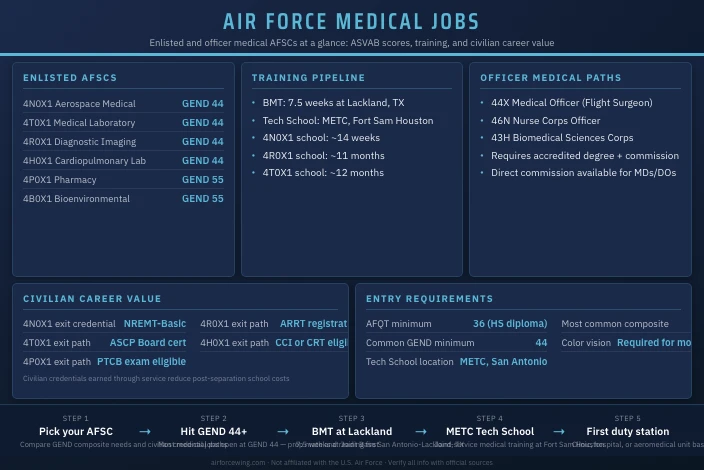
The Seven Enlisted Medical AFSCs
All seven enlisted medical AFSCs flow through the same front door: Basic Military Training at Joint Base San Antonio-Lackland, TX, followed by Technical School at the Medical Education and Training Campus (METC) at Fort Sam Houston, San Antonio. METC is a joint-service training hub where Air Force students train alongside Army and Navy medical students. The shared campus means standardized clinical curricula and certifications that civilian employers recognize regardless of which branch awarded them.
Here’s the full enlisted lineup with ASVAB composite requirements:
| AFSC | Title | Composite | Minimum Score |
|---|---|---|---|
| 4N0X1 | Aerospace Medical Technician | GEND | 44 |
| 4T0X1 | Medical Laboratory | GEND | 44 |
| 4R0X1 | Diagnostic Imaging | GEND | 44 |
| 4H0X1 | Cardiopulmonary Laboratory | GEND | 44 |
| 4C0X1 | Mental Health | GEND | 44 |
| 4P0X1 | Pharmacy | GEND | 55 |
| 4B0X1 | Bioenvironmental Engineering | GEND | 55 |
The General (GEND) composite is drawn from Word Knowledge, Paragraph Comprehension, Arithmetic Reasoning, and Mathematics Knowledge, the reading and math subtests. A GEND of 44 is achievable with solid preparation. Two roles set a higher bar: Pharmacy and Bioenvironmental Engineering both require GEND 55, reflecting the more demanding analytical and calculation work in those specialties.
4N0X1 Aerospace Medical Technician
4N0X1 is the Air Force’s generalist medic role and the most widely assigned medical AFSC. Technicians work in urgent care clinics, flight medicine facilities, and deployed medical support units. They perform patient assessments, administer medications and immunizations, manage wound care, and support aeromedical evacuation missions.
Tech School at METC runs approximately 14 weeks. Graduates earn a Nationally Registered EMT-Basic (NREMT) credential at completion. Six specialty tracks (called shredouts) become available at the 5-skill level, including the 4N0X1C Independent Duty Medical Technician: a 26-week advanced course that qualifies Airmen to serve as the primary medical provider at remote sites. The 4N0X1H Paramedic shredout leads to EMT-Paramedic certification, a credential that commands significantly higher civilian salaries.
4T0X1 Medical Laboratory Technician
4T0X1 Airmen process blood, tissue, and body fluid specimens to support diagnosis and treatment across Air Force medical facilities. The work covers hematology, urinalysis, blood banking, microbiology, and clinical chemistry. Tech School at METC runs approximately 12 months and mirrors the coursework required for civilian Medical Laboratory Technician (MLT) certification through ASCP.
This is a high-value civilian transition path. Lab technicians are in demand across hospital networks, reference labs, and outpatient facilities. The shortage of qualified lab workers has kept wages competitive in most metro areas.
4R0X1 Diagnostic Imaging Technician
4R0X1 Airmen operate X-ray, CT, and fluoroscopic imaging systems in Air Force clinics and hospitals. The training program at METC runs approximately 11 months and covers radiographic positioning, exposure technique, patient safety, and image quality evaluation. Graduates are eligible to sit for the ARRT (American Registry of Radiologic Technologists) certification exam after separation.
The ARRT credential is a hard requirement at most civilian imaging positions. Earning it through military service eliminates the typical two-year associate’s degree cost, which averages $15,000-$30,000 at community colleges.
4H0X1 Cardiopulmonary Laboratory Technician
4H0X1 Airmen perform electrocardiography, stress testing, Holter monitoring, and pulmonary function testing. They work alongside cardiologists and pulmonologists in Air Force medical groups, collecting and interpreting the data those providers use to make treatment decisions. Training at METC covers EKG lead placement, spirometry, and cardiac telemetry.
Post-service, 4H0X1 Airmen are well positioned for Cardiovascular Technologist roles and can pursue the Certified Cardiac Rhythm Technician (CCRT) or Registered Cardiopulmonary Technician (RCT) credentials with their training hours.
4C0X1 Mental Health Technician
4C0X1 Airmen work in behavioral health clinics under the supervision of licensed psychologists, psychiatrists, and social workers. The role involves patient intake, case management support, group therapy facilitation, and crisis intervention assistance. It is not a clinical license, 4C0X1 Airmen are paraprofessionals, not independent practitioners, but the clinical exposure is direct and the work is meaningful.
This AFSC pairs well with psychology, social work, or counseling graduate programs after separation. Civilian psychiatric technician and behavioral health tech roles are accessible entry-level options with no additional credentialing required.
4P0X1 Pharmacy Technician
4P0X1 Airmen manage prescription processing, medication dispensing, and formulary inventory in Air Force pharmacy operations. The higher GEND 55 requirement reflects the precision arithmetic and reading the job demands: dosage calculations, drug interaction checks, and patient medication counseling require accuracy that lower composite scores don’t consistently predict.
PTCB (Pharmacy Technician Certification Board) exam eligibility follows service. Civilian pharmacy tech wages are stable and growing, with hospital pharmacy positions offering more than retail roles.
4B0X1 Bioenvironmental Engineering Technician
4B0X1 Airmen assess occupational and environmental health hazards on Air Force installations. They measure noise levels, air quality, chemical exposure, and radiation to protect the Airmen working in industrial environments, flightlines, maintenance shops, fuel facilities, and munitions storage areas. The job is less clinical than the other medical AFSCs and involves substantial time in the field and writing technical reports.
This role typically requires a Secret security clearance. The civilian equivalent is industrial hygienist or environmental health and safety specialist, both of which are in demand across manufacturing, construction, and energy sectors.
ASVAB Requirements and How to Hit Them
Most Air Force medical jobs require a GEND composite of 44 or higher. That means scoring well across four subtests: Word Knowledge, Paragraph Comprehension, Arithmetic Reasoning, and Mathematics Knowledge. If your baseline practice scores show weakness in math, that’s the subtest to fix first. Arithmetic Reasoning and Mathematics Knowledge together account for half the GEND composite.
The AFQT minimum for Air Force enlistment is 36 (or 65 with a GED). Your AFQT gets you through the door; the GEND composite determines which medical jobs you actually qualify for. For a full breakdown of composite scores across all seven medical AFSCs and specific prep strategies, the ASVAB scores for Air Force medical AFSC jobs post covers each role in detail.
ASVAB line score minimums are set by AFI 36-2101 and can change when the regulation is updated. Always confirm current requirements with an Air Force recruiter before your MEPS appointment. The scores above are current as of this writing but are not guaranteed for future enlistment cycles.
The Training Pipeline
Every enlisted medical Airman follows the same two-phase pipeline before reaching their first duty station.
Tech School is academically demanding. Anatomy, physiology, pharmacology, and medical terminology are standard early content across all medical pipelines. Arrival with solid reading and math skills makes the academic phase faster. A focused ASVAB prep program in the weeks before MEPS will help you build those fundamentals before you need them in the classroom.
Pay in Air Force Medical Careers
Medical AFSCs receive the same base pay scale as all other Air Force career fields. Pay is set by DFAS, applies uniformly, and increases with rank and years of service.
| Grade | Rank | Monthly Base Pay (2026) |
|---|---|---|
| E-1 | Airman Basic | $2,407 |
| E-2 | Airman | $2,698 |
| E-3 | Airman First Class | $2,837 - $3,198 |
| E-4 | Senior Airman | $3,142 - $3,816 |
| E-5 | Staff Sergeant | $3,343 - $4,422 |
| E-6 | Technical Sergeant | $3,401 - $5,044 |
Base pay doesn’t include allowances. Most Airmen living off-base receive Basic Allowance for Housing (BAH), which varies by duty location and dependency status. The flat Basic Allowance for Subsistence (BAS) adds $476.95 per month for all enlisted members. TRICARE Prime coverage for active-duty members and their dependents carries no enrollment fee, deductible, or copay.
Medical fields occasionally carry enlistment or reenlistment bonuses based on Air Force manning priorities. Confirm current incentives with your recruiter, they change on a fiscal year cycle.
Civilian Career Transfer Value
This is where Air Force medical careers separate themselves from most other AFSC options. The credentials earned during service translate to licensed, certified civilian jobs without requiring another two or four years of school.
| AFSC | Civilian Career | Civilian Credential Path |
|---|---|---|
| 4N0X1 | EMT / Paramedic | NREMT-B at Tech School; Paramedic via 4N0X1H shredout |
| 4R0X1 | Radiologic Technologist | ARRT exam eligible after separation |
| 4T0X1 | Medical Laboratory Technician | ASCP MLT exam eligible after separation |
| 4H0X1 | Cardiovascular Technologist | CCI or RCT exam eligible |
| 4P0X1 | Pharmacy Technician | PTCB exam eligible |
| 4C0X1 | Psych / Behavioral Health Tech | Direct hire entry-level; graduate school pathway |
| 4B0X1 | Industrial Hygienist / EHS Specialist | CIH or CSP credential pathway |
A four-year enlistment in 4R0X1 or 4T0X1 effectively replaces a two-year associate’s degree program, plus you received housing, healthcare, and salary throughout. For anyone weighing military service against community college, the math tends to favor service for healthcare career starters.
Officer Medical Paths
Commissioned officers in Air Force medical careers enter through different channels than enlisted Airmen. The three primary designator groups are:
44X Medical Officer covers physicians across multiple specialties: flight surgeons, internists, emergency medicine physicians, and surgeons. Flight surgeons (48X) assess and manage the medical fitness of aircrew and serve at flight medicine units worldwide. Most 44X officers enter through direct commission after completing medical school, residency, and licensure. The Health Professions Scholarship Program (HPSP) offers full medical school funding in exchange for an active-duty service commitment.
46N Nurse Corps Officer requires a Bachelor of Science in Nursing (BSN) and an active state nursing license before commissioning. Nurse Corps officers manage nursing units, lead clinical teams, and serve in aeromedical evacuation squadrons. BSN graduates can access the Nurse Enlisted Commissioning Program (NECP) if they are already serving as enlisted medical Airmen.
43H Biomedical Sciences Corps spans a wide range of non-physician clinical officers: pharmacists, physical therapists, optometrists, audiologists, laboratory officers, and healthcare administrators. Entry requirements depend on the specific specialty but generally require an applicable graduate degree and professional license.
The Air Force officer medical career field page covers commissioning paths, education requirements, and designator-specific details.
Enlisted vs. Officer Medical: Which Path Fits You?
The choice often comes down to where you are in your education and career timeline.
Choose the enlisted path if:
- You don’t yet have a bachelor’s degree
- You want hands-on clinical experience before committing to a specific healthcare profession
- You want the military to fund your education while you work
- You’re considering nursing or PA school and want clinical hours first
Choose the officer path if:
- You already hold a healthcare degree and license
- You want leadership responsibility from the start
- You’re a physician, dentist, nurse, or pharmacist looking for a service commitment with scholarship support
There’s also a hybrid route. Enlisted medical Airmen can apply for the Air Force’s Enlisted Commissioning Program (ECP) or Nurse Enlisted Commissioning Program (NECP) after serving, using their clinical experience and military service as the foundation for an officer career. The comparison between these two tracks is explored in depth in Air Force medical officer vs: enlisted medic.
Choosing Between Medical AFSCs
A few practical questions will narrow your options quickly.
Do you want direct patient contact? 4N0X1 gives the broadest clinical exposure. 4H0X1, 4R0X1, and 4T0X1 are more procedurally focused but still patient-facing. 4B0X1 is the least patient-facing.
Do you want a specific civilian license? 4R0X1 maps directly to ARRT, 4T0X1 to ASCP, 4P0X1 to PTCB. These are nationally recognized, employer-required credentials in their respective fields.
How high is your GEND composite? If you’re at GEND 44-54, your options cover five of the seven AFSCs. Hitting GEND 55 opens 4B0X1 and 4P0X1. Spending extra prep time on math can meaningfully expand your choices.
Do you have any prior healthcare experience? EMT certification, CNA work, or volunteer EMS experience won’t change ASVAB requirements, but they give context for which clinical environment you’ll find most engaging. That matters, you’re likely spending three to six years in it.
The deeper side-by-side comparison of the three most popular options is in 4N0X1 vs: 4T0X1 vs: 4P0X1. For Airmen looking at post-service civilian job prospects specifically, best Air Force medical jobs for civilian healthcare careers ranks the AFSCs by post-separation employment outcomes.
This site is not affiliated with the U.S. Air Force or any government agency. Verify all information with official Air Force sources before making enlistment or career decisions.
Explore the full Air Force medical career group to see individual AFSC profiles, including training lengths, specific ASVAB thresholds, and duty station options for each role.