Air Force Jobs That Transfer to Civilian Careers
Most people who enlist don’t spend a full career in the Air Force. The average enlisted airman separates somewhere between the four- and six-year mark, walks out with a DD-214, and immediately asks the same question: what does any of this mean on a resume? The honest answer depends almost entirely on which AFSC they chose.
Some jobs train you for skills that civilian employers actively recruit. Others leave you with experience that’s hard to translate outside the service. Picking the right AFSC at enlistment can mean the difference between a $50,000 first-year salary and a $100,000 one.
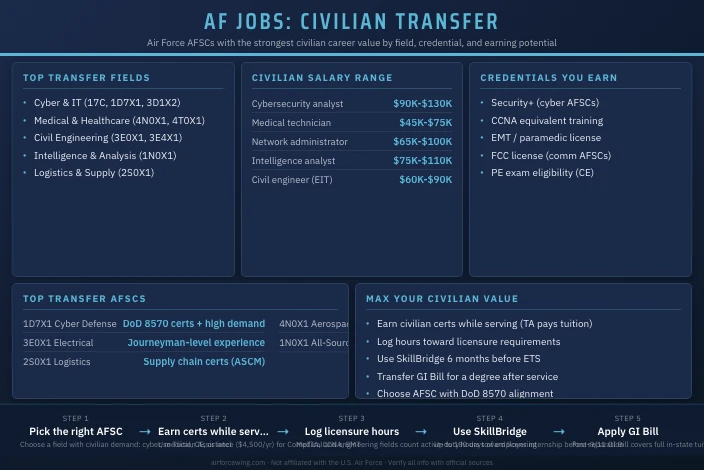
Why AFSC Choice Drives Civilian Outcome
The military pays all E-4s the same. A Senior Airman with a cybersecurity AFSC and a Senior Airman running vehicle maintenance earn the same basic pay: $3,659 per month at two years of service. But their civilian earning potential at separation diverges sharply.
Three factors determine how well an AFSC transfers:
- Certification alignment: Jobs that train to recognized civilian standards (CompTIA Security+, EMT-Basic, FAA licensing) let you exit with a credential, not just experience.
- License hour accumulation: Medical and engineering roles count active-duty hours toward state licensing requirements, which takes years to build in the civilian world.
- Security clearance value: A TS/SCI clearance, earned in intelligence or cyber AFSCs, adds significant salary weight in the defense contractor market.
Your ASVAB composite scores determine which of these fields you can qualify for. Cyber and intelligence jobs typically require high ELEC or GEND composite scores. Medical roles draw from ADMI and GEND. Civil engineering jobs pull from MECH and MAGE composites. Knowing your scores before you sit with a recruiter puts you in control of the conversation.
Cyber and IT: The Highest-Ceiling Field
No field transfers better from military to civilian employment than cyber and information technology. Demand for people with hands-on defensive operations experience and an active security clearance consistently outpaces supply.
The key AFSCs in this field:
| AFSC | Title | What You Learn |
|---|---|---|
| 1D7X1 | Cyber Defense Operations | Network defense, intrusion detection, incident response |
| 3D0X2 | Cyber Systems Operations | Server administration, Active Directory, cloud infrastructure |
| 3D1X2 | Cyber Transport Systems | Routing, switching, WAN architecture |
| 17C | Cyberspace Operations Officer (enlisted equivalent: 1B4X1) | Offensive and defensive cyberspace operations |
Airmen in cyber AFSCs train to DoD Directive 8570 standards, meaning they walk out with CompTIA Security+, and often Network+ and CEH as well, paid for through government training programs. A mid-career cybersecurity analyst with an active TS clearance earns between $90,000 and $130,000 in most metro markets.
The Air Force cyber career group offers the deepest pipeline in the enlisted force for IT skill development. Tech school for 1D7X1 runs roughly six months, long enough to build real technical depth before your first assignment.
Medical: Credentials and Clinical Hours
Healthcare is the other field where military training produces a transferable credential on day one of separation. The Air Force medical career group trains airmen to the same EMT, phlebotomy, and laboratory standards that civilian healthcare employers hire to.
4N0X1 Aerospace Medical Technician is the flagship entry. You complete EMT-Basic certification during tech school, then accumulate clinical hours across your assignment that count toward National Registry recertification and, depending on the state, toward higher licensure like EMT-Paramedic or Registered Nursing pathways.
Other strong options in the field:
- 4T0X1 Medical Laboratory: ASCP MLT certification path, high civilian lab demand
- 4P0X1 Pharmacy Technician: PTCB certification, direct civilian pharmacy employment
- 4R0X1 Diagnostic Imaging: Radiologic technologist licensing hours
Civilian medical technician salaries run $45,000 to $75,000 at entry, with registered nurses and advanced technicians earning substantially more. The Air Force medical career group is one of the fastest-growing fields in terms of civilian hiring demand post-separation.
Civil Engineering: Licensure-Eligible Experience
The 3E series of civil engineering AFSCs covers electrical systems, HVAC, plumbing, structural work, and fire protection. What makes this field stand out is that many states count active-duty CE work experience toward the hours required to sit for journeyman licensing exams.
The most transferable AFSCs:
- 3E0X1 Electrical Systems: Works on installation power distribution, runs toward journeyman electrician licensing
- 3E4X1 Utilities Systems: HVAC and plumbing systems, covers NATE and EPA 608 certification pathways
- 3E5X1 Engineering Contracting: Reads blueprints, manages construction scope, transitions to project management
An Engineer-in-Training credential with active-duty CE experience can command $60,000 to $90,000 starting in construction management or facilities engineering roles. The civil engineering career group also produces strong candidates for federal facility management jobs, which remain plentiful for veterans.
The trade licensing angle is worth calling out specifically: a journeyman electrician in most metro areas earns more than $80,000 a year, and master electricians regularly top $100,000. Starting that clock while on active duty means reaching licensure years earlier than a civilian apprentice would.
Intelligence: TS/SCI Plus Analyst Skills
Intelligence AFSCs combine a high-value security clearance with analytical tradecraft that defense contractors and federal agencies pay well to hire. The 1N series covers all-source analysis, signals, human intelligence, and geospatial disciplines.
1N0X1 All-Source Intelligence Analyst is the broadest entry point. Airmen learn structured analytical methodology, intelligence writing, and briefing skills during a tech school pipeline that runs around five months. Most 1N0X1 assignments include access to classified systems and exposure to national-level intelligence products.
The civilian value comes from two directions:
- An active Top Secret/SCI clearance is an employment credential in itself. Intelligence community contractors routinely offer cleared analysts $75,000 to $110,000 for work that directly mirrors military intelligence tasks.
- The analyst skillset (structured problem-solving, written assessments, briefing senior decision-makers) transfers to business intelligence, risk analysis, and financial sector roles even outside the cleared world.
More on the financial angle in how a TS/SCI clearance boosts your civilian salary.
Logistics: Certifications and Supply Chain Demand
Logistics might not sound glamorous, but the civilian supply chain industry is consistently one of the largest hiring sectors in the economy, and Air Force logistics training maps directly to it.
2S0X1 Materiel Management covers inventory control, distribution, and asset tracking across a global supply chain. Airmen who pursue the ASCM (Association for Supply Chain Management) certification path while serving exit with a credential that retail, e-commerce, and manufacturing employers actively recruit.
Other transferable logistics AFSCs:
- 2T0X1 Traffic Management: Routes freight and manages transportation contracts, equivalent to a civilian logistics coordinator role
- 2T2X1 Air Transportation: Loads aircraft to weight and balance specifications, transitions to commercial cargo and airline ground operations
Entry-level supply chain coordinator roles run $50,000 to $70,000, with ASCM-certified specialists moving into $80,000 to $100,000 management positions faster than peers who lack the credential.
How to Stack the Deck Before You Separate
Choosing the right AFSC is only the first step. What you do during your enlistment determines how strong the civilian outcome actually is.
Four things that compound your value:
- Use Tuition Assistance while on active duty. The Air Force covers up to $4,500 per year in college tuition with no service obligation attached. Knocking out an associate degree or relevant certifications while serving is free money most airmen leave on the table.
- Track your licensure hours. Medical and engineering airmen should verify with their state licensing board early in their enlistment which activities count toward civilian hour requirements. Documenting this from day one pays off at separation.
- Apply to SkillBridge. The DoD SkillBridge program lets airmen work with a civilian employer for up to 180 days before separation while still receiving military pay and benefits. Getting a job offer before the last day on active duty is a significant advantage.
- Know your post-service education options. The Post-9/11 GI Bill covers full in-state tuition at public universities after service. Private school attendance is capped at around $29,921 per academic year. That’s enough funding to finish a bachelor’s degree in a high-demand field at no out-of-pocket cost.
Which Field Fits Your ASVAB Scores
Every field covered here requires specific ASVAB line scores. Cyber and intelligence jobs tend to have the highest thresholds. Medical and logistics are more accessible. Getting your scores up before you commit to a specific AFSC opens more options.
| Career Field | Key Composite | Typical Minimum Score |
|---|---|---|
| Cyber / IT | ELEC or GEND | 64-70+ |
| Medical | ADMI or GEND | 44-52+ |
| Civil Engineering | MECH or MAGE | 47-57+ |
| Intelligence | GEND | 58-64+ |
| Logistics | ADMI or GEND | 44-54+ |
These are general ranges. Exact minimums are set in AFI 36-2101 and vary by specific AFSC. Studying for the right composite, not just the AFQT, is how you qualify for the jobs with the most civilian upside. Air Force ASVAB test prep resources cover the composite-specific study strategy in detail.
The full breakdown of every enlisted AFSC and its requirements is at Air Force enlisted careers.
You may also find Best Air Force Jobs for 2026 and Highest-Paying Air Force AFSC Jobs helpful.
This site is not affiliated with the U.S. Air Force or any government agency. Verify all information with official Air Force sources before making enlistment or career decisions.