Air Force Jobs That Require a Security Clearance
A security clearance is the entry ticket to some of the most technically demanding and well-paid careers the Air Force offers. It also follows you out the door when you separate, opening defense contractor and federal agency jobs that pay a premium specifically because the clearance is already active. Here’s what every level requires, which AFSCs need it, and what can get you disqualified before you ever sit in a classified facility.
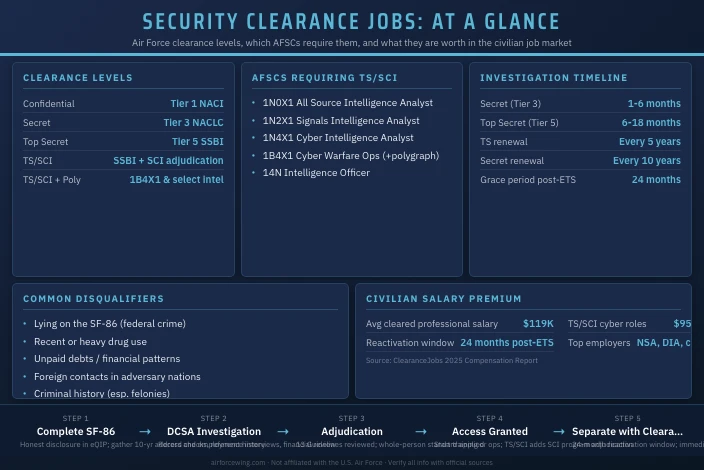
Clearance Levels Explained
The U.S. government uses three standard clearance levels. Each one unlocks access to a different classification tier, and each requires a more thorough investigation than the one below it.
Confidential is the baseline. It covers the lowest classification tier and is the least common entry-level requirement in the Air Force. Most jobs that need a clearance start at Secret or above.
Secret is the most common clearance across the Air Force. Logistics, communications, and many operations AFSCs require it. The background investigation, called a Tier 3 National Agency Check with Local Agency Checks and Credit Check (NACLC), reviews your criminal record, credit history, foreign contacts, and prior employment going back several years.
Top Secret (TS) requires a significantly deeper review: a Tier 5 Single Scope Background Investigation (SSBI). Investigators interview your neighbors, coworkers, and personal references. They check finances, foreign travel, and any history of mental health treatment or substance use. TS is the minimum for all Air Force intelligence AFSCs.
Top Secret/Sensitive Compartmented Information (TS/SCI) is not a separate clearance level but an added access layer on top of a Top Secret clearance. SCI access is granted for specific intelligence programs or compartments. Most Air Force intelligence jobs and all offensive cyber roles require TS/SCI. Some also require a counterintelligence (CI) polygraph or full-scope polygraph as a condition of the assignment.
| Clearance Level | Investigation Type | Typical Career Fields |
|---|---|---|
| Confidential | Tier 1 NACI | Some admin, support roles |
| Secret | Tier 3 NACLC | Logistics, communications, operations |
| Top Secret | Tier 5 SSBI | Intelligence, space, some cyber |
| TS/SCI | Tier 5 SSBI + SCI adjudication | Intel (all 1N series), cyber ops (1B4X1) |
| TS/SCI + Polygraph | SSBI + CI or full-scope poly | 1B4X1 Cyber Warfare Ops, select intel billets |
Which AFSCs Require a Clearance
The Air Force does not publish a single consolidated list matching every AFSC to a clearance level, but AFI 36-2101 and career field education and training plans (CFETPs) specify requirements at the specialty level.
Intelligence (1N Series)
Every Air Force intelligence AFSC requires at minimum a Top Secret clearance. Most require access at the TS/SCI level from day one of tech school.
- 1N0X1 All Source Intelligence Analyst: TS/SCI required for course attendance
- 1N1X1 Geospatial Intelligence Specialist: TS/SCI
- 1N2X1 Signals Intelligence Analyst: TS/SCI
- 1N3X1 Cryptologic Language Analyst: TS/SCI; language proficiency tested at DLI
- 1N4X1 Cyber Intelligence Analyst: TS/SCI
- 1N8X1 Targeting Analyst: TS/SCI
The SSBI process typically starts when you accept an intel contract. If the investigation is not complete before tech school, you may be held at Lackland or reassigned while it processes.
Cyber Operations (1B4X1 and 3D Series)
Cyber Warfare Operations (1B4X1) is the most clearance-intensive enlisted AFSC in the Air Force. It requires TS/SCI plus a CI polygraph, and some billets demand a full-scope polygraph. This is the AFSC that conducts offensive cyber operations, the access requirements reflect what’s at stake.
The 3D series covers more conventional cyber and IT roles:
- 3D0X2 Cyber Systems Operations: Secret; some positions require TS depending on unit
- 3D0X4 Computer Systems Programming: Secret baseline
- 3D1X2 Cyber Transport Systems: Secret
Space Operations (1C6X1 and 13S)
Space operations require a Top Secret clearance at a minimum. Satellite command-and-control, space surveillance, and missile warning missions involve classified systems. The officer equivalent, 13S Space Operations, carries the same TS requirement.
Intelligence Officer (14N)
The 14N Intelligence Officer AFSC requires a completed Tier 5 investigation and TS/SCI access. Officers in this field routinely hold SCI access across multiple programs simultaneously, and many assignments add polygraph requirements on top.
Communications and Command and Control
Not every communications AFSC requires a clearance, but several do:
- 1C3X1 Command Post: Secret
- 1C6X1 Space Systems Operations: Top Secret
- 3C0X2 Communications. Computer Systems: Secret for most positions
The Investigation Process
The clearance process starts with the SF-86 (Standard Form 86), officially called the Questionnaire for National Security Positions. You complete it through the eQIP (Electronic Questionnaires for Investigations Processing) online system. The form asks about your residence history going back 10 years, employment, education, foreign contacts, finances, drug use, criminal history, and mental health treatment.
Honesty on the SF-86 is non-negotiable. The government does not automatically disqualify you for disclosing problems. They do disqualify people who lie and get caught, and investigators will catch it.
How Long It Takes
Timeline estimates vary by workload and complexity, but general ranges hold:
- Secret (Tier 3): 1 to 6 months for most applicants
- Top Secret (Tier 5 SSBI): 6 to 18 months, sometimes longer for complex cases
- TS/SCI adjudication: Add additional time on top of the TS investigation
Renewals are required periodically: every 5 years for Top Secret, every 10 years for Secret.
Disqualifying Factors
A clearance denial is not automatic for any single issue. Adjudicators apply a “whole person” standard that weighs severity, recency, frequency, and whether you’ve taken steps to address a problem. That said, certain patterns consistently lead to denial.
Financial issues are among the most common reasons clearances are denied or revoked. Unpaid debts, bankruptcies, or patterns of not meeting financial obligations suggest unreliability. This doesn’t mean one missed payment kills your chances, a single hardship with documented resolution usually isn’t disqualifying.
Drug use is evaluated based on recency, frequency, and the drug involved. Marijuana use in states where it’s legal is still a federal disqualifier. Recent or heavy use of harder substances is almost always fatal to a clearance application. The Air Force has specific drug screening policies separate from the clearance process.
Other factors that frequently appear in denial cases:
- Foreign contacts or family members with ties to adversary nations
- Criminal history, especially felonies or crimes involving dishonesty
- Deliberately falsifying the SF-86
- History of unauthorized disclosure of classified information
- Mental health conditions that impair judgment (note: seeking treatment is not automatically disqualifying)
- Alcohol-related incidents, particularly patterns suggesting dependency
Lying on the SF-86 is a federal crime and will end your clearance eligibility permanently. Disclose problems honestly. Investigators will find them, and deception is harder to mitigate than the underlying issue.
Why a Clearance Is Valuable After Service
Active-duty Airmen with clearances are, in many cases, more marketable than civilian candidates with equivalent skills because they bring a pre-paid, pre-verified credential. Employers in the defense and intelligence sectors don’t just prefer cleared candidates, many positions legally cannot be filled without one, and obtaining a new clearance for a civilian hire takes years and costs tens of thousands of dollars.
Defense and federal intelligence contractors pay a documented premium for cleared workers. The average salary for security-cleared professionals reached $119,131 in 2025, well above median pay for comparable uncleared roles. Cybersecurity positions requiring TS/SCI clearances commonly fall in the $95,000 to $150,000+ range depending on location and employer.
When you separate, your clearance enters a grace period. You can reactivate it for up to 24 months after leaving active duty without restarting the full investigation process. That window is your most valuable recruitment asset, and the cleared hiring market moves fast.
Career paths that actively recruit Air Force veterans with clearances:
- Defense Intelligence Agency (DIA), National Security Agency (NSA), National Geospatial-Intelligence Agency (NGA)
- CIA directorate of operations and analysis roles
- Major defense contractors (Booz Allen Hamilton, SAIC, Leidos, Raytheon, L3Harris)
- Federal law enforcement: FBI, DHS, Secret Service
- Cleared cybersecurity firms: penetration testing, threat intelligence, incident response
The 1N series and 1B4X1 produce the strongest hiring pipeline directly into intelligence community roles. But even a Secret clearance from a logistics or communications background opens DoD contractor jobs that pay significantly more than equivalent civilian positions.
This site is not affiliated with the U.S. Air Force or any government agency. Verify all information with official Air Force sources before making enlistment or career decisions.
Explore the full range of clearance-required roles at the Air Force intelligence career field hub. The enlistment process guide explains how the clearance investigation fits into the broader timeline from MEPS to tech school. For a deeper look at how clearance level correlates with what you’ll earn after you separate, the Air Force intelligence and cyber AFSC guide covers every 1N and cyber AFSC side by side.