Air Force Jobs That Don't Deploy Often
Every Air Force recruiter will tell you that all Airmen are deployable. That’s true. But “deployable” doesn’t mean every job deploys at the same rate. An aircraft maintainer might leave home every 12 to 18 months. A financial management specialist at the same base might go years without a deployment. The AFSC on your enlistment contract is the single biggest factor in how often you’ll spend time away from home.
This post covers the enlisted AFSCs with the steadiest home-station schedules, the ASVAB scores you need to qualify, and the real tradeoffs that come with choosing stability over operational tempo.
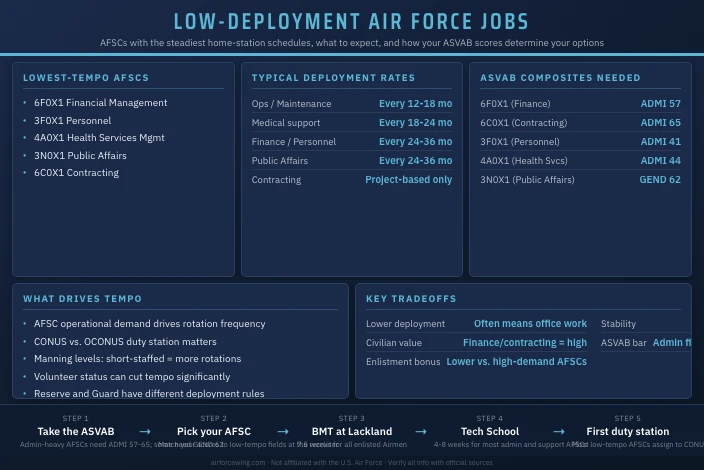
Why Deployment Rates Vary by AFSC
Deployment orders follow mission requirements, not personal preference. Some AFSCs are directly tied to combat operations, weapons loaders, maintainers, security forces, and special warfare troops go where the aircraft and the fight go. Others support functions that the Air Force runs from the continental United States, sending people overseas only for specific projects or surge needs.
Three things drive how often an AFSC deploys:
- Operational demand: Jobs tied to flying operations, munitions, or direct combat support rotate more frequently because the mission requires a continuous presence overseas.
- Manning levels: An AFSC with chronic shortages sends individuals more often to fill gaps. Well-manned career fields can spread the burden across more people.
- Duty station: CONUS assignments at non-operational bases, logistics hubs, training centers, and headquarters installations, generate fewer deployments than bases with active flying wings.
No Air Force job is deployment-proof. But the jobs below consistently show the lowest rotation frequencies across the enlisted force. The Air Force doesn’t publish official deployment statistics by AFSC, so the figures here reflect broadly reported patterns from official Air Force sources and veteran-facing outlets. Individual experience will vary depending on unit manning and world events.
Finance and Contracting
Financial Management (6F0X1) and Contracting (6C0X1) sit at the low end of deployment tempo. Both fields are office-based, analytical, and tied to administrative systems that the Air Force can run from CONUS installations.
Finance requires ADMI 57 on the ASVAB. Contracting sets one of the higher enlisted bars at ADMI 65, which reflects how demanding the work actually is. ADMI pulls from General Science, Paragraph Comprehension, Word Knowledge, and Arithmetic Reasoning. Strong verbal and math scores get you there.
When these Airmen do deploy, it’s usually for a specific assignment tied to contract oversight on a base construction project or financial audit support. That’s a different profile than a 12-month rotation at a forward operating location.
Both AFSCs also translate directly to well-paying civilian careers. Federal contracting specialists and government financial analysts are in consistent demand across the defense industry. Skills built in uniform transfer cleanly to those roles.
Personnel (3F0X1)
Force Support (3F0X1) manages military personnel records, assignments, promotions, and administrative processing. The work keeps Air Force installations running, it doesn’t go forward with the fight.
At ADMI 41, this AFSC has one of the lower bars among administrative fields. Tech school runs roughly four weeks at Keesler AFB, Mississippi. Most first assignments go to large CONUS bases with active personnel offices.
Among enlisted AFSCs, 3F0X1 sits near the bottom of the deployment rotation list. When assignments do come up, they go to established overseas bases with regular administrative needs, not austere forward locations.
| AFSC | ASVAB Composite | Typical Deployment Frequency |
|---|---|---|
| 6C0X1 Contracting | ADMI 65 | Project-based, infrequent |
| 6F0X1 Financial Management | ADMI 57 | Every 24-36 months |
| 3N0X1 Public Affairs | GEND 62 | Every 24-36 months |
| 3F0X1 Personnel | ADMI 41 | Every 24-36 months |
| 4A0X1 Health Services Mgmt | ADMI 44 | Every 18-24 months |
Public Affairs (3N0X1)
Public Affairs (3N0X1) handles media relations, base communications, and official Air Force messaging. It’s one of the more unique AFSCs in the enlisted force, the work is writing, photography, video production, and spokesperson duties, not technical maintenance or direct mission support.
Qualifying requires GEND 62, a composite built from verbal and math subtests. If you scored well on the English and reading sections of the ASVAB, that bar is within reach.
Rotation frequency is low compared to operational career fields. Most PA Airmen work from CONUS bases, wing-level public affairs offices, or Pentagon assignments. Overseas assignments do happen, usually to cover Air Force operations for media coverage, but they’re shorter and less frequent than what you’d see in a maintenance or security forces AFSC.
Health Services Management (4A0X1)
Health Services Management (4A0X1) handles administrative functions inside Air Force medical treatment facilities. Scheduling, medical records, patient administration, and clinic management fall under this AFSC.
Qualifying takes ADMI 44 on the ASVAB. Tech school runs about eight weeks at Fort Sam Houston, Texas. Most first-duty assignments go to larger Air Force bases with active medical centers.
Compared to the force overall, rotation cycles for 4A0X1 run long. Medical support is needed overseas, but these Airmen typically cycle on timelines well beyond what operational AFSCs see. Assignments go to established theater medical facilities, not remote forward positions.
Medical administrative experience transfers cleanly to civilian roles in hospital systems, insurance companies, and federal health agencies. Air Force medical careers span a wide range of AFSCs beyond the clinical side.
What Lower Tempo Actually Means
Choosing a low-deployment AFSC isn’t cost-free. A few realities to weigh:
- Enlistment bonuses are smaller. The Air Force pays the biggest bonuses to fill hard-to-man positions. Administrative and support fields rarely carry large signing incentives.
- Promotion competition can be stiff. Some low-tempo AFSCs are well-manned, which means more people competing for the same Staff Sergeant and Technical Sergeant slots.
- The work is mostly office-based. If you’re joining the Air Force wanting operational variety or physical challenge, financial management and personnel aren’t going to deliver that.
- “Low deployment” is relative. The Air Force can direct any Airman to deploy, especially during surges. The frequencies above reflect typical patterns, not guarantees.
What you get in return is real stability for families, consistent schedules, and, especially in finance and contracting, skills that pay well after service.
ASVAB Scores and Your Options
Every AFSC covered here falls under the ADMI or GEND composite categories. ADMI draws from General Science, Paragraph Comprehension, Word Knowledge, and Arithmetic Reasoning. GEND uses Word Knowledge, Paragraph Comprehension, Arithmetic Reasoning, and Mathematics Knowledge. Both reward strong verbal skills over mechanical or electronics knowledge, which is the opposite of what most recruits assume they need to prepare for.
If you haven’t taken the ASVAB yet, your verbal and math preparation directly determines which of these fields you can access. Contracting at ADMI 65 is the highest bar. Personnel at ADMI 41 is the most accessible entry point. Most people who struggle with ADMI composites are weak on the Paragraph Comprehension and Word Knowledge subtests, those are coachable with targeted reading practice.
Your AFQT score (minimum 36 for active-duty Air Force) gets you in the door. But your composite scores are what determine the specific career fields available to you at MEPS. It’s worth knowing your likely composite before you sit with a recruiter.
A strong ADMI score opens every low-tempo administrative field covered here. Contracting and Finance are the most competitive, build your verbal scores before you test.
Air Force ASVAB test prep covers the specific subtests that feed these composites and how to raise your scores before you go to MEPS.
Reserve and Guard Considerations
Air Force Reserve and Air National Guard units follow different deployment patterns than active duty. Guard and Reserve Airmen in support AFSCs often deploy far less frequently than their active-duty counterparts, since their units are primarily assigned to stateside missions and activate for specific operational needs. A Reserve financial management specialist, for example, may serve one weekend a month and two weeks annually without ever receiving a deployment order.
If home-station stability is your primary goal, a Guard or Reserve commitment in a finance, personnel, or contracting AFSC is worth researching. The tradeoff is part-time pay and benefits versus a full-time active-duty package. Reserve and Guard service also lets you keep a civilian career running alongside your military commitment, a real advantage for people who want both.
Browse Air Force enlisted careers to see full AFSC profiles across every career group, including deployment context, training pipelines, and ASVAB requirements.
For a broader look at which AFSCs score well across multiple categories, including pay, civilian transfer, and work environment, the best Air Force jobs for 2026 pillar covers the full enlisted picture.
This site is not affiliated with the U.S. Air Force or any government agency. Verify all information with official Air Force sources before making enlistment or career decisions.