Air Force Intelligence and Cyber AFSC Jobs
Two Air Force career fields consistently produce the most sought-after veterans in the federal government and private sector: intelligence and cyber. Both require high ASVAB composite scores. Both require a Top Secret security clearance. And both translate directly into six-figure civilian careers at agencies like the NSA, CIA, and major defense contractors. If you’re trying to decide which path fits you, this guide lays out every major AFSC in both fields side by side.
The Intelligence Career Field
Air Force intelligence encompasses six primary enlisted AFSCs, all under the 1N series. These jobs collect, analyze, and report on adversary capabilities, intentions, and activities. The work ranges from analyzing satellite imagery to translating intercepted communications in real time.
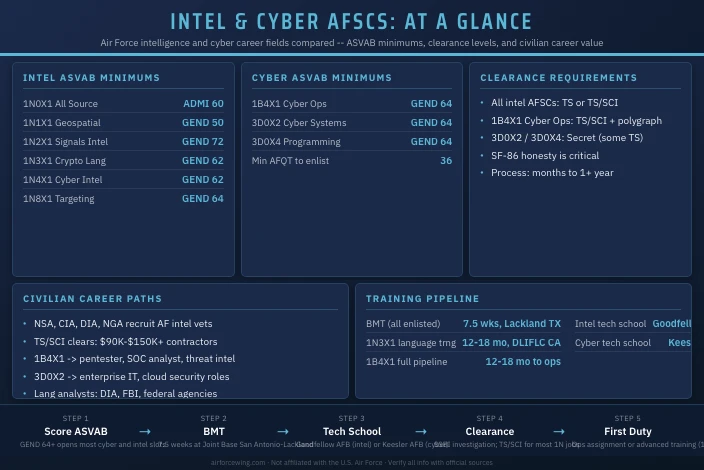
Every intelligence AFSC requires at minimum a Top Secret (TS) clearance, and most require access at the TS/SCI (Sensitive Compartmented Information) level. The clearance investigation process, called a Single Scope Background Investigation (SSBI), starts when you enlist and can take anywhere from a few months to over a year to complete.
Most intelligence tech schools are located at Goodfellow AFB, TX. After BMT at Joint Base San Antonio-Lackland, you’ll typically spend four to six months in technical training there before your first assignment.
Intelligence AFSC Overview
| AFSC | Title | ASVAB Composite | Minimum Score |
|---|---|---|---|
| 1N0X1 | All Source Intelligence Analyst | ADMI | 60 |
| 1N1X1 | Geospatial Intelligence Specialist | GEND | 50 |
| 1N2X1 | Signals Intelligence Analyst | GEND | 72 |
| 1N3X1 | Cryptologic Language Analyst | GEND | 62 |
| 1N4X1 | Cyber Intelligence Analyst | GEND | 62 |
| 1N8X1 | Targeting Analyst | GEND | 64 |
What Each Intelligence AFSC Does
1N0X1 All Source Intelligence Analyst is the generalist role. Analysts synthesize reporting from human, signals, and imagery sources into finished intelligence products. The ADMI composite (General Science + Paragraph Comprehension + Word Knowledge + Arithmetic Reasoning) is the only intelligence AFSC that does not use GEND. Minimum score is 60.
1N1X1 Geospatial Intelligence Specialist analyzes satellite and aerial imagery to identify targets, assess battle damage, and build terrain models. The GEND minimum of 50 is the lowest in the field. Competition for slots is still real despite the lower bar, clearance eligibility and available billets both filter the pool.
1N2X1 Signals Intelligence Analyst is the most technically demanding intel AFSC. These airmen collect and analyze electronic signals from radar systems and communications networks. The GEND minimum of 72 is one of the highest enlisted thresholds across the entire Air Force, not just in intelligence.
1N3X1 Cryptologic Language Analyst listens to, translates, and analyzes foreign-language communications. This AFSC requires a passing score on the Defense Language Aptitude Battery (DLAB), a separate test from the ASVAB. Training starts with language instruction at the Defense Language Institute Foreign Language Center (DLIFLC) at Presidio of Monterey, CA. Language assignment is based on mission need. The GEND minimum is 62.
1N4X1 Cyber Intelligence Analyst sits at the intersection of intelligence and cyber operations, analyzing adversary cyberspace activities to support offensive and defensive missions. GEND minimum is 62. This AFSC uses TS/SCI clearance and typically requires a polygraph.
1N8X1 Targeting Analyst develops target packages for kinetic and non-kinetic operations by integrating geospatial, signals, and human intelligence data. The GEND minimum of 64 reflects the analytical complexity of the work. TS/SCI access is required.
The Cyber Career Field
Air Force cyber jobs split across two series: the 1B series for dedicated cyber operations, and the 3D series for systems operations, programming, and transport. The distinction matters for both what you do daily and what clearance level you’ll need.
The GEND composite (Word Knowledge + Paragraph Comprehension + Arithmetic Reasoning + Mathematics Knowledge) drives most cyber qualifications. The ELEC composite (General Science + Arithmetic Reasoning + Mathematics Knowledge + Electronics Information) applies to roles with more hardware focus.
Cyber AFSC Overview
| AFSC | Title | ASVAB Composite | Minimum Score |
|---|---|---|---|
| 1B4X1 | Cyber Operations Specialist | GEND | 64 |
| 3D0X2 | Cyber Systems Operations | GEND | 64 |
| 3D0X4 | Computer Systems Programming | GEND | 64 |
What Each Cyber AFSC Does
1B4X1 Cyber Operations Specialist is the Air Force’s offensive and defensive cyber warfare role. These airmen plan and execute missions in cyberspace under U.S. Cyber Command. It is the most selective cyber AFSC and typically requires TS/SCI clearance with a Counterintelligence Scope Polygraph (CSP). The pipeline for clearance at this level can run 12 to 18 months after enlistment.
3D0X2 Cyber Systems Operations focuses on managing and securing classified network infrastructure, servers, operating systems, and enterprise platforms. Think systems administration at scale on Air Force networks. A Secret clearance is the standard entry requirement, though some assignments require Top Secret.
3D0X4 Computer Systems Programming is the enlisted coding role. Airmen write, test, and maintain software for Air Force systems. It requires the same GEND 64 as 1B4X1 but carries a lighter clearance burden at most entry-level assignments.
This site is not affiliated with the U.S. Air Force or any government agency. Verify all information with official Air Force sources before making enlistment or career decisions.
Security Clearance: What the Process Looks Like
Every intelligence and cyber AFSC requires at least a Secret clearance. Most intel jobs require TS/SCI from day one. The 1B4X1 cyber path routinely adds a polygraph on top of that.
The clearance process starts with the SF-86, a detailed questionnaire covering your entire background, finances, foreign contacts, drug use, criminal history, and more. Investigators verify everything you report and look for what you don’t report.
What commonly causes delays or disqualifications:
- Unpaid debt, bankruptcy, or tax liens
- Extensive foreign contacts or dual citizenship
- Drug use (hard drugs are more likely disqualifying; marijuana history is evaluated case by case)
- Criminal history, including arrests that did not result in conviction
- Dishonest or incomplete answers on the SF-86
The polygraph is standard for SCI-level access. Investigators are looking for undisclosed information, not trying to trap you. Honesty on the SF-86 is more important than having a clean record, adjudicators use a whole-person standard, and voluntary disclosure is treated far more favorably than information discovered during investigation.
Start clearing your financial picture before you enlist. Pay off outstanding debts. Document foreign contacts accurately. The investigation won’t start until after you enlist, but you can prepare well before that.
For a detailed look at which specific jobs carry which clearance levels, Air Force Jobs That Require a Security Clearance walks through the full picture across both fields.
ASVAB Composite Requirements Side by Side
The intelligence and cyber fields share overlapping composite requirements. Understanding both helps you study strategically.
| Composite | Formula | Who Uses It |
|---|---|---|
| GEND | Word Knowledge + Paragraph Comprehension + Arithmetic Reasoning + Mathematics Knowledge | Most intel and cyber AFSCs |
| ADMI | General Science + Paragraph Comprehension + Word Knowledge + Arithmetic Reasoning | 1N0X1 only |
| ELEC | General Science + Arithmetic Reasoning + Mathematics Knowledge + Electronics Information | Cyber hardware roles |
The 1N2X1 GEND minimum of 72 is the hardest target in either field. Everything else clusters between 50 and 64 for intel, and at 64 for the three core cyber AFSCs.
If your GEND is currently below 64, both career fields are largely closed to you except for 1N1X1 geospatial (GEND 50) and 1N0X1 all-source (ADMI 60). The Air Force ASVAB test prep guide covers how to build your composites from a diagnostic test up through targeted study plans.
For a full breakdown of which intel AFSC fits your current score, see 1N0X1 vs 1N1X1 vs 1N2X1: Which Intel AFSC. If you’re weighing cyber against communications jobs with similar ELEC requirements, Air Force Cyber vs Communications AFSC compares them directly.
Training Pipelines
Both fields follow the same basic structure: 7.5 weeks of BMT at Joint Base San Antonio-Lackland, then tech school at a field-specific location.
Intelligence tech school locations:
- Goodfellow AFB, TX: 1N0X1, 1N1X1, 1N2X1, 1N4X1, 1N8X1
- DLIFLC, Presidio of Monterey, CA: 1N3X1 (language training, typically 12 to 18 months)
Tech school lengths range from about 14 weeks for geospatial intelligence up to roughly 30 weeks for signals intelligence. The 1N3X1 language pipeline is the longest in the enlisted force, some language tracks exceed 18 months of instruction.
Cyber tech school locations and typical lengths:
- Keesler AFB, MS: Primary cyber technical training location for 3D-series AFSCs
- Hurlburt Field, FL / Fort Meade, MD: Advanced and mission-specific training for 1B4X1
The 1B4X1 pipeline runs longer than most. After tech school, new cyber operations specialists cycle through advanced skills training and mission qualification before taking an operational assignment. Plan for 12 to 18 months from BMT to first real-world mission assignment.
Civilian Career Value
This is where both career fields separate from most other enlisted paths. A TS/SCI clearance plus verifiable experience in intelligence or cyber operations makes you a high-value hire the day you separate.
Government and intelligence community jobs:
- NSA, CIA, DIA, and NGA actively recruit former Air Force intelligence personnel
- Federal law enforcement roles at FBI, DHS, and DEA draw heavily from intel and cyber alumni
- GS-7 to GS-11 entry grades are typical for veterans with clearances and technical experience
Defense contractor market:
- Cleared cyber and intelligence contractors bill at $90,000 to $150,000 or more at the mid-career level
- The demand for cleared personnel consistently outpaces supply, a TS/SCI holder rarely waits long for a job offer
- Companies like Booz Allen Hamilton, SAIC, Leidos, and Raytheon Technologies recruit directly from Air Force technical schools
Private sector cyber:
- 1B4X1 and 3D0X2 experience translates directly to roles like penetration tester, security operations center analyst, and threat intelligence analyst
- Industry certifications (Security+, CEH, OSCP) pair well with military service history and often require only limited additional study for veterans who held these roles
The TS/SCI clearance and civilian salary premium breaks down the exact pay gap between cleared and uncleared workers in tech and federal contracting.
Choosing Between Intelligence and Cyber
Both fields require high ASVAB scores and a clearance. The difference comes down to what kind of work you want to do.
Choose intelligence if you:
- Are strong in reading comprehension and analytical reasoning
- Want to work with foreign language, geospatial data, or signals analysis
- Are interested in policy, strategy, and the intelligence community as a long-term career
Choose cyber if you:
- Have an existing interest in networking, programming, or information security
- Want hands-on technical work with systems and networks
- Are targeting private sector tech or federal cybersecurity roles after service
The two fields are not mutually exclusive in terms of career transition. Many veterans move from intelligence into cybersecurity roles, especially if they served in 1N4X1 (Cyber Intelligence Analyst) or 1B4X1 (Cyber Operations Specialist).
Explore the full AFSC listings for each field at Air Force Intelligence careers and Air Force Cyber careers.
You may also find Best ASVAB Scores for Intelligence AFSC Jobs and Best ASVAB Scores for Cyber AFSC Jobs helpful as you narrow down your options.