Air Force Height and Weight Standards
Most recruits focus on the ASVAB. But a surprising number of applicants get turned away at MEPS before the test even matters. They don’t meet the body composition standard. Knowing exactly what the Air Force checks, and how the screening works, keeps you from showing up unprepared.
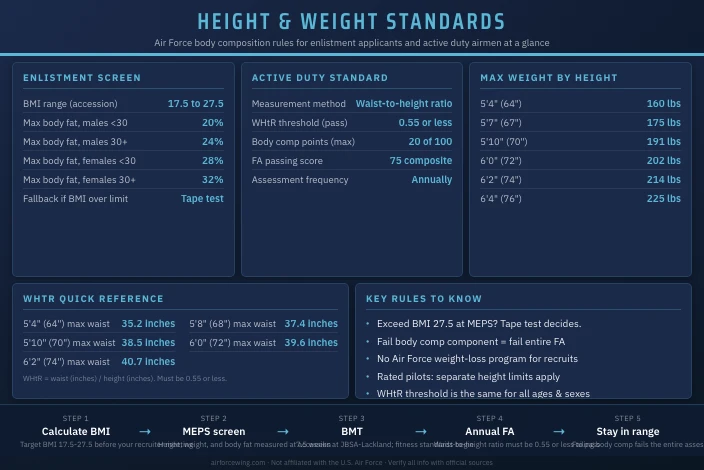
What the Air Force Actually Measures
The Air Force does not use a single height-and-weight table to decide who’s in and who’s out. The screening involves two separate stages depending on where you are in the process.
For enlistment applicants, recruiters use a BMI range as the first screen. The acceptable range at accession is 17.5 to 27.5 BMI. If your BMI falls outside that window, the recruiter can apply a body fat measurement as a secondary check. Maximum body fat at accession is 26% for males and 36% for females.
For active duty airmen in the annual Fitness Assessment, the controlling standard has shifted to waist-to-height ratio (WHtR). A WHtR at or below 0.55 meets the body composition component. That means if you are 70 inches tall (5'10"), your waist must be 38.5 inches or less. The formula is simple: divide your waist measurement in inches by your height in inches.
These are two distinct systems. Enlistment uses BMI plus body fat as a fallback. The Fitness Assessment uses waist-to-height ratio.
Enlistment Height and Weight Chart
The table below shows the maximum weight allowed at MEPS by height. These figures align with a BMI of approximately 27.5. Applicants who exceed the maximum weight for their height will face a body fat assessment before being cleared.
| Height | Max Weight |
|---|---|
| 4'10" (58") | 131 lbs |
| 4'11" (59") | 136 lbs |
| 5'0" (60") | 141 lbs |
| 5'1" (61") | 145 lbs |
| 5'2" (62") | 150 lbs |
| 5'3" (63") | 155 lbs |
| 5'4" (64") | 160 lbs |
| 5'5" (65") | 165 lbs |
| 5'6" (66") | 170 lbs |
| 5'7" (67") | 175 lbs |
| 5'8" (68") | 180 lbs |
| 5'9" (69") | 186 lbs |
| 5'10" (70") | 191 lbs |
| 5'11" (71") | 197 lbs |
| 6'0" (72") | 202 lbs |
| 6'1" (73") | 208 lbs |
| 6'2" (74") | 214 lbs |
| 6'3" (75") | 220 lbs |
| 6'4" (76") | 225 lbs |
| 6'5" (77") | 231 lbs |
| 6'6" (78") | 237 lbs |
There is also a minimum weight requirement. At 5'0", the floor is 97 lbs. At 5'10", it is 132 lbs. Recruits who fall below the minimum BMI of 17.5 face the same secondary screening process as those over the maximum.
Body Fat Limits at Accession
If you exceed the maximum weight for your height, you don’t automatically fail. A body fat measurement gives you a second shot. The limits at accession are broken down by age and sex:
| Group | Maximum Body Fat |
|---|---|
| Males under 30 | 20% |
| Males 30 and older | 24% |
| Females under 30 | 28% |
| Females 30 and older | 32% |
Body fat is measured using circumference-based tape methods at MEPS. There is no alternative 3D scan or hydrostatic option at this stage. If you exceed the body fat limit for your group, your recruiter cannot clear you to ship.
The Air Force does not run a weight-loss program for applicants. If you’re over the limit, you train down and come back.
Active Duty Body Composition: Waist-to-Height Ratio
Once you’re in, the Fitness Assessment governs how body composition is measured. The body composition component is worth up to 20 points out of the 100-point total. The minimum composite passing score is 75, but you must also pass each component individually.
The waist-to-height ratio replaced the old standalone waist circumference measurement as the primary screen. The threshold is WHtR of 0.55 or less.
To calculate your own number:
- Measure your waist at the narrowest point, in inches.
- Divide by your height in inches.
- The result must be 0.55 or less to pass.
A 6'0" airman (72 inches) can have a waist of up to 39.6 inches and still pass. A 5'4" airman (64 inches) has a ceiling of 35.2 inches. Taller airmen get proportionally more room; the ratio keeps the standard consistent across body types.
The WHtR threshold applies regardless of age or gender. Everyone in the active duty force uses 0.55 as the cutoff for this component.
What Happens If You Fail Body Composition
Failing the body composition component of the Fitness Assessment results in a failing overall score regardless of how well you perform on the run or muscular fitness events. A composite score below 75, or a failure on any single component, counts as a failing assessment.
Consequences build quickly:
- A failing assessment triggers mandatory fitness improvement program enrollment.
- Repeated failures affect promotion eligibility and reenlistment.
- Members on a Fitness Improvement Program face more frequent testing.
The Fitness Assessment is annual for most airmen, though members with a recent failure or medical deferral may test more frequently. Body composition failures are distinct from medical disqualifications, which are a separate category of enlistment barriers covered in Air Force medical disqualifications. The Air Force Fitness Assessment covers scoring, exemptions, and the full point breakdown in detail.
Height Limits for Rated Positions
Standard enlistment and officer positions use the height and weight standards above. Rated aviation positions carry additional height restrictions tied to ejection seat geometry and cockpit fit. These are separate from body composition and are managed through the aviation selection process.
Pilot candidates typically must fall between 64 and 77 inches in standing height, with sitting height and reach also measured. If aviation is your goal, those specific limits matter more than the general weight table. The rated position requirements are covered in the officer selection process for 11X and related designators.
Tips for Meeting the Standard Before MEPS
Getting within range before you walk into the recruiting office saves time and removes a variable from the application process.
- Check your BMI first. Use your current height and weight to calculate BMI. If you’re above 27.5, you have a defined target before the body fat fallback kicks in.
- Reduce waist measurement, not just overall weight. The active duty standard is waist-based, so training for a lower waist circumference directly addresses what gets measured.
- Give yourself lead time. Recruiters cannot ship you until you clear the standard. A recruiter meeting you three months before your preferred ship date gives you room to comply without pressure.
- Understand the fallback. If your BMI is over 27.5 but your body fat is under the age/sex limit, you can still qualify. Know both numbers going in.
Explore the full range of enlisted career options at Air Force enlisted careers to see which AFSC paths align with your goals once you clear the physical screen. If you’re still deciding between enlisted and officer, the paths to serve guide walks through how each commissioning and enlistment route works.
The Physical Standard Is a Floor, Not a Goal
Clearing the minimum body composition requirement gets you in the door. Staying well under the WHtR threshold once you’re active gives you more buffer on the Fitness Assessment and reduces the risk of a component failure dragging down an otherwise strong score.
The Air Force PT test scoring chart shows exactly how waist-to-height points scale alongside the run and muscular fitness events, which helps you understand where to prioritize your training.
For a complete walkthrough of how body composition fits alongside running, strength, and core standards, see our Air Force physical fitness guide.
This site is not affiliated with the U.S. Air Force or any government agency. Verify all information with official Air Force sources before making enlistment or career decisions.