Air Force Fitness Test: Standards, Scoring, and How to Pass
Every airman takes the Air Force Fitness Assessment at least once a year. It affects promotions, deployment eligibility, and in extreme cases, whether you stay in the Air Force at all. The test has four components, scores on a 100-point scale, and uses age- and gender-normed standards, so a 40-year-old and a 20-year-old are not held to the same times. Understanding how each component is scored, where the point weight falls, and what the minimum thresholds are gives you a specific target to train toward instead of guessing.
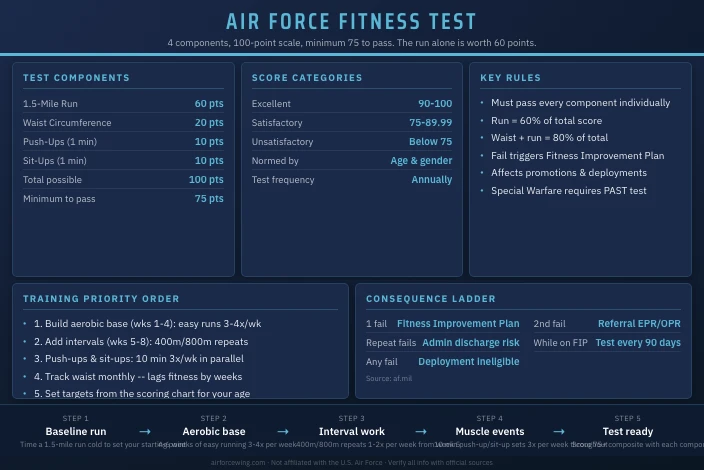
The Four Components
The Fitness Assessment (FA) measures three fitness areas: aerobic capacity, body composition, and muscular endurance. Four events cover those areas.
1.5-Mile Run is the heaviest component by far. It carries 60 of the 100 points available. Run time is scored against age- and gender-specific tables, and elite performers can score maximum points well before the absolute time limit. This is where most people win or lose the test.
Waist Circumference accounts for 20 points. The Air Force uses waist measurement as its body composition standard. Measurement is taken at the narrowest point of the natural waist. Like the run, standards are normed by age and gender.
Push-Ups and Sit-Ups each contribute 10 points. Both are timed at one minute. Reps are counted against age- and gender-specific tables, same as the run.
| Component | Max Points | Time/Duration |
|---|---|---|
| 1.5-Mile Run | 60 | Timed run |
| Waist Circumference | 20 | Single measurement |
| Push-Ups | 10 | 1 minute |
| Sit-Ups | 10 | 1 minute |
The math makes the run the priority. Getting close to max points on the run while meeting minimums on the other three events beats a balanced-but-mediocre score across the board.
Scoring and Passing Standards
The minimum composite score to pass the FA is 75 out of 100. Falling below 75 is a failing score, regardless of how well you perform on individual components.
There is a second condition that trips people up: each component has its own minimum threshold. Scoring 80 on the overall composite means nothing if you fail to meet the minimum on a single event. You must clear the minimum on every component and hit 75 composite to receive a passing result.
Score categories break down like this:
| Composite Score | Category |
|---|---|
| 90-100 | Excellent |
| 75-89.99 | Satisfactory |
| Below 75 | Unsatisfactory (Fail) |
A score of 90 or above is “Excellent” and reflects positively in promotion packages. Satisfactory (75-89.99) is a passing score and meets the standard for deployments and most career actions. Unsatisfactory triggers a mandatory fitness improvement program and can affect assignments and promotions.
Consecutive failing scores have more serious consequences, including possible administrative action and separation from service. One fail is recoverable. Repeated fails are not.
Age and Gender Norms
Standards are adjusted by 10-year age brackets and by gender. The same push-up rep count that earns maximum points for a 45-year-old might not meet the minimum for a 22-year-old. The Air Force is measuring fitness relative to what is physiologically expected for your demographic, not against a universal standard.
The practical implication: know your specific bracket. A 28-year-old woman and a 28-year-old man have different run time targets for the same point value. Your recruiter or commander can provide the current normed tables for your age and gender group.
Age brackets for scoring purposes run roughly as follows:
- Under 25
- 25-29
- 30-34
- 35-39
- 40-44
- 45-49
- 50 and over
For detailed point values by bracket, see the Air Force PT Test Scoring Chart.
How the Run Dominates the Math
Most people do not fail the FA because of push-ups or sit-ups. They fail because of the run or waist measurement, the two components that together account for 80 of 100 points.
Consider a scenario: You max push-ups and sit-ups (20 points total). But your run earns 38 of 60 possible points, and your waist earns 14 of 20 possible points. Your composite is 72, a fail, even though you dominated the muscular endurance portion. The run alone can pull a score below 75 if you are a mid-tier performer.
This is why training for the FA means training for the 1.5-mile run first. Improving your run time by 30 seconds can add 6-8 points to your composite. Improving your push-up count by 5 reps adds less than 2 points in many age brackets.
For a structured run training plan, see How to Train for the 1.5-Mile Run.
Waist Measurement: The Hidden Trap
Many airmen spend months training their run and muscular events but ignore waist circumference until it’s too late. At 20 points, a failing waist measurement alone can make a 75 composite nearly impossible to reach.
Standards vary by age and gender. General ranges for a passing waist measurement run roughly 32-35 inches for men and 29-32 inches for women, depending on age bracket. But the exact threshold for your bracket matters, so check your current tables rather than using round numbers.
A few things that help:
- Consistent calorie management over weeks and months, not crash dieting before test day
- Cardiovascular training (like run training) reduces overall body fat, which affects waist measurement
- Strength training for core stability does not directly reduce waist circumference but supports body composition over time
Failing the waist standard is the most common reason airmen with otherwise decent run times still fail the FA. Treat it as a 20-point event, not an afterthought.
For current measurement standards by age and gender, see Air Force Height and Weight Standards.
What Happens at BMT
The Air Force Fitness Assessment is the official annual test for active-duty airmen. Basic Military Training (BMT) at Joint Base San Antonio-Lackland uses a similar format to build the fitness base that the FA requires, but the training progression at BMT is designed for recruits who may be starting from low baseline fitness.
At BMT, you’ll run multiple times per week, do push-ups and sit-ups in organized PT sessions, and participate in a final fitness test before graduation. You will not take the official FA during BMT. That is a post-BMT event once you are assigned to your first duty station.
Arriving at BMT with a baseline run time under 13 minutes for men or 15 minutes for women puts you ahead of the curve. Recruits who arrive in poor shape spend the first weeks catching up rather than building, and some are sent to the Physical Reconditioning Course (PRC) if they can’t keep up.
For a full breakdown of what physical training looks like from week 1 through graduation, see Air Force BMT Physical Training: What to Expect.
Special Warfare: A Different Standard
The fitness standards described above apply to most Air Force enlisted and officer careers. Special Warfare AFSCs (Combat Controller, Pararescue, Tactical Air Control Party, Special Reconnaissance, and others) require candidates to pass the Physical Ability and Stamina Test (PAST) in addition to the standard FA.
The PAST is not a scoring test. It is a pass/fail gate with much higher physical demands than the standard FA: timed 500-meter swim, pull-ups, sit-ups, push-ups, a 1.5-mile run, and a 3-mile run. Failing any single event ends the attempt.
Special Warfare careers are detailed at the Special Warfare careers section, and the full PAST standards are covered in Special Warfare Fitness Requirements: PAST Standards.
Medical Disqualifications and Physical Standards
Fitness test performance is separate from the medical screening done at MEPS (Military Entrance Processing Station). MEPS evaluates medical history and physical condition before enlistment. The FA tests you after you are in.
Some conditions can prevent enlistment or limit which AFSCs are available. Vision, hearing, cardiac, and musculoskeletal conditions are the most common categories that arise during MEPS screening. These are not the same as fitness test failures.
For a full list of conditions that can affect enlistment eligibility, see Medical Disqualifications for Air Force Enlistment.
Building a Training Plan
Passing the FA for the first time, or recovering from a marginal score, requires a plan built around the run. Here is a simplified framework:
The Air Force PT Test Scoring Chart will show you the exact run time and rep counts you need for your age bracket, which lets you set precise weekly targets.
Frequency and Consequences
Most airmen test once per year under normal conditions. Those on a Fitness Improvement Program (FIP) following a failing score may test more frequently, typically every 90 days until scores recover.
Failing one FA puts you on a FIP. Failing again within a short window can result in:
- A referral Officer Performance Report (OPR) or Enlisted Performance Report (EPR)
- Ineligibility for deployment
- Loss of promotion eligibility for certain cycles
- In cases of repeated failures: administrative discharge proceedings
The Air Force treats the FA as a professional standard, not just a health metric. Commanders take it seriously, and it shows up in career records.
Before You Enlist
If you are still deciding whether the Air Force is the right path, the fitness standards are one of several factors worth understanding. Careers, pay, job availability, and where you will be stationed all matter as much as the fitness requirements.
A complete look at enlisted career options, including ASVAB score requirements and training timelines, is at Air Force enlisted careers. And if you haven’t started ASVAB prep yet, the Air Force ASVAB test prep guide covers everything from composite score targets to a day-by-day study plan.
You may also find Air Force BMT Physical Training: What to Expect and What Happens at Air Force BMT helpful as you prepare for the full enlistment process.
For a complete overview of every fitness standard, scoring table, and training strategy in one place, see our Air Force physical fitness guide.
This site is not affiliated with the U.S. Air Force or any government agency. Verify all information with official Air Force sources before making enlistment or career decisions.