Air Force EOD: Requirements and Career Path
The Air Force EOD career field has the highest ASVAB minimums in the entire civil engineering group, a training pipeline that runs over eight months, and an attrition rate that filters out most candidates before they finish school. Those facts are stated upfront because this is not a career field where someone stumbles in by accident. Getting there requires deliberate preparation, and staying there requires the psychological stability to work with live explosives in high-stakes environments. If that description still sounds interesting, here is exactly what qualifies you, what training looks like, and where the career goes.
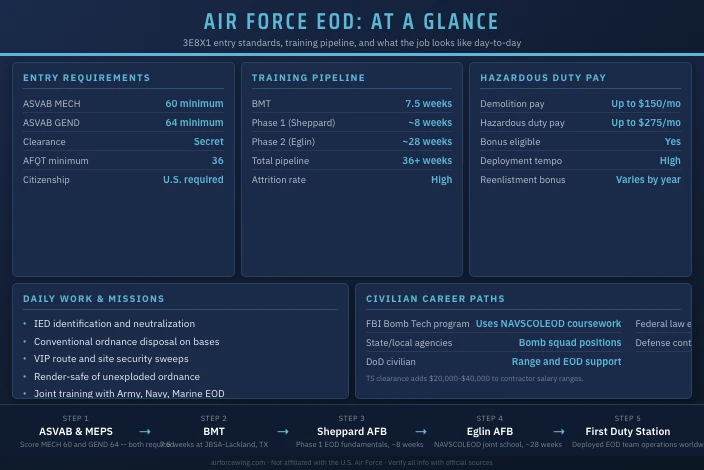
What 3E8X1 EOD Actually Does
Explosive Ordnance Disposal technicians identify, render safe, and dispose of explosive hazards. That covers a wider range than most people expect.
On a domestic installation, the day-to-day work involves responding to suspect packages, clearing ranges of unexploded ordnance, and conducting security sweeps before VIP visits. When a dignitary lands at an Air Force base, EOD techs have already swept the route. When a training range has a dud round, EOD handles it.
In deployed environments, the mission shifts toward improvised explosive devices. EOD teams work alongside ground units to clear routes, respond to IED finds, and conduct post-blast analysis after an explosion. The work puts EOD technicians in the same threat environment as the units they support. Deployments are frequent, this career field has one of the higher deployment tempos in the enlisted force.
The full mission set includes:
- IED identification and render-safe procedures
- Conventional ordnance disposal (bombs, artillery rounds, rockets)
- Chemical, biological, and nuclear ordnance handling (covered in advanced training)
- VIP security sweeps for air bases and off-installation events
- Joint operations with Army, Navy, and Marine EOD teams
ASVAB Requirements
The 3E8X1 AFSC requires two composites simultaneously: MECH 60 and GEND 64. Both must be met, a strong score on one does not compensate for falling short on the other.
The MECH composite draws from four ASVAB subtests:
| Subtest | Abbreviation |
|---|---|
| General Science | GS |
| Auto and Shop Information | AS |
| Mathematics Knowledge | MK |
| Mechanical Comprehension | MC |
The GEND composite draws from:
| Subtest | Abbreviation |
|---|---|
| Word Knowledge | WK |
| Paragraph Comprehension | PC |
| Arithmetic Reasoning | AR |
| Mathematics Knowledge | MK |
Most technical AFSCs require only one composite. EOD demands two at elevated minimums. That makes it one of the most selective AFSC qualifications in the 3E group and one of the harder composite pairs to hit across the whole enlisted force.
The AFQT minimum for Air Force enlistment is 36, but clearing that threshold only opens the recruiter conversation. The dual composite requirement is what actually controls access to EOD.
Study priorities for EOD candidates:
- Mechanical Comprehension, the single highest-impact subtest for the MECH composite
- Mathematics Knowledge, shared between both composites, so every point here works twice
- Auto and Shop Information, often undertrained; a weak AS score can sink the MECH composite
- Word Knowledge and Paragraph Comprehension, the GEND 64 minimum means verbal scores matter as much as mechanical
If your ASVAB scores fall short, the Air Force ASVAB study guide covers targeted strategies for raising MECH and GEND composites.
Other Entry Requirements
A strong ASVAB score gets you in the recruiter’s door. The full qualification list goes further.
Security clearance: EOD is the only 3E AFSC that requires a clearance, specifically, a Secret clearance before entering the training pipeline. The background investigation covers criminal history, financial history, foreign contacts, and substance use. Any disqualifying factor in those areas ends the EOD path before training starts.
Citizenship: U.S. citizenship is required for clearance eligibility. Permanent residents cannot qualify for EOD.
Medical standards: EOD has stricter medical screening than most enlisted AFSCs. Normal color vision is required. Hearing standards are more stringent than the general enlistment baseline. Any history of conditions affecting fine motor control, balance, or psychological stability will receive heightened scrutiny.
Physical fitness: The Air Force Fitness Assessment sets the minimum baseline for all Airmen. EOD candidates should treat that baseline as a floor, not a target. The work is physically demanding, carrying equipment in heat, working in a heavy bomb suit for extended periods, and maintaining manual dexterity under stress all require a base of physical conditioning well above the minimum passing standard.
Psychological screening: EOD selection includes evaluation for stress tolerance, impulse control, and the ability to perform precision tasks under pressure. There is no single “EOD personality test,” but commanders and recruiters watch for candidates who can work methodically when the situation is urgent.
Training Pipeline
The EOD pipeline is the longest in the 3E career group and one of the longer enlisted training pipelines in the Air Force.
Pay and Hazardous Duty Pay
EOD technicians receive standard Air Force enlisted base pay for their grade and years of service. At E-4 (Senior Airman), which is the typical grade at Tech School completion, base pay runs $3,142 to $3,816 per month depending on time in service.
What separates EOD compensation from other 3E specialties is special duty pay. Technicians qualify for both demolition duty pay (up to $150/month) and hazardous duty pay (up to $275/month) when actively performing EOD duties. Those amounts add to base pay and are not subject to the same tax treatment in deployed locations.
| Pay Type | Monthly Amount |
|---|---|
| Demolition Duty Pay | Up to $150 |
| Hazardous Duty Pay | Up to $275 |
| Basic Allowance for Subsistence | $476.95 (all enlisted) |
Enlistment and reenlistment bonuses are available for 3E8X1 based on Air Force manning priorities. Bonus amounts change by fiscal year, confirm current figures with your recruiter before signing.
Deployment and Operational Tempo
EOD is a high-deployment career field. Most EOD technicians deploy multiple times during a standard enlistment. The exact frequency depends on unit assignment and global force management requirements, but candidates should plan for at least one deployment in a four-year contract and likely more.
Deployed work differs significantly from garrison duty. Overseas, EOD teams operate with ground maneuver units, supporting route clearance, responding to IED finds, and conducting post-blast investigations. The threat environment is real. EOD technicians have served in every major U.S. combat operation since Vietnam, and the career field has sustained casualties in recent conflicts.
The deployment tempo affects family life. Frequent rotations mean extended time away from home, and the unpredictable nature of EOD taskings can make it harder to plan personal milestones around. This is a realistic factor to weigh before committing to the career field.
Physical and Psychological Demands
The physical demands of EOD are significant, but they are not primarily about raw strength or speed. The job requires endurance, fine motor control, and the ability to maintain precision under stress.
The bomb suit worn during render-safe operations weighs roughly 80 pounds. Working in that suit in warm climates is physically exhausting. Technicians must be able to work extended periods in full protective gear while maintaining the manual dexterity required to manipulate IED components.
Psychologically, EOD work is unusual. The job requires performing deliberate, methodical tasks in situations where the consequences of error are fatal. Some people find that reality intolerable. Others find that the clarity of high stakes actually helps them focus. Neither response is a character flaw, but EOD selects hard for the second type.
The career field also carries cumulative stress. Multiple deployments, repeated exposure to blast incidents, and the weight of decisions made in the field can affect long-term psychological health. The Air Force has specific mental health resources for EOD technicians, and there is increasing institutional recognition that cumulative operational stress requires active management, not just individual resilience.
Civilian Career Paths
EOD training and clearance status translate directly into civilian demand after service. The career paths split into three main tracks.
Federal law enforcement is the most direct transition. The FBI’s Bomb Technician program uses NAVSCOLEOD curriculum as part of its certification basis, which means EOD veterans enter with skills already recognized by the program. The ATF, Secret Service, and DHS also hire bomb technicians and explosive specialists with military EOD backgrounds. Federal law enforcement positions offer competitive pay, pension systems, and continued mission relevance.
State and local bomb squads hire from the military EOD pipeline regularly. Large municipal police departments maintain dedicated bomb squads, and military EOD experience is the primary qualification pathway. These positions typically require a law enforcement background, so some veterans pursue police officer credentials first before transitioning to a bomb squad assignment.
Defense contractors and DoD civilians represent the highest-paying track for many EOD veterans. Contractors supporting range clearance, explosive site remediation, and counter-IED training programs actively recruit from the military pipeline. A Secret or TS/SCI clearance combined with EOD certification adds $20,000 to $40,000 or more to contractor compensation compared to equivalent roles without that background.
| Civilian Track | Representative Roles |
|---|---|
| Federal law enforcement | FBI Bomb Tech, ATF Special Agent, Secret Service |
| State/local agencies | Municipal bomb squad, state police EOD |
| Defense contractors | Range clearance, explosive safety, C-IED training |
| DoD civilian | Installation EOD, range operations, weapons safety |
Is EOD the Right Career Field
EOD offers something most military careers do not: a specific, verifiable skill set that is valued in both federal civilian and private sector markets immediately after separation. The training is long and difficult. The work is dangerous. The deployments are frequent. Those facts are not reasons to avoid the career field, they are the filter that determines whether it fits.
The right candidate is someone who performs well under pressure rather than despite it, can pass the dual composite ASVAB requirement, has a clean background for Secret clearance, and is genuinely comfortable with the reality that the job involves live explosives on a regular basis.
The wrong candidate is someone drawn primarily to the prestige or identity of the role rather than the actual work. EOD technicians spend significant time doing unglamorous maintenance, paperwork, and training rotations between deployments. The moments of high stakes are real, but they are not the majority of the job.
This site is not affiliated with the U.S. Air Force or any government agency. ASVAB line score requirements, medical standards, and bonus availability can change when AFI 36-2101 is updated or at the start of a new fiscal year. Verify current requirements with an Air Force recruiter before making any enlistment decisions.
For the full civil engineering career group including all seven 3E AFSCs, visit the Air Force civil engineering career group. The Air Force ASVAB study guide covers the MECH and GEND composite strategies most relevant to EOD qualification.