Air Force Enlistment Bonuses: How They Work
The Air Force currently advertises bonuses up to $50,000 for new enlistees. That number grabs attention, but the details behind it matter just as much as the headline figure. How the money gets paid, which jobs qualify, and what happens if you leave early are all things you need to understand before you sign anything.
This guide covers the mechanics of Air Force enlistment bonuses from start to finish.
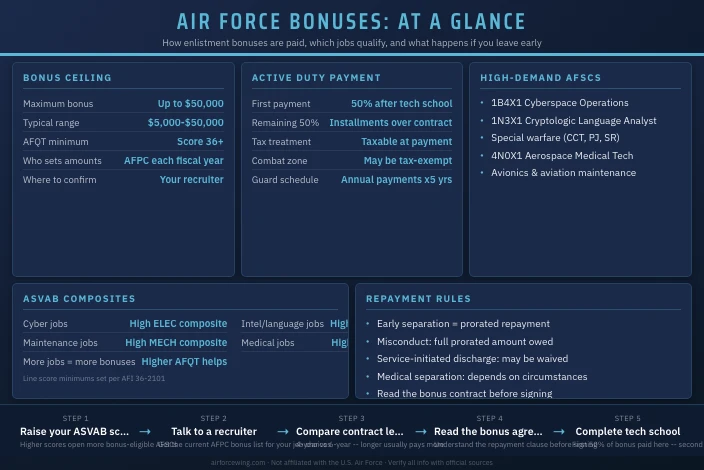
How Enlistment Bonuses Work
An enlistment bonus is a cash payment the Air Force offers to recruits who commit to a specific job and contract length. It’s not a salary supplement. It’s a targeted tool the Air Force uses to fill positions that are hard to staff.
The Air Force doesn’t publish a public spreadsheet of every bonus by AFSC. Bonus availability and amounts change based on current manning levels and the needs of the service. What’s on offer when you talk to a recruiter may differ from what was available six months earlier.
Who sets the amounts? Air Force Personnel Center (AFPC) determines which AFSCs qualify for bonuses each fiscal year. Recruiters access the current list through internal systems. The only way to know exactly what’s available for your job choice is to ask your recruiter directly.
When you purchase through links on our site, we may receive compensation at no extra cost to you.
Higher ASVAB line scores open more bonus-eligible jobs. An ASVAB prep course can help you qualify for the high-demand specialties that consistently offer the largest bonuses.
How the Money Is Paid
Understanding the payment schedule matters because it affects how you should plan your finances.
Active duty payment structure:
- First half is paid after you complete technical training
- Second half is paid in installments over the remaining months of your enlistment contract
So on a 4-year contract with a $20,000 bonus, you’d receive $10,000 after tech school. The remaining $10,000 would be spread across your remaining active duty time.
Air National Guard payment structure:
Guard enlistment bonuses are paid differently. The total bonus is divided into equal annual payments over five years, starting when you finish tech school.
Key point: You don’t see a dollar of your bonus while you’re in Basic Military Training. The clock starts after technical training is complete.
Taxes on Your Bonus
Enlistment bonuses are taxable income. When you receive a bonus payment, federal taxes are withheld at the time of payment.
There is one significant exception: if you receive a bonus payment while serving in a designated combat zone, that amount may be excluded from federal income tax. This applies only to the payment received during the qualifying period, not to payments made before or after.
State tax rules vary. Some states exempt military pay and bonuses entirely. Others tax them at standard income rates. Check your home state’s rules before making spending plans based on your gross bonus amount.
Which AFSCs Offer Bonuses
Bonus eligibility follows demand. The Air Force pays the most to fill jobs that take the longest to train, require specialized skills, or have the highest civilian competition for talent.
Several career fields have consistently appeared on bonus lists in recent years:
Cyber and intelligence
- 1B4X1 (Cyberspace Operations), high technical demand, long training pipeline, civilian sector competition
- 1N3X1 (Cryptologic Language Analyst), requires Defense Language Aptitude Battery testing and language training that can last over a year
- 14N equivalents in the enlisted space, signals and intelligence roles often carry incentive pay
Special warfare
- 1Z0X1 (Combat Controller), 1Z2X1 (Pararescue), 1Z4X1 (Special Reconnaissance), physically demanding pipelines with high attrition mean the Air Force needs a steady supply of qualified candidates
- Bonus amounts in special warfare roles can be among the highest offered
Medical
- 4N0X1 (Aerospace Medical Technician) and related healthcare AFSCs, medical training is expensive, and the Air Force competes with civilian healthcare employers
- Bonuses in this field vary by specific AFSC and current manning
Maintenance and aviation support
- Avionics, aircraft maintenance, and munitions specialties cycle on and off bonus lists depending on aircraft program needs and retention rates
Linguists
- Language-qualified personnel are difficult to recruit and train. Bonuses for certain language specialties can be substantial.
This list reflects historically high-demand areas. It is not a current bonus list. Verify with your recruiter which specific AFSCs carry bonuses when you’re ready to enlist.
Quick Ship Bonuses
Some bonus programs reward recruits who can ship to Basic Military Training on short notice. These “quick ship” incentives help the Air Force fill training slots that open up unexpectedly.
Quick ship bonuses typically require you to ship within a set window, often 30 to 90 days from signing your contract. The AFSC you’re assigned matters here. Not every quick ship slot carries a bonus, and the jobs available for quick ship are whatever happens to have open training slots.
The trade-off is real: you may get a larger bonus by shipping fast, but you’ll have less time to prepare for BMT, handle personal affairs, or choose from a broader list of jobs.
How ASVAB Scores Affect Your Bonus Eligibility
Your ASVAB score doesn’t directly determine how much bonus you’re offered. But it controls which jobs you can access, and that’s what actually determines your bonus potential.
The Air Force uses composite line scores built from subtest combinations:
| Composite | ASVAB Subtests Used |
|---|---|
| MAGE | Mechanical, Auto/Shop, General Science, Electronics |
| ELEC | General Science, Arithmetic Reasoning, Math Knowledge, Electronics |
| MECH | General Science, Auto/Shop, Math Knowledge, Mechanical |
| ADMI | General Science, Paragraph Comprehension, Word Knowledge, Arithmetic Reasoning |
| GEND | Word Knowledge, Paragraph Comprehension, Arithmetic Reasoning, Math Knowledge |
Cyber jobs typically require a high ELEC composite. Intelligence and language roles lean on GEND. Special warfare jobs often require strong MECH and overall AFQT scores. Medical AFSCs have specific line score minimums as well.
A recruit who scores 65 on the AFQT qualifies for more jobs than someone who scores 36 (the minimum). More jobs means more potential bonus opportunities. The direct path to a bigger bonus is a stronger ASVAB performance. For a deeper look at the connection, see Air Force bonuses for high ASVAB scores.
Check out ASVAB scores for every Air Force AFSC for a full breakdown of line score requirements by job.
Bonus Amounts: What to Expect
The Air Force has advertised bonuses up to $50,000 for new enlistees. That figure represents the ceiling, not the average.
Most bonuses fall well below the maximum. Typical ranges by category:
- Entry-level high-demand jobs: $5,000 to $15,000
- Technical jobs with long pipelines: $15,000 to $30,000
- Special warfare and critical-shortage AFSCs: $20,000 to $50,000
Contract length affects the amount. A 6-year commitment typically pays more than a 4-year commitment for the same AFSC. Recruiters will usually present the options side by side so you can compare.
These figures are illustrative. Actual amounts depend on current AFPC bonus tables, which change. The only way to get a confirmed number is to have your recruiter check the current list for your specific AFSC and contract length.
Bonus Repayment: What Happens if You Don’t Finish
Signing a bonus agreement creates a legal obligation. If you separate before completing your contract, you’ll owe money back to the government.
How repayment works:
Repayment is generally calculated on a prorated basis. If you received $20,000 for a 4-year contract and separated after 2 years, you’d owe back roughly half of the remaining unpaid bonus.
The specific calculation depends on how much of the bonus has already been paid. Since active duty bonuses are split between post-tech-school payment and installments, the math varies by how far into your contract you are when you separate.
Circumstances that affect repayment:
- Honorable discharge due to service needs: Repayment may be waived if the Air Force separates you for reasons outside your control.
- Medical separation: Repayment rules depend on whether the condition was service-connected and when it arose.
- Misconduct or voluntary separation: You will almost certainly owe the prorated amount back.
Before signing any bonus agreement, read it carefully. Ask your recruiter to walk you through the repayment clause specifically. This is a legally binding contract. The full process of reviewing and pushing back on contract terms is covered in how to negotiate your Air Force enlistment contract.
What Else Changes with a Longer Contract
Bonuses aren’t the only factor that shifts with contract length. Understanding the full picture helps you make a better decision.
A 6-year commitment versus a 4-year commitment means:
- More time before you’re eligible to get out if circumstances change
- More time accumulating retirement credit under the Blended Retirement System (BRS), though 6 years still falls well short of the 20 needed to vest in a pension
- Potentially better job and base assignment options, since longer commitments can come with preferences
- More access to tuition assistance and GI Bill time-in-service requirements
The bonus is real money. But don’t let it be the only number you’re looking at when comparing contract options.
Reserves and Air National Guard
Enlistment bonuses exist for the Air Force Reserve and Air National Guard as well, and the amounts can be comparable to active duty programs. The key differences are the payment schedule (annual installments over five years for the Guard) and the fact that you’re committing to a part-time service obligation with periodic active duty periods.
Reserve and Guard bonuses are also determined by AFSC demand, which may differ from active duty needs. A job on the active duty bonus list isn’t automatically on the Guard or Reserve list, and vice versa.
The Real Value of an Enlistment Bonus
A $20,000 bonus sounds significant. Taxed and spread across a multi-year contract, it’s meaningful but not transformative on its own.
The better way to think about it: a bonus-eligible job is usually a high-demand, high-skill job. Those same jobs tend to carry better civilian market value after service, stronger tech school training, and more competitive advancement opportunities within the Air Force.
Chasing the biggest bonus number without regard for the job itself is a mistake. But if you’re torn between two jobs you’d genuinely enjoy and one offers a substantial bonus, that’s a real factor worth weighing.
You may also find AFSC jobs with the biggest signing bonuses and Air Force officer bonuses and incentive pay helpful as you compare your options. For a deeper look at what goes into your total compensation package, the Air Force benefits guide covers pay, housing, healthcare, and education benefits in one place. Browse Air Force enlisted careers to see which career groups have the highest-demand AFSCs and their ASVAB requirements.