Air Force Duty Stations: Where Will You Live
One of the most common questions from people considering enlistment: “Where will I actually end up?” The honest answer is that your AFSC, the needs of the Air Force, and your own preferences all play a role. But understanding how the assignment system works takes the mystery out of it. You’re not just handed a location at random.
How the Air Force Assignment System Works
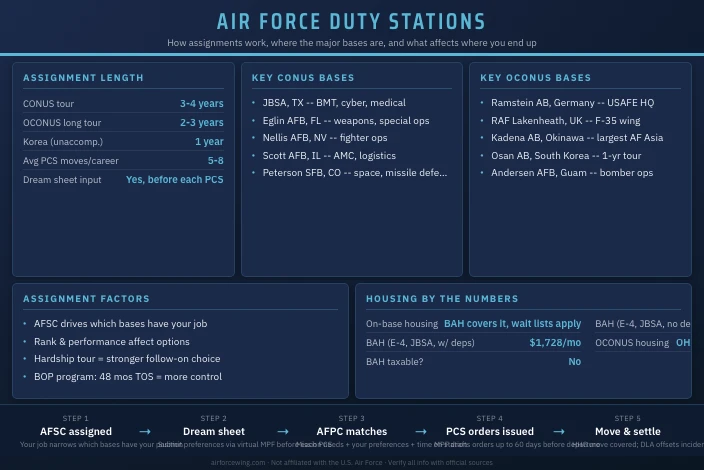
The Air Force Personnel Center (AFPC) in San Antonio manages all active duty assignments. Your AFSC determines which bases have positions for your career field. Not every base hosts every job, so a cyber analyst and an aircraft maintainer will see very different assignment rosters.
Assignments are driven first by manpower requirements. If a base needs a Staff Sergeant in your career field and you’re eligible, AFPC will consider you for that slot. Seniority, special qualifications, and time on station all affect who gets matched to which opening.
How long you stay depends on the assignment type:
- CONUS (Continental U.S.): Typically 3 years, sometimes extended to 4
- OCONUS short tours (Korea, remote locations): 1 year unaccompanied or 2 years accompanied
- OCONUS long tours (Germany, Japan, UK): 2-3 years
After completing your assignment, AFPC will issue Permanent Change of Station (PCS) orders sending you to a new location. Most Airmen move every 3-4 years across a 20-year career.
The Dream Sheet
Before each PCS cycle, you submit an assignment preference list through the virtual Military Personnel Flight. This is called the “dream sheet.” You rank your top choices by location. AFPC considers these preferences when filling slots, but mission needs come first. Getting your top pick isn’t guaranteed, though it happens more often than the skeptics claim.
The Base of Preference (BOP) program gives experienced Airmen more control. Once you have 48 months time on station, you can apply for available PCS assignments at locations you choose. First-term Airmen need at least 12 months time on station before the move date.
Major CONUS Duty Stations
The Air Force has installations across nearly every region of the United States. Different career fields concentrate at different bases based on the missions assigned there.
| Region | Major Installation | Primary Mission |
|---|---|---|
| Southeast | Eglin AFB, FL | Weapons testing, special operations |
| Southeast | Hurlburt Field, FL | Air Force Special Operations Command |
| Southeast | Maxwell AFB, AL | Air University, Officer Training School |
| Southwest | Nellis AFB, NV | Fighter operations, Red Flag exercises |
| South | Joint Base San Antonio, TX | BMT, medical training, cyber, personnel |
| South | Barksdale AFB, LA | B-52 operations, Global Strike Command |
| Midwest | Scott AFB, IL | Air Mobility Command, logistics |
| Midwest | Offutt AFB, NE | USSTRATCOM, ISR, intelligence |
| Mountain West | Peterson SFB, CO | Space Command, missile defense |
| Mountain West | Schriever SFB, CO | Space operations, satellite systems |
| Pacific | Travis AFB, CA | Air Mobility Command, C-17 operations |
| Pacific | Beale AFB, CA | U-2 reconnaissance, ISR |
| Northwest | Fairchild AFB, WA | C-17 operations, survival training school |
| Northeast | McGuire-Dix-Lakehurst, NJ | Airlift, refueling, joint operations |
Your AFSC is the primary filter. An Airman in space operations will see Colorado, California, and Florida on their assignment roster. Someone in aircraft maintenance will see different bases entirely, centered around fighter or airlift wings.
OCONUS Assignments
OCONUS assignments take you outside the continental United States, including Europe, the Pacific, and a few remote locations. These tours are a major part of Air Force life that most Airmen experience at least once.
Europe is home to several large installations:
- Ramstein AB, Germany: the Air Force’s largest overseas base, with fighter wings, the USAFE headquarters, and a major medical center
- RAF Lakenheath, UK: F-35 wing, about two hours from London
- Aviano AB, Italy: F-16 wing in northeastern Italy
- Incirlik AB, Turkey: Strategic location supporting Middle East operations
Pacific installations include:
- Kadena AB, Japan (Okinawa): the largest U.S. Air Force base in Asia, with F-15s and a full range of support career fields
- Misawa AB, Japan: smaller base in northern Honshu, strong intelligence mission
- Osan AB and Kunsan AB, South Korea: 1-year unaccompanied tours for most career fields; considered a hardship tour with additional pay
- Andersen AFB, Guam: B-52 and bomber task force operations in the Pacific
OCONUS assignments come with extra pay. Overseas Housing Allowance (OHA) replaces BAH for most locations, covering rent in the local economy. Many overseas bases also qualify for Cost of Living Allowance (COLA) when local prices significantly exceed U.S. levels.
What Affects Your Assignment
Several factors give you more or less influence over where you go.
Your AFSC matters most. Some career fields have positions at 30 or more installations worldwide. Others are concentrated at 4-5 bases. If you’re in a specialized field like U-2 operations or Air Force Special Operations, your options are narrower by design.
Time in service and rank open doors. Senior NCOs with strong performance records carry more weight with their career field manager at AFPC. Mid-career Airmen who’ve built a track record can make a stronger case for preferred assignments.
Hardship tour completion often earns you a preferred follow-on assignment. Completing an unaccompanied Korea tour gives you more bargaining power for your next location. AFPC uses this as a tool to fill difficult billets.
Voluntary assignments exist for bases that have trouble filling slots. Signing up for a hard-to-fill location can earn additional incentives or move you up the list for a desired follow-on.
Living on Base vs. Off Base
Once you arrive at your duty station, you’ll choose between on-base housing and renting in the local community. Both have trade-offs.
On-base housing (when available) is assigned through the base housing office. Your BAH typically goes directly to the housing contractor, leaving your base pay untouched. Wait lists exist at busy installations. The upside is zero commute and a built-in community of military families.
Off-base housing gives you more space and privacy, usually for less rent than civilian equivalents in the same area. Your BAH rate covers median rent costs in the duty station’s ZIP code. At Joint Base San Antonio, an E-4 without dependents receives $1,359/month in BAH; with dependents, that rises to $1,728/month.
BAH is not taxable. A $1,500/month BAH allowance is worth more than $1,500 in wages. Factor this in when comparing Air Force compensation to civilian salaries.
Overseas Life: What to Expect
An OCONUS tour is a genuinely different experience. You’ll live in a foreign country, often with your family, for 2-3 years. The practical side takes adjustment.
Most OCONUS bases have on-base commissaries, exchanges, and support services that soften the transition. Schools for military children exist at larger installations like Ramstein and Kadena. Smaller bases may require off-base schooling or Department of Defense Dependents Schools enrollment.
The access to travel is a real benefit. A weekend in Paris from Ramstein is a two-hour train ride. An Okinawa assignment puts Japan, South Korea, and Southeast Asia within a few hours by plane. Service members who take advantage of these tours describe them as some of the best years of their careers.
The downside is distance from family back home. Emergency leave exists and AFPC handles compassionate reassignment cases, but the distance is real and worth planning for before accepting or requesting an overseas tour.
Managing Multiple PCS Moves
A 20-year career typically means 5-8 PCS moves. That’s a real logistical reality for families with kids in school and spouses with careers.
The military covers moving costs through the household goods system and Dislocation Allowance (DLA) to offset incidental costs. DLA rates increased 3.8% in 2026, ranging from roughly $1,019 for an E-1 without dependents to higher amounts for senior grades with families.
A few programs help families stay in place:
- Home Basing Program: Allows some Airmen to return to a previous duty station after an OCONUS tour
- Follow-On Assignment Program: Lock in your next assignment before you leave your current one, giving families more lead time to plan
- STAY Act (proposed 2025): Congressional legislation aimed at reducing discretionary PCS moves to improve family stability
Your spouse’s career, your children’s schools, and where your family support network is located are all real factors. The assignment system doesn’t ignore them, but it does put mission needs first. The best approach is to communicate your family situation through your Career Field Manager and keep your dream sheet updated.
For more on the full picture of Air Force life, read What Air Force Life Is Really Like and Is the Air Force Worth It. If you’re weighing career fields by location, Air Force enlisted careers shows which AFSCs concentrate at which bases. The enlistment process guide explains how the assignment system fits into the broader steps from MEPS to your first duty station.
This site is not affiliated with the U.S. Air Force or any government agency. Verify all information with official Air Force sources before making enlistment or career decisions.